Years you worked. Zeroes on your estimate.
You pulled up your retirement estimate and the total creditable service is lower than it should be. The temporary appointment you held in the late 1980s — gone. The years before you left federal service and took a refund — gone. Your Peace Corps service — gone. OPM didn't forget those years. Some service needs a deposit or redeposit for full credit; certain CSRS periods can receive credit without payment but with an annuity reduction. The rules depend on your retirement system, service, and dates.
The problem is that the rules for buying back civilian service are split across two retirement systems, four different service types, and a half-dozen date thresholds that change what's creditable, what it costs, and whether partial payment is even possible. Your agency HR office handles these cases a few times a year at most. OPM's handbook is regulatory prose written for benefits administrators, not for the employee staring at a billing statement.
Meanwhile, interest may increase an unpaid balance. Its start date and posting schedule depend on service type; Peace Corps and VISTA deposits have a two-year interest-free period.
The Civilian Service Deposit Navigator
This guide takes every type of civilian service credit payment that OPM recognizes — non-deduction deposits, redeposits for refunded service, and Peace Corps and VISTA volunteer deposits — and lays out the rules, the forms, the costs, and the process in one document. It is built for the federal employee who needs to know exactly what qualifies, what it costs, and how to get a clean submission through agency HR and into OPM's queue without a rejected form or a lost year.
Where free OPM resources explain what a deposit is, this guide walks you through what to do — which form to file, what documentation to attach, how to handle the 6-month pre-retirement cutoff, and how to track the submission from agency HR to OPM billing and ask agency HR to file the paid-in-full account statement in your eOPF for your retirement records.
What's inside
- Non-deduction service rules by system and date — the FERS pre-1989 vs. post-1988 divide (post-1988 service is generally non-creditable unless a special provision of law allows a deposit), the CSRS pre- and post-October 1982 rules, and the deposit rates for each scenario so you know immediately whether a period can be bought back and what it costs
- Redeposit mechanics for refunded contributions — how the FY2010 NDAA restored FERS redeposits, the full-payment requirement for FERS annuity-computation credit, the CSRS October 1, 1990 and March 1, 1991 service-end cutoffs and how retirement date affects actuarial reductions, and the installment payment process
- Peace Corps and VISTA deposit process — the volunteer deposit rate by system and service year (FERS: 3% generally, 3.25% for 1999, 3.4% for 2000; CSRS: 7% generally, 7.25% for 1999, 7.4% for 2000), how to get your service certification through the RPCV Portal or My AmeriCorps, and the documentation chain from Peace Corps records to SF 3108
- FERS contribution tier reclassification — how appointment dates and qualifying-service tests can determine eligibility for the regular-employee rates of original FERS (0.8%), FERS-RAE (3.1%), or FERS-FRAE (4.4%), including the service-on-December 31, 2012/2013 and five-year tests, and the multi-thousand-dollar payroll refund for overpaid contributions that follows the reclassification
- SF 3108 and SF 2803 filing guide — Part A employee instructions, what your agency certifies in Part B, common reasons HR returns forms without processing, and the routing difference between active employees (through agency HR) and eligible separated employees (direct to OPM Boyers)
- The 6-month pre-retirement threshold — why OPM directs employees within 6 months of retirement not to file standalone deposit forms, and how to attach the deposit request to your retirement application package instead
- Interest calculation and payment timing — the Treasury variable rate (4.25% for calendar year 2026) for applicable balances, the December 31 annual schedule for those balances, the difference between midpoint-of-service and refund-date interest starts, and how to estimate what you owe before OPM bills you
- Tracking and escalation framework — how to request Form RI 36-23 (Civil Service Deposit Account Statement) from OPM, what to do when your SF 3108 has been sitting at agency HR for months with no bill, and the escalation path through the OPM Customer Service line and your congressional representative
- Mixed FERS/CSRS service histories — how deposit rules interact for employees who transferred from CSRS to FERS with a CSRS component, including the 10% annuity reduction for unpaid CSRS non-deduction deposits on pre-October 1982 service
What you get
- The complete Civilian Service Deposit Guide — 13 chapters covering every deposit and redeposit type, the statutory rules, the forms, payment options, tier reclassification, appeals, and common misconceptions, with worked dollar examples and OPM citation references
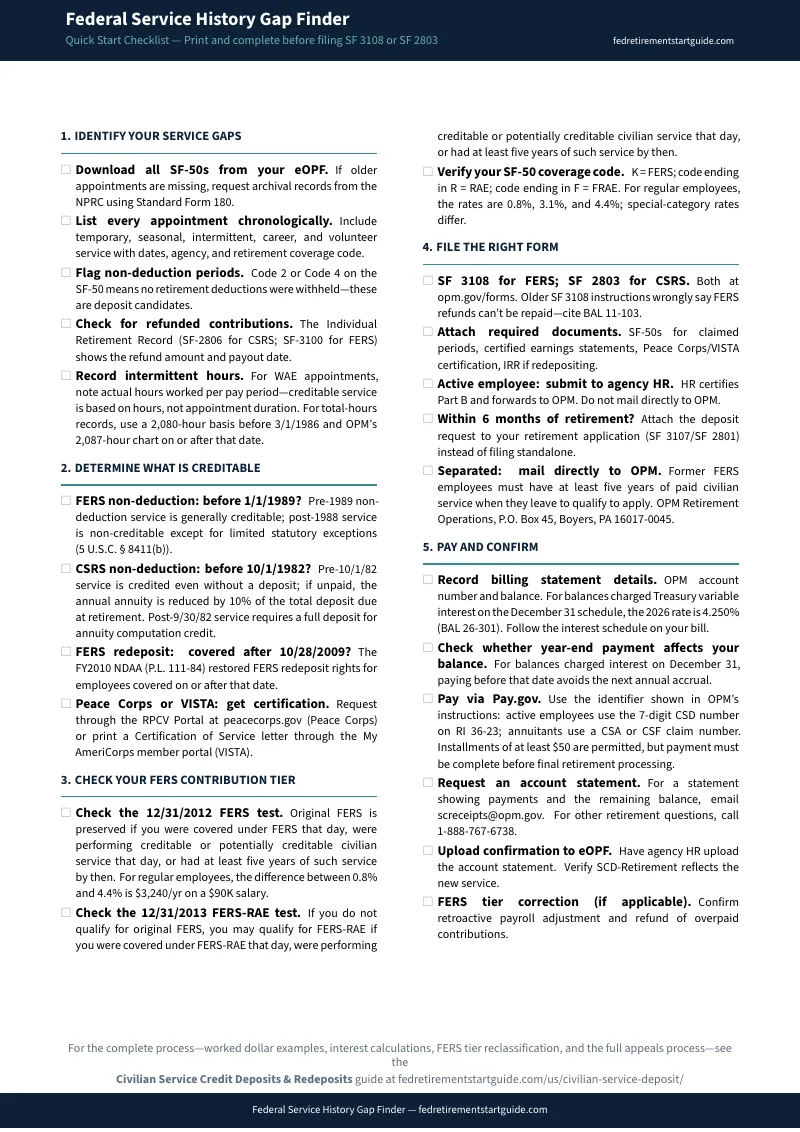
- Federal Service History Gap Finder checklist — a 23-item diagnostic checklist in 5 phases: identify your service gaps, determine what's creditable, check your FERS contribution tier, file the right form, and pay and confirm
- 4 printable worksheets — a service history gap finder for logging every SF-50 and flagging deposit candidates, an SF 3108 / SF 2803 submission checklist with common rejection reasons, an interest accrual and payment log for tracking your OPM account, and an eOPF reconciliation checklist for verifying everything is in order after paying in full
Who this is for
Current and recently separated federal employees whose service histories include periods that may not be counted toward their pension — and the family members or representatives helping them sort it out.
- Your retirement estimate excludes temporary, seasonal, or intermittent appointments from before 1989
- You left federal service, took a refund of your retirement contributions, and later returned
- You served in the Peace Corps or AmeriCorps VISTA and have not yet filed for service credit
- You were hired after 2013 and believe earlier creditable service could lower your FERS contribution rate
- Your agency HR returned an SF 3108 without processing it, or you submitted one months ago and have received no bill from OPM
- You are within a few years of retirement and want all deposits settled before the 6-month standalone-filing cutoff
Why not free resources?
OPM publishes comprehensive regulatory guidance on civilian service credit deposits. The CSRS/FERS Handbook chapters on creditable service and service credit payments are authoritative. They are also hundreds of pages of CFR-cited prose organized by regulatory topic, not by the question you're trying to answer.
Federal employee forums are where most people first learn about deposits and redeposits. The advice is often helpful — but it's scattered across years of threads, mixed with outdated pre-NDAA information about FERS redeposits, and rarely distinguishes between the FERS all-or-nothing rule and the CSRS actuarial reduction. One incorrect post about post-1988 non-deduction service being "buyable" gets repeated until someone corrects it, and by then the original poster has already filed a form that HR will reject.
Vendor-sponsored retirement seminars cover deposits briefly, but their primary business is TSP rollovers and private insurance sales — service credit payments send money to OPM, not to the advisor's firm, so the topic rarely gets more than a slide.
This guide takes the OPM handbook's regulatory authority and organizes it around the decisions you actually need to make: what qualifies, what it costs, how to file, and how to track the payment to completion.
Satisfaction guarantee
If the guide doesn't give you what you need to navigate the deposit or redeposit process with confidence, email [email protected] for a full refund. No forms, no time limit.
Start your service history audit
Download the free checklist to identify which periods in your service history may need a deposit or redeposit. When you're ready to understand the rules behind each type, file the forms correctly, and track the payment to completion, the full guide is waiting.
The free checklist flags the gaps. The full guide shows you exactly how to close them — the rules, the forms, the costs, and the process from filing to paid-in-full confirmation in your eOPF.
Frequently Asked Questions
What if the rules change after I buy?
We update the guide when the rules change. Email us any time, even years later, and we'll send you the current edition free.