You've Spent Decades Earning This Coverage. Don't Lose It to a Paperwork Mistake.
You know FEHB is one of the best health insurance programs in the country. The government pays 72%–75% of your premium, and it follows you into retirement — if you qualify.
But here's what your HR briefing didn't cover:
- The five-year continuous enrollment rule that silently disqualifies retirees who had a coverage gap they didn't know about
- The Medicare Part B decision at 65 that either saves you thousands in copays or costs you $202.90/month for coverage you don't fully use
- The permanent late-enrollment penalty — 10% added to your Part B premium for every year you were eligible but didn't sign up — that never goes away
- The Form RI 79-9 suspension pathway that lets you try Medicare Advantage without permanently losing FEHB — versus the cancellation that ends your eligibility forever
OPM provides the regulations. Medicare.gov provides the enrollment forms. Neither provides the coordination framework that shows you how the two systems interact at every decision point between your retirement application and age 65.
The Coverage Coordination Blueprint
This guide introduces what we call the Coverage Coordination Blueprint — a chronological decision framework that maps every FEHB and Medicare interaction to the specific date, form, and financial threshold where it matters in your retirement timeline.
Instead of reading FEHB brochures and Medicare handbooks separately and hoping you connect the right dots, the Blueprint walks you through each decision in the order you'll face it: five-year rule verification first, then retirement transition planning, then the Medicare enrollment at 65, then the annual optimization cycle afterward.
Most federal benefits resources treat FEHB and Medicare as separate topics. The Coverage Coordination Blueprint treats them as a single, interlocking system — because that's what they become the moment you file your retirement application.
What's Inside
- Five-Year Rule Audit Walkthrough — exactly which SF-50 codes to look for in your eOPF, how TRICARE credit and spousal coverage count toward the requirement, and what to do if you find a gap before your separation date
- Retirement Transition Cash-Flow Planner — managing interim pay (60%–80% of estimated pension), the annual leave lump sum, and the FERS Special Retirement Supplement earnings test ($24,480 limit in 2026) during OPM's 3–5 month processing window
- Three Medicare Coordination Paths — the premium math for FEHB-only, FEHB + Part A, and the full wrap-around strategy where Medicare + FEHB together eliminate most out-of-pocket costs. Includes plan-specific coordination details for BCBS Basic, GEHA Standard, Aetna Direct, and other nationwide plans
- IRMAA Surcharge Calculator — how your Modified Adjusted Gross Income from two years ago sets your Part B and Part D premiums, which income thresholds trigger each tier, and when to file Form SSA-44 for a life-changing event adjustment
- Form RI 79-9 Suspension Guide — the step-by-step process for suspending (not cancelling) FEHB to try TRICARE-for-Life, CHAMPVA, or a commercial Medicare Advantage plan, with the re-enrollment rules that protect you if you want to come back
- PSHB Postal Integration Chapter — the mandatory Part B enrollment rules for post-2025 postal retirees, the Part D EGWP lock-in that eliminates all drug coverage if you opt out, and the compliance checklist that prevents irreversible coverage termination
- Spousal Coverage Protection — how your survivor annuity election determines your spouse's FEHB eligibility after your death, the notarized consent requirement for reducing below the default, and the coverage levels that must be in place
- FEGLI Decision Framework — age-band premium jumps (Option B doubles at 45), the 75% reduction election that makes Basic coverage free at 65, and the math for deciding whether to convert or replace before retirement
- WEP/GPO Repeal Financial Impact — how the Social Security Fairness Act's retroactive payments and restored monthly benefits can trigger IRMAA surcharges two years later, and the SSA-44 filing strategy to manage it
- Complete Forms Directory — SF 3107, SF-2809, RI 79-9, CMS-40B, CMS-L564, SSA-44, and every other form you'll need, with the submission address, processing timeline, and common rejection reasons for each
Your Download Includes
- guide.pdf — The full FEHB & Medicare coordination guide (13 chapters)
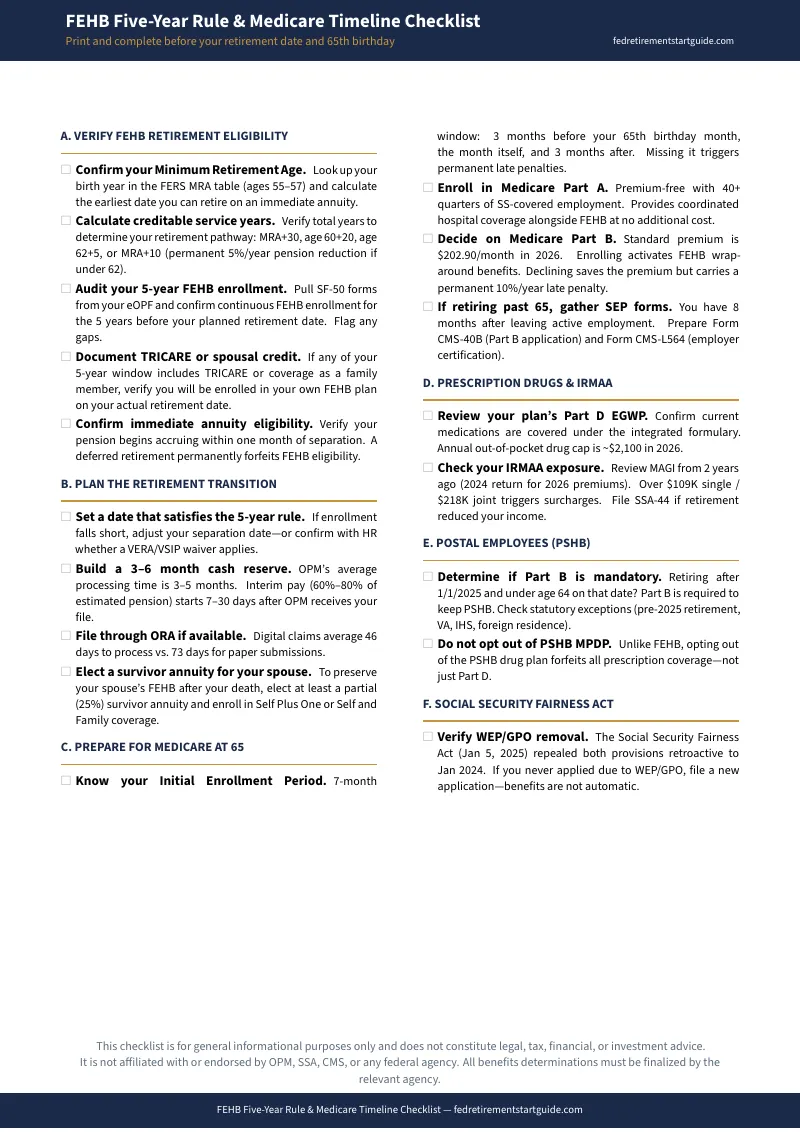
- checklist.pdf — The FEHB Five-Year Rule & Medicare Timeline Checklist
- five-year-rule-audit.pdf — Year-by-year SF-50 enrollment log and HR corrections list
- retirement-cash-flow-planner.pdf — Interim-pay shortfall and five-month cash-bridge math
- medicare-coordination-paths.pdf — Fill-in premium math for FEHB-only, FEHB + Part A, and the wrap-around
- irmaa-surcharge-planner.pdf — MAGI lookup, 2026 brackets, and Form SSA-44 filing log
- ri-79-9-suspension-worksheet.pdf — Suspend-versus-cancel decision and RI 79-9 packet checklist
- pshb-postal-compliance.pdf — Part B mandate exceptions and PSHB MPDP lock-in check
- spousal-coverage-protection.pdf — Survivor annuity election and notarized-consent tracker
- fegli-retirement-decision.pdf — Basic reduction math and Option B age-band cost write-in
- wep-gpo-irmaa-tracker.pdf — Repeal filing path and the IRMAA hangover from retro payments
- forms-submission-tracker.pdf — SF 3107, SF 2809, RI 79-9, CMS-40B, CMS-L564, SSA-44, plus portal and call log
One download. No subscription. No membership renewal.
Who This Guide Is For
- Federal employees within 5 years of retirement who need to verify their FEHB eligibility and understand the Medicare decisions ahead
- Retirees turning 65 deciding whether to add Medicare Part B to their existing FEHB coverage
- USPS employees and postal annuitants navigating the mandatory Part B and Part D EGWP requirements under PSHB
- Spouses who need to understand how a survivor annuity election protects — or eliminates — their own health coverage
- Anyone who has gotten conflicting advice from HR, benefits fairs, online forums, or broker seminars about whether to keep FEHB, add Medicare, or switch entirely
Why Not Just Use Free Resources?
You can absolutely find the individual pieces for free. OPM publishes the five-year rule regulations. Medicare.gov explains Part B enrollment. NARFE articles cover FEHB coordination. The information exists — scattered across dozens of agency websites, carrier brochures, and forum threads written before the 2025 PSHB transition changed the rules for postal retirees.
The problem isn't access. It's synthesis. No free resource shows you how a coverage gap in year three of your FEHB enrollment affects your retirement eligibility, how that eligibility affects your Medicare timing, how that timing affects your IRMAA bracket, and how that bracket affects the premium math on whether Part B is worth it for your specific plan.
This guide connects those decisions into a single chronological framework — the Coverage Coordination Blueprint — so you can work through them in order instead of discovering at your retirement seminar that you missed a step three years ago.
Independent. No Commissions. No Plan Recommendations.
This guide carries no insurance advertising, accepts no carrier commissions, and does not recommend specific FEHB plans or Medicare Advantage products. It is an independent educational resource that explains how the systems work and how to evaluate your options — without any financial incentive to steer you toward a particular carrier.
The publishers are not licensed insurance agents, financial advisors, or benefits brokers. The guide provides process navigation and decision frameworks, not individualized coverage advice.
Start With the Free Checklist
The free FEHB Five-Year Rule & Medicare Timeline Checklist gives you the verification steps: confirm your continuous enrollment, calculate your Medicare enrollment window, and flag any compliance gaps.
If the checklist raises questions the answers to — about the premium math, the suspension process, or the PSHB rules — the full guide provides the complete coordination framework.