Your Symptoms Don't Show on an X-Ray. OPM Still Needs to See Them.
Depression flattens your ability to analyze a case file. PTSD triggers a panic attack in a conference room full of colleagues. Anxiety makes the commute feel like walking into a building that's on fire. Bipolar disorder turns a stable caseload into a minefield of missed deadlines and impulsive decisions.
These conditions destroy your capacity for useful and efficient service — the exact legal standard OPM uses to evaluate disability retirement. But because there is no blood test, no MRI, no fracture to point to on a screen, psychiatric claims get denied at higher rates than orthopedic ones. Not because they're weaker. Because the evidence is assembled wrong.
The Psychiatric Evidence Architecture System
This guide gives you a framework for translating invisible symptoms into the documented, form-by-form evidence OPM's adjudicators need to approve a FERS disability retirement for a mental health condition.
It is not legal advice. It is not a medical diagnosis. It is the administrative bridge between your psychiatrist's clinical knowledge and OPM's bureaucratic requirements — built so you or a family member can assemble a complete, compliant application without hiring a $4,000–$8,000 federal disability attorney.
What's Inside
- SF 3112A Walkthrough — Applicant's Statement of Disability — How to write a narrative that links your psychiatric symptoms to specific essential job function failures, not a journal entry about how hard life has been. OPM doesn't care about your feelings. They care about whether depression made you miss the statutory processing deadline three months running.
- SF 3112C Physician Briefing Kit — A structured framework you hand to your psychiatrist or psychologist so they write a statement that meets OPM's four mandatory criteria: DSM-5-TR diagnosis, clinical history, functional restrictions tied to your Position Description, and a 12-month prognosis. Most physicians write clinically competent letters that are legally useless to OPM. This fixes that.
- Hostile Supervisor Strategy for SF 3112B — What to do when your supervisor thinks depression is laziness and plans to write a minimizing statement. How to ensure official leave records, attendance logs, and performance evaluations override a hostile narrative.
- Security Clearance Protection Protocol — SEAD 4 Guideline I analysis for cleared federal employees terrified that documenting a psychiatric condition will cost them their clearance. The guide explains what actually triggers an adjudicative concern versus what the regulation explicitly protects.
- Annuity Calculation Worksheets — Worked examples of the Year 1 formula (60% of High-3 minus SSDI) and Year 2+ formula (40% of High-3 minus 60% of SSDI), with the age-62 recalculation. No guesswork on what you'll actually receive.
- SSDI Filing Roadmap — The mandatory Social Security application that every FERS disability retiree must submit, including the offset mechanics. Updated for the 2025 WEP/GPO repeal — the old reductions no longer apply.
- FEHB and PSHB Continuation Rules — How to keep your health insurance through disability retirement, including the 5-year enrollment rule for FEHB and the Medicare Part B mandate for postal employees under PSHB.
- Privacy Submission Protocols — Step-by-step instructions for sending sensitive psychiatric records directly to OPM's medical officers in sealed envelopes, bypassing agency HR.
Who This Guide Is For
- Federal employees with depression, PTSD, anxiety, bipolar disorder, or another psychiatric condition that prevents useful and efficient service
- Spouses and family members managing the application when the employee's condition makes paperwork impossible
- Employees on a PIP, facing proposed removal for medical inability, or in LWOP after exhausting sick and annual leave
- Cleared personnel (Secret, TS, SCI) who need to understand what SEAD 4 actually says before they'll put anything on paper
Why Free Resources Fall Short
Law firm blogs give you just enough to realize you need help — then funnel you toward a retainer that costs thousands. Agency HR hands you the forms but cannot tell you how to fill them out persuasively. Union stewards know grievances, not OPM psychiatric evidence standards. Reddit threads mix genuine advice with dangerously outdated information about WEP offsets and interim pay timelines.
This guide sits in the gap: specific enough to actually use, organized form by form, updated for the 2025 Social Security Fairness Act and the 2026 Garland v. OPM ruling, and priced so you can decide whether you need an attorney after you understand the process — not before.
What the Free Checklist Covers vs. the Full Guide
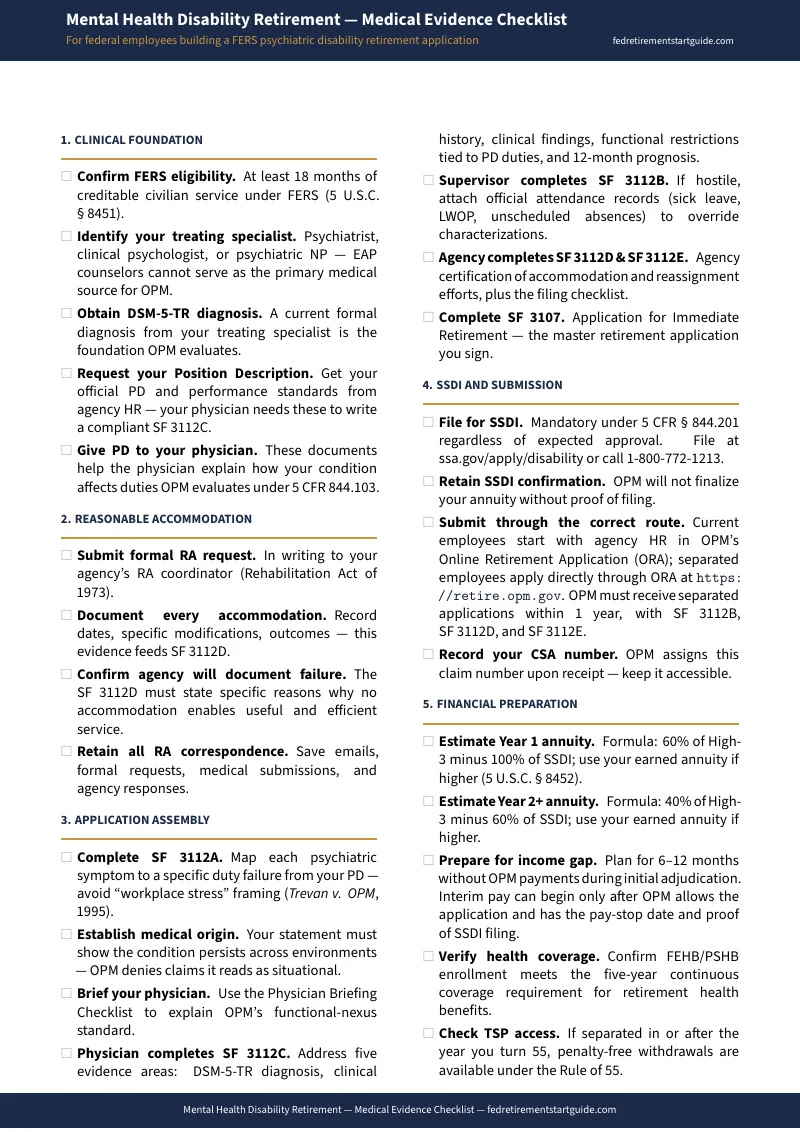
The free checklist tells you what to gather: which forms, which records, which physician-statement elements. The full guide tells you how — how to write each form section, how to brief your doctor, how to handle a hostile supervisor, and how the financial pieces connect. The checklist is the supply list. The guide is the blueprint.
Get the Psychiatric Evidence Architecture System →
Our Guarantee
If the guide doesn't help you understand the disability retirement process for your mental health condition, email [email protected] for a full refund — no time limit, no fine print.