Your FEGLI premiums were invisible for 25 years. In retirement, they become the line item that eats your pension.
While you were working, the federal government quietly paid one-third of your Basic life insurance premium. That subsidy made FEGLI one of the cheapest group term policies in the country. It also made you stop thinking about it.
Then you cross an age-band threshold — 55, 60, 65 — and the Leave and Earnings Statement makes the cost visible. Option B premiums roughly double every five years. Option C follows the same curve. And the moment you retire, the government subsidy disappears entirely. You pay 100% of every premium from your pension.
Meanwhile, at retirement you must complete Standard Form 2818 and choose a Basic reduction election — 75% Reduction, 50% Reduction, or No Reduction — that is permanent. OPM does not allow changes after separation. Not for buyer's remorse, not for changed circumstances, not for anything.
Most federal employees make this election based on a 15-minute conversation with an HR specialist who processes hundreds of retirements a year. The FEGLI Decision Guide gives you the rate tables, premium projections, form walkthrough, and comparison framework to make it based on your actual numbers — your salary, your pension, your age band, your health, and your household's coverage needs.
The Retirement Election Workbook
This is not another summary of what FEGLI covers. OPM already publishes that, free, in a hundred-page handbook written for benefits administrators. The FEGLI Decision Guide is a Retirement Election Workbook — a process tool that translates OPM's regulatory language into a structured decision sequence with the math attached.
Where the OPM handbook says three reduction options exist, the workbook shows you the lifetime premium cost of each one at your salary level. Where a seminar slide says "consider your coverage needs," the workbook gives you the age-band rate tables and a premium-drag formula so you can calculate exactly how much Option B will cost at 70 and 75 relative to your pension. Where a benefits officer says "make sure your beneficiary is current," the workbook walks you through the SF 2823 filing process and explains how divorce decrees interact with OPM's strict order of precedence.
The guide does not recommend whether to keep or drop coverage. It does not sell insurance. It has zero referral relationships with any carrier, broker, or financial adviser. The purchase price is the only compensation — preserving the objectivity that makes the analysis trustworthy.
What's Inside
The Five-Year Participation Rule Audit — The first gate. You must have been continuously enrolled in each FEGLI coverage type for the five years immediately before retirement, or you lose it at separation. The guide walks through SF-50 FEGLI eligibility codes, explains how breaks in service affect the clock, and shows you exactly how to verify your enrollment history before you assume everything carries over.
Basic Reduction Election Analysis — The three paths compared side by side: total premiums paid across your expected lifespan, coverage retained at each age milestone, and the break-even point where No Reduction starts costing more in premiums than the additional coverage is worth. A worksheet helps you plug in your own Basic Insurance Amount and pension to see which election fits your situation.
Option B and Option C Premium Projections — The complete 2026 age-band rate tables for all optional coverages, plus the premium-drag formula that shows what each multiple costs as a percentage of your pension at 65, 70, 75, and beyond. Most retirees have never seen the full cost curve — the guide lays it out so the number at age 75 is not a surprise.
SF 2818 Field-by-Field Walkthrough — A plain-language translation of every section of the retirement life insurance election form, with the common errors flagged — unsigned forms, inconsistent coverage codes, missing reduction selections — that trigger OPM processing delays. With the current retirement processing backlog, a form error does not just create paperwork. It delays your annuity.
Beneficiary Designation Audit (SF 2823) — OPM distributes death benefits based on the designation on file, not your will, not your trust, not your verbal instructions. If you filed SF 2823 at hire and have since married, divorced, or had children, the guide walks you through updating it — including how court orders and divorce decrees interact with the standard order of precedence.
The Conversion Window — If you lose FEGLI coverage at retirement, you have exactly 31 days to convert it to an individual policy without medical underwriting. The guide explains what conversion covers, what it costs, and the specific situations where it is your best option versus those where it is not worth the premium.
FEGLI vs. Private Coverage Framework — The neutral comparison: FEGLI's guaranteed-issue advantage for employees with health conditions versus private level-term's cost advantage for healthy non-tobacco users who can lock in rates for 15–20 years. No recommended carriers, no referral links, no commissions. Just the math and the decision criteria.
Postal Employee Clarification — The PSHB transition changed health insurance for postal workers. It changed nothing about FEGLI. The guide draws the boundary clearly so postal retirees stop conflating two separate programs.
Retirement Income Coordination — How FEGLI premium costs interact with your FERS or CSRS annuity, Social Security benefits (with the WEP/GPO repeal fully reflected), TSP required minimum distributions under SECURE 2.0, and the 2026 cost-of-living adjustments.
The Paperwork Timeline — A calendar-based sequence from five years out through the first 108 days after separation, covering every verification, form filing, and decision point in the order you need to handle them.
Questions to Take to Your Adviser — Prepared questions for insurance professionals, estate attorneys, divorce counsel, and retirement benefits counselors — so the expensive hour you spend with a professional is focused on your specific situation, not on explaining how FEGLI works.
Who It's For
- Federal employees within five years of retirement who have never modeled what FEGLI will cost after separation and need to see the numbers before completing SF 2818
- Employees who attended a "free" retirement seminar and were told to drop FEGLI for private coverage — and want a neutral second opinion before signing anything
- Mid-career laterals who joined federal service later, carry smaller pensions, and need to know whether optional coverage premiums are sustainable on their retirement income
- Anyone who has not updated SF 2823 in over a decade and is not sure whether their current beneficiary designation matches their current family situation
- Spouses and partners who need to understand the household's life insurance coverage, survivor protection, and premium trajectory after the federal employee separates
Why Not the Free Resources?
The OPM FEGLI Handbook is 100+ pages of regulatory prose under Title 5 CFR. It explains the rules. It does not tell you what each rule costs you, which election fits your situation, or what to verify before you sign the form.
Pre-retirement seminars are broad overviews covering all of FERS in two hours. FEGLI gets one slide and a suggestion to "consider your coverage needs." The guide is an entire manual dedicated to the life insurance transition.
NARFE, WAEPA, and GEBA publish FEGLI information — but NARFE locks deep content behind membership dues, and WAEPA and GEBA run FEGLI comparison tools designed to sell their own alternative group life products. The guide has no membership gate, no products to sell, and no commercial relationships.
Insurance brokers at pre-retirement seminars show polished presentations comparing FEGLI unfavorably to private coverage. What they rarely mention: FEGLI requires no medical underwriting, their premium comparison often stops at age 65, and they earn a commission on every replacement policy they sell. The guide gives you the framework to check their claims before you make an irrevocable decision.
What You Get
Your purchase includes 9 printable PDFs — the full guide plus 7 standalone worksheets and reference sheets you can print individually and bring to meetings, HR appointments, or your desk:
- The FEGLI Decision Guide — 13 chapters covering every component of FEGLI into retirement, with rate tables, worked examples, and printable worksheets
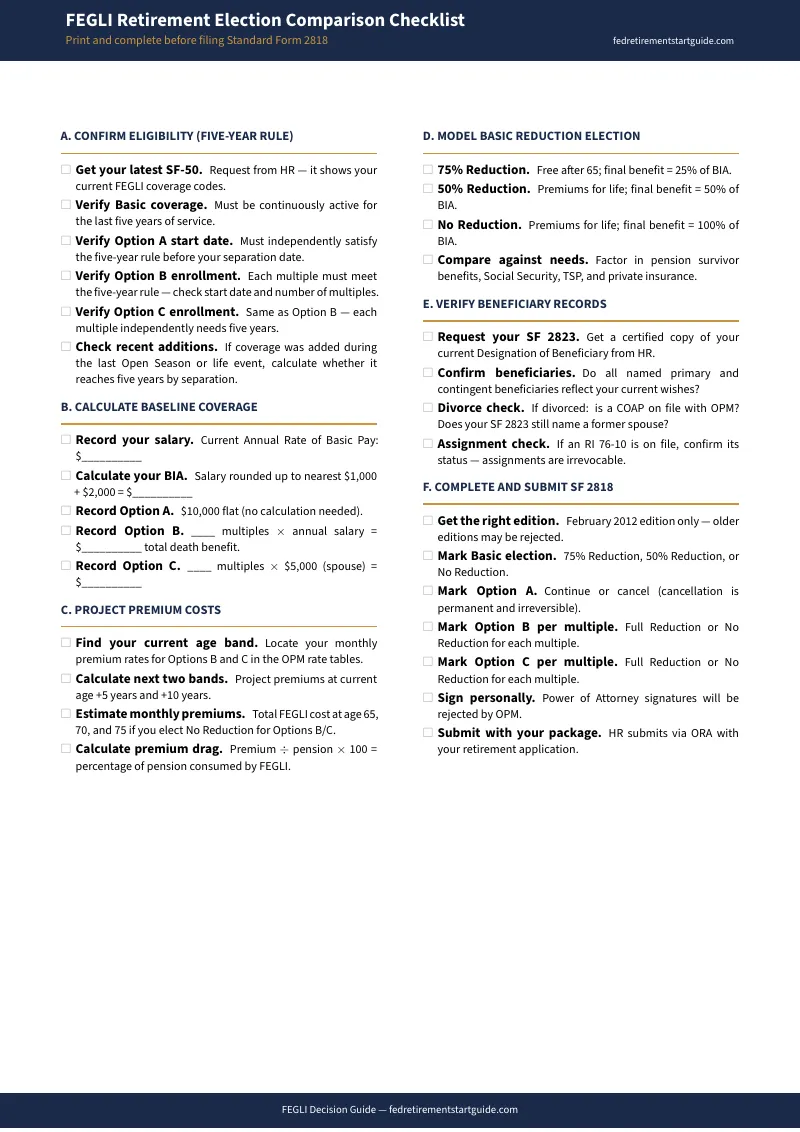
- FEGLI Retirement Election Comparison Checklist — a quick-start checklist for verifying eligibility, recording coverage amounts, and auditing beneficiary records
- Basic Reduction Election Worksheet — fill-in worksheet for comparing the 75%, 50%, and No Reduction elections using your own BIA
- Option B & C Premium Projection Reference — complete age-band rate tables with a premium-drag worksheet showing cost as a percentage of your pension
- SF 2818 Form Completion Reference — field-by-field companion for completing the retirement election form, with common errors flagged
- Beneficiary Designation Audit — step-by-step checklist for verifying SF 2823, checking court orders, and filing updates
- Retirement Paperwork Timeline — calendar-based tracker from five years out through OPM adjudication
- Deferred vs. Postponed Retirement Reference — side-by-side comparison of the two early separation paths and their insurance consequences
- Questions to Take to Your Adviser — prepared questions organized by professional type — insurance, estate, divorce, and retirement benefits
Satisfaction Guarantee
If the guide does not help you understand your FEGLI elections, email [email protected] and we will refund your purchase. No conditions, no time limit, no questions.
The Election That Cannot Be Changed
Every other retirement benefit allows adjustments after separation. You can change your health plan during Open Season. You can adjust your TSP withdrawal strategy. You can delay or accelerate Social Security claiming. The FEGLI reduction election on SF 2818 is permanent. What you check on that form is what you live with.
The guide makes sure you check the right box — not based on the default, not based on a broker's pitch, but based on the actual cost to your household over your expected retirement.
Not ready for the full guide? Download the free FEGLI Retirement Election Comparison Checklist — a structured framework for confirming your eligibility, recording your current coverage amounts, and identifying your next premium jump. The full guide is there when you need the complete process.