You saved for decades inside the TSP. Now you need to get the money out — without triggering a tax penalty or locking yourself into the wrong election.
The day after your separation, nothing happens. Your TSP account shows "Active." The online withdrawal tools are grayed out. Your agency is still processing your final payroll, and the separation code that unlocks your account hasn't been transmitted yet. That processing lag runs 30 to 60 days — and during that window, you're watching your bank balance shrink while your retirement savings sit behind a locked portal.
When the account finally unlocks, you face a sequence of irreversible elections. Partial withdrawal or full distribution? Installments or a MetLife annuity? Direct rollover or take the check? Each choice has a different tax withholding rule, a different spousal consent requirement, and a different consequence for your Required Minimum Distributions years from now. Get one wrong — request an indirect rollover instead of a direct transfer, for example — and the TSP withholds 20% for federal taxes on a check made out to you. To avoid owing taxes on the full amount, you have to replace that 20% from your own pocket and deposit the entire original balance into an IRA within 60 days.
Financial advisors will walk you through these decisions. They charge 1% of assets under management per year. On a $500,000 TSP balance, that's $5,000 annually — over $100,000 across a 20-year retirement. Most of what they do in the first session is explain the same administrative mechanics that the TSP's own booklets cover, just in a sequence that makes sense.
The TSP Transaction Sequence — Every Portal Step, in Order
This guide does what the TSP booklets don't: it walks through the entire post-separation distribution process as a single, sequential workflow. Instead of jumping between dense regulatory documents, cross-referencing IRS publications, and hoping you haven't missed a step, you follow one path from your last day on the job through your first completed withdrawal.
It does not recommend investments, suggest a drawdown rate, or tell you whether to roll your balance into an IRA. Those are personal financial decisions. What it does is explain exactly how to execute each transaction type on the TSP.gov portal — the administrative mechanics that determine whether your money arrives in your bank account, your IRA, or the IRS.
What's inside
- The separation code timeline — why your account stays locked for 30–60 days after your final day, how to monitor your employment status under "Personal Details" on TSP.gov, and how to build a cash bridge using your lump-sum annual leave payout while OPM processes your retirement application at 60%–80% interim pay
- Pre-separation account verification — the profile checks, beneficiary audit (Form TSP-3 vs. the statutory order of precedence), and direct deposit setup that must happen before your account unlocks, including the 7-day banking hold the TSP requires before processing any distribution
- Loan settlement — the three paths for an outstanding general-purpose or residential loan (payoff, manual payments, or foreclosure), the 1099-R consequences of each, the Rule of 55 exception, and how to execute a Qualified Plan Loan Offset rollover to avoid taxes on a foreclosed balance
- Post-separation withdrawal options — step-by-step instructions for installment payments (fixed-dollar amounts vs. IRS life-expectancy calculations), partial on-demand withdrawals ($1,000 minimum), total distributions, MetLife annuity purchases ($3,500 minimum, single-life vs. joint-life, cash refund and 10-year certain options), and direct rollovers to an IRA or employer plan
- The indirect rollover trap — the difference between a direct transfer and an indirect distribution, the mandatory 20% withholding on checks payable to you, the 60-day redeposit window, and the exact check formatting ("FBO [Your Name]") that ensures a tax-free transfer
- Spousal consent and court orders — FERS notarized consent vs. CSRS written notification, the default joint-life annuity with 50% survivor benefit for balances over $3,500, how to secure a notarized waiver (Form TSP-99), and how to verify whether a divorce decree or court order has frozen your account
- Tax withholding elections — the default withholding rates for each distribution type (20% on single payments, single-filer-zero-exemptions on long-term installments), how to adjust your W-4P settings in My Account, and how to target withdrawals from your traditional balance, Roth balance, or both on a pro-rata basis
- Required Minimum Distributions — the SECURE 2.0 age thresholds (73 for pre-1960, 75 for 1960+), how the TSP calculates and auto-distributes your remaining RMD balance every December, the Roth exemption from pre-death RMDs, and the reduced 25% penalty (10% if corrected within two years)
- Roth in-plan conversions — the conversion feature launched January 28, 2026, the $500 minimum and 26-conversion annual cap, and why taxes on converted amounts must be paid from outside funds
- Benefit coordination — how TSP withdrawals interact with the FERS Special Retirement Supplement earnings test ($24,480 exempt limit for 2026), the WEP/GPO repeal, FEGLI premium increases at 5-year age bands, and the Postal Service Health Benefits Medicare Part B mandate
- Common pitfalls — online account lockout, missing the 7-day banking hold, default withholding surprises, outdated beneficiary records, and forgetting to cancel contributions before a mid-year separation
- Forms directory — every TSP, IRS, and OPM form referenced in the guide with its purpose, filing method, and contact number
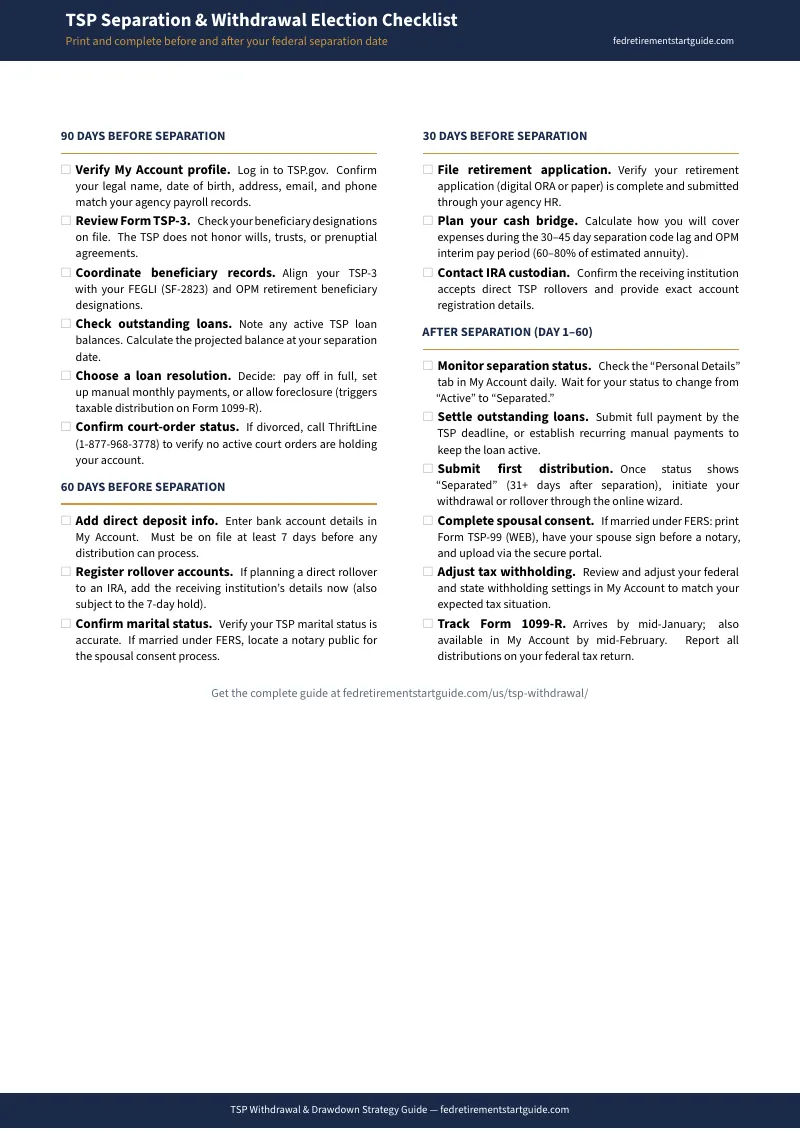
- 90-day pre-separation action plan — a chronological checklist from 90 days before separation through Day 60 post-separation, covering account verification, loan decisions, cash bridge planning, spousal consent, and your first withdrawal request
Who this is for
Federal employees and uniformed service members within 90 days of separation who want to manage their own TSP distributions without hiring a fee-based financial advisor.
- You're approaching retirement or separation and need to understand the withdrawal election sequence before your account unlocks
- You have an outstanding TSP loan and need to decide between payoff, manual payments, or foreclosure before your last paycheck
- You want to compare installments, partial withdrawals, rollovers, and the MetLife annuity using the actual portal tools — not a sales pitch disguised as education
- You need to navigate spousal consent notarization and want to know which elections trigger it and which don't
- You're a self-directed retiree who reads the manual — you just need someone to organize it into a sequence that makes sense
Why not free resources?
The TSP's own publications are the authoritative source. They're also structured as standalone regulatory booklets — one for withdrawals, one for loans, one for beneficiaries, one for tax notices — with no unified walkthrough connecting them. You're left cross-referencing five different documents to figure out whether you need spousal consent before or after you submit a rollover request.
Online forums are full of well-meaning advice from people who separated under different rules, different years, and different retirement systems. The CSRS participant telling you "I just had to notify my spouse" is technically correct — for CSRS. Under FERS, that same action requires notarized consent, and skipping it gets your paperwork rejected.
Financial advisory firms offer "free" webinars and calculators, but every one is a funnel to an ongoing wealth management engagement. They're not wrong that planning matters. But if you've already decided what you want to do and just need to know how to execute it on TSP.gov without triggering the wrong tax withholding, there's a gap between the free webinar and the $5,000-per-year advisory contract.
This guide sits in that gap: the procedural clarity of the TSP's own materials, organized as a single sequential workflow, at a fraction of a single advisory session.
What you get
- The complete TSP Withdrawal & Drawdown Strategy Guide — 13 chapters covering the full post-separation distribution process, from the separation code lag through your first completed withdrawal, RMD planning, and benefit coordination
- The TSP Separation & Withdrawal Election Checklist — a 19-item chronological checklist organized across four timeline phases: pre-separation verification, loan settlement, the separation code waiting period, and post-unlock withdrawal execution
- 8 standalone printable worksheets and reference cards — a 90-day action plan timeline, a withdrawal option comparison worksheet, a loan settlement decision tree, a direct rollover setup checklist, a spousal consent checklist (print and bring to the notary), a tax withholding quick reference card, a forms and contacts directory, and an RMD planning worksheet with Roth conversion planning
Satisfaction guarantee
If the guide doesn't give you what you need to navigate your TSP distributions with confidence, email us for a full refund. No forms, no questions, no waiting period.
Start with the checklist
Download the free checklist to see the full decision sequence and timeline. When you're ready to understand the mechanics behind each step — the portal walkthrough, the tax withholding rules, the spousal consent process — the full guide is waiting.
The free checklist tells you what decisions to make and when. The full guide shows you how each transaction works on TSP.gov — so you submit your withdrawal request knowing exactly what will happen next.