
One Marriage Changes Everything About Your Survivor Annuity — and OPM Won't Walk You Through It
You're receiving a FERS or CSRS survivor annuity after the death of a federal employee or retiree. Now you're thinking about remarrying — or you already have — and you need to know what happens next. Does the annuity stop? Does your health coverage end? What do you report to OPM, and when?
The answers depend on a handful of facts: your age on the day of the marriage, how long you were married to the deceased, whether you're a surviving spouse or a former spouse, and whether the later marriage is still intact. Get any of these wrong and you could face a terminated annuity, lost FEHB or PSHB coverage, or an OPM overpayment notice demanding thousands of dollars back.
The official rules are scattered across Title 5 of the U.S. Code, dozens of Code of Federal Regulations sections, and OPM forms that look almost identical but serve completely different purposes. The Survivor Remarriage Navigator pulls those scattered regulations into a single reference you can actually follow — with a reporting checklist, a restoration workflow, and the specific deadlines OPM enforces but rarely explains in plain language.
What the Guide Covers
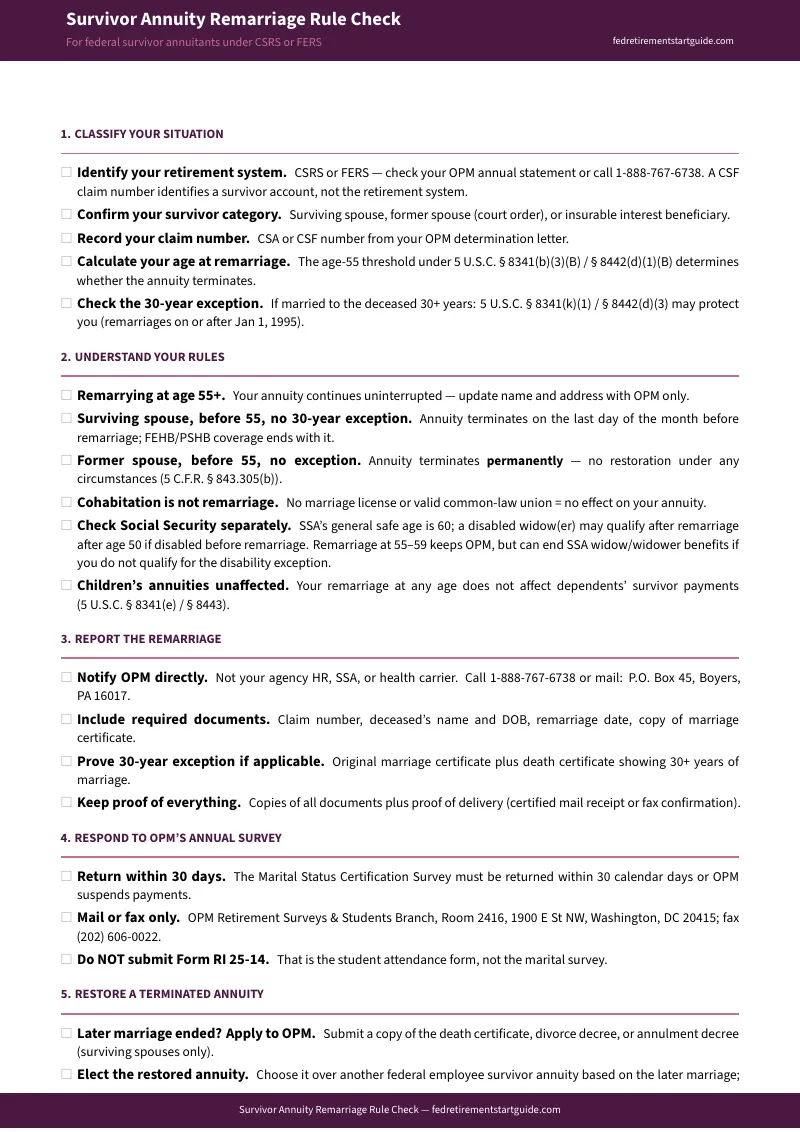
- The age-55 rule, explained once and clearly — remarrying at 55 or older keeps the annuity running under both FERS and CSRS; remarrying before 55 triggers termination unless the 30-year marriage exception applies (remarriages on or after January 1, 1995, where the marriage to the deceased lasted at least 30 years)
- Former spouse annuities and permanent forfeiture — a former spouse survivor annuity terminated by remarriage before 55 cannot come back through divorce or death of the later spouse; a narrow CSRS exception applies when an annulment meets 5 CFR § 831.644(d)(2), while FERS former-spouse entitlements are not restored under 5 CFR § 843.305(b)
- FEHB and PSHB health coverage — when survivor health benefits end, how to handle the transition, and the 60-day re-enrollment window from OPM's notice of eligibility after annuity restoration; postal survivors entitled to Medicare Part A must also enroll in Medicare Part B to enroll in PSHB, subject to exceptions the guide addresses separately
- OPM's marital certification survey — what it is, how it differs from Form RI 25-14 (which is a student attendance form, not a marital survey), the 30-day deadline, and what happens to the annuity if the survey goes unanswered
- Reporting a remarriage to OPM — what to submit, how to send it, how to establish proof of delivery, and what documents OPM asks you to send
- Annuity restoration after a later marriage ends — the step-by-step process for a surviving spouse when a subsequent marriage ends by death, divorce, or annulment: assembling evidence, the lump-sum repayment requirement, the election between competing survivor benefits, and the FEHB/PSHB reinstatement timeline
- Overpayments and waiver requests — how OPM calculates overpayment debt, the reconsideration window, and the waiver process under 5 CFR §§ 831.1401–831.1404 for CSRS and §§ 845.301–845.304 for FERS
- A reporting checklist — every form, document, and deadline organized in one place so nothing slips through a 30-day window
Who This Is For
- A surviving spouse under 55 who wants to understand what remarriage will do to the annuity and health coverage before making a decision
- A surviving spouse at or over 55 who wants to confirm that the annuity continues without interruption
- A surviving spouse whose later marriage has ended and needs to get a terminated annuity reinstated — with the right evidence and within the right deadlines
- A former spouse receiving a survivor annuity who needs to know the permanent forfeiture rule and the narrow CSRS annulment exception under 5 CFR § 831.644(d)(2)
- An adult child, representative payee, executor, or family member helping a survivor navigate OPM correspondence
Why Not Just Read the OPM Handbook?
OPM's handbooks, the Code of Federal Regulations, and agency HR offices all provide pieces of the picture. But the rules for survivor remarriage are spread across 5 U.S.C. §§ 8341 and 8442, 5 CFR Parts 831, 838, 842, 843, 845, and 890, and multiple OPM forms — some of which share similar names but serve entirely different purposes. OPM Retirement Services processes high volumes of claims and cannot walk individual annuitants through how the pieces fit together. Union representatives can explain the statutory rules but have no authority over OPM adjudications. A federal benefits attorney charges $300–$700 an hour, which makes sense for a contested court order but not for an uncontested reporting task.
The guide consolidates the fragmented regulations into a single, plain-language reference with checklists and timelines — so you can organize your records, meet OPM's deadlines, and know when you actually do need a lawyer.
What You Get
The download includes 8 PDFs:
- The guide — 52 pages covering every remarriage scenario for FERS and CSRS survivor annuitants: the age-55 rule, the 30-year exception, former spouse forfeiture, FEHB/PSHB health coverage, reporting, restoration, overpayments, representative payees, and the OPM appeals process
- Reporting checklist — 24 items across 6 phases: classify your situation, understand your rules, report the remarriage, respond to OPM's annual survey, restore a terminated annuity, and protect against overpayment
- Award classification ledger — record your retirement system, claim number, survivor category, and the age and marriage-duration thresholds that apply to you
- Marital certification survey tracker — a year-by-year log for recording when you received and returned OPM's annual survey, with proof-of-delivery fields
- Annuity restoration organizer — track every step of the restoration application: eligibility, documents, lump-sum repayment, competing benefit election, and submission
- FEHB/PSHB reinstatement calendar — track the 60-day health coverage re-enrollment window after annuity restoration
- Agency communication log — record every call, letter, and fax with OPM, SSA, and health plan carriers
- Income planning worksheet — map your OPM and Social Security income streams before remarrying at age 55–59, where the two agencies use different safe ages
Full refund, no time limit. If anything is unclear, email [email protected] — we read every message.
This guide explains the federal rules and the OPM reporting process. It is not financial, tax, or legal advice, does not recommend whether to remarry or which elections to make, and is not affiliated with OPM, the TSP, USPS, or any federal agency. Free help is available directly from OPM Retirement Services.
Get the Survivor Remarriage Navigator — for less than the cost of a single hour with an attorney, you get the full regulatory picture in one place.
Frequently Asked Questions
What if the rules change after I buy?
We update the guide when the rules change. Email us any time, even years later, and we'll send you the current edition free.