
Your Agency Filed the Paperwork. OPM Decides Whether They Got It Right.
You spent 20 years in covered service — field operations, tower cabs, structure fires. Your agency's HR system says you are eligible for enhanced retirement under FERS special provisions. But OPM is the sole statutory authority that adjudicates your claim, recalculates your annuity, and issues your retirement payments. And the first time OPM looks at your personnel records is after you have separated from service.
If OPM finds an incorrect retirement code in Block 30 of a single SF-50, they recalculate your covered service under the standard 1.0% formula instead of the enhanced 1.7% multiplier. If your transfer from a field position to a supervisory role exceeded the three-day break-in-service limit, OPM can strip the enhanced status from every year that followed. If your military buyback deposit was not completed before your final separation date, OPM excludes that service from both eligibility and annuity calculations — and there is no mechanism to complete the deposit after you leave.
None of these errors show up on your agency's retirement estimate. They surface three to four months later, in a letter from OPM's adjudication unit, after your network credentials are terminated and your electronic Official Personnel Folder is no longer accessible.
The Covered-Service Verification System
The Special Category Retirement Guide is a process manual built specifically for federal law enforcement officers, firefighters, and air traffic controllers who need to verify their personnel records, calculate their enhanced annuity, and file a clean retirement application through OPM's digital platform — before the administrative window closes.
Standard FERS retirement guides are written for 2.1 million federal employees retiring under ordinary provisions. They cover the basics and move on. This guide starts where those guides stop: the specific rules, calculations, deadlines, and record-verification steps that apply only to Special Category Employees under 5 U.S.C. §§ 8412(d)–(e) and 8415(b)–(f).
What's Inside
- SF-50 Record Audit Framework — A systematic process for pulling your entire SF-50 history, verifying Block 30 retirement codes on every personnel action, cross-referencing position descriptions against covered-service designations, and identifying corrections that must be processed before separation. Your agency maintains these records, but only OPM adjudicates them — the guide bridges the gap between what HR tells you and what OPM will accept.
- Enhanced Annuity Calculation Walkthrough — The complete 1.7%/1.0% formula with worked examples for LEOs, firefighters, and air traffic controllers. How to determine your high-three average salary including LEAP and AUO premium pay. How unused sick leave converts to additional service months using OPM's 2,087-hour chart. And the uncapped 1.7% multiplier available to controllers who transition into exempt supervisory positions under § 8415(f).
- Position Transfer Verification — The exact documentation for transitions between primary (rigorous) and secondary (supervisory/administrative) positions. The three-day break-in-service limit. The three-year minimum primary service requirement. The consequences of a coding error or a gap that exceeds the window. One missed requirement can permanently strip your enhanced status from every subsequent year of service.
- FERS Supplement MRA Exemption Guide — Most FERS retirees face an immediate earnings test that reduces the supplement by $1 for every $2 of earned income above $24,480. Special category retirees who separate before MRA are exempt until they reach it — meaning years of unrestricted private-sector income while the supplement pays in full. The guide covers the exemption rules, the reporting requirements once MRA arrives, and the exact formula for calculating your supplement amount.
- First Responder Fair RETIRE Act Protections — OPM's proposed regulations (July 2026) implement the new rules for first responders injured in the line of duty on or after December 9, 2024. If you are reassigned to a non-covered position due to a qualifying injury, you can retain your 1.7% multiplier and special category eligibility. The guide covers agency certification requirements, the higher contribution rate, and the refund option.
- WEP/GPO Repeal Strategy — The Social Security Fairness Act (January 2025) repealed both offsets. If you never applied for Social Security because the offsets would have zeroed your benefit, you must file a new claim and consider an SSA-561 reconsideration within 60 days to protect retroactive payments back to January 2024. The adjustment is not automatic for new applicants.
- Digital ORA Application Walkthrough — OPM's Online Retirement Application became mandatory July 1, 2026. Digital submissions average about 40 days to process, but special category applications are classified as complex cases with longer timelines. The guide covers the upload requirements, common errors that flag applications for manual review, and the interim payment process during adjudication.
- Deposit and Buyback Completion Framework — Civilian service credit deposits (1.3% plus interest for pre-1989 service), FERS redeposits for refunded contributions, and military service deposits (3% of basic military pay plus interest). Every deposit has a different calculation method, a different deadline, and a different consequence for incomplete payment. The military deposit must be completed before your final separation date — the guide maps every timeline.
- TSP, FEHB/PSHB, and FEGLI Election Analysis — The TSP age-50 penalty-free withdrawal rule for special category employees, SECURE 2.0 catch-up contributions and the mandatory Roth requirement for high earners, FEHB continuation requirements and PSHB Medicare Part B integration, and FEGLI reduction schedules with cost projections across age bands. Every election made at separation locks in for decades.
Who This Is For
Federal law enforcement officers — special agents, border patrol agents, criminal investigators, and other 1811/1896-series positions covered under FERS special provisions. If you are within five years of mandatory separation at age 57 and you need to verify that your covered service is coded correctly, that your LEAP is included in the high-three calculation, and that your military buyback is complete, this guide walks you through every step.
Federal firefighters — structural and wildland firefighters across DOD, DOI, USFS, and other land management agencies. If you have transferred from a primary rigorous position to a supervisory role and you need to confirm that the transfer documentation preserves your enhanced status, or if you are approaching mandatory separation and need to calculate your annuity with sick leave conversion, the guide covers your specific provisions.
Air traffic controllers — FAA and DOD controllers facing mandatory separation at age 56. If you are considering a transition to an exempt supervisory position to extend your career and access the uncapped 1.7% multiplier under § 8415(f), or if you need to understand the second-level supervisor exemption from mandatory separation, the guide addresses the controller-specific rules that standard FERS resources skip.
Injured first responders — LEOs, firefighters, CBP officers, and controllers who suffered duty-related injuries and were reassigned to non-covered positions. The First Responder Fair RETIRE Act creates a new path to retain your enhanced retirement coverage, but the eligibility requirements and agency certification process are specific. The guide covers what qualifies, what does not, and how to document the claim.
Why Not Just Use Free Resources?
OPM publishes the FERS handbook, retirement center guides, and the ORA platform documentation. Your union provides legislative updates and general benefits education. These resources explain the system. They do not provide a process for auditing whether the system was applied correctly to your specific career history.
The gap is structural. OPM writes policy for all 2.1 million FERS employees — special category provisions get a fraction of the coverage. Your agency HR office maintains your records but cannot adjudicate your claim. Financial planners manage portfolios at several hundred dollars per hour and focus on investment strategy, not on verifying SF-50 retirement codes or calculating civilian service deposits. Retirement training workshops explain what the rules are; they do not give you an audit framework for checking whether the rules were correctly applied to your records.
The guide fills the space between the official policy and the personnel records: a systematic process for verifying that every covered-service period, every position transfer, and every deposit is documented correctly before you submit the application that OPM will adjudicate — without access to your electronic personnel folder, and without the ability to process corrections after the fact.
Satisfaction Guarantee
If the guide does not help you verify your covered-service records, calculate your enhanced annuity, or prepare your retirement application, email [email protected] and we will issue a full refund.
Verify Your Records Before You Lose Access
Your agency terminates network credentials immediately upon separation. The 60-to-90-day window before your retirement date is the only time you can audit your personnel records, identify errors, and get corrections processed while you still have standing. Once you separate, the records go to OPM — and OPM adjudicates what they receive.
The guide costs — a fraction of a single hour with a federal retirement planner. It covers the covered-service audit, the annuity calculation, every deposit deadline, the digital ORA submission, and the benefits elections that lock in at separation. Plus 9 standalone printable worksheets — an SF-50 record audit log, an annuity calculation worksheet, a deposit and buyback tracker, a 12-month retirement timeline, a FERS Supplement calculator, a TSP contribution planner, a FEGLI cost comparison, a survivor annuity election worksheet, and a contacts and resources reference card — along with a quick-start checklist you can work through systematically before your retirement date.
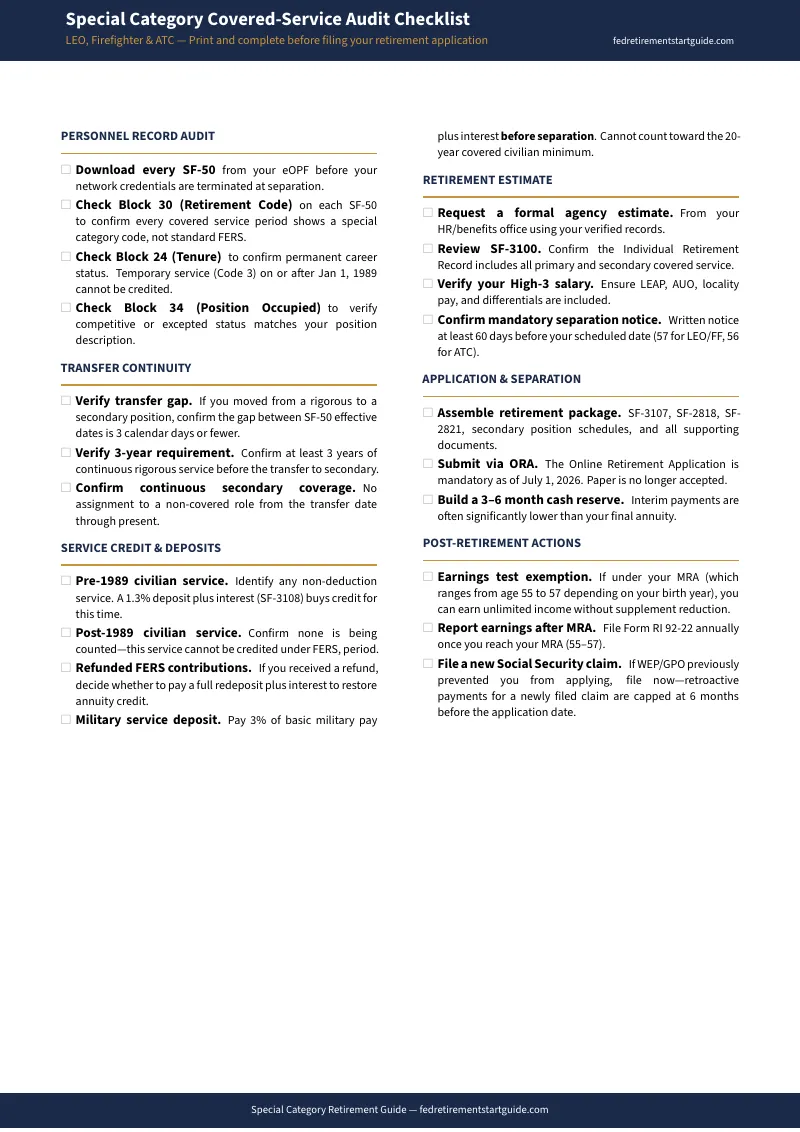
Not ready for the full guide? Download the free Special Category Covered-Service Audit Checklist — a structured framework for verifying SF-50 retirement codes, tracking position transitions, and confirming deposit deadlines. It covers the first step: finding out whether your records need attention. The full guide is there when you need the complete process.