Five Agencies, One Application — and Nobody Shows You the Postal Route
Your back gave out on the route. Or the anxiety made it impossible to case mail. Or the shoulder surgery means you will never lift a tray over your head again. Whatever brought you here, the problem is not your diagnosis. The problem is what comes next.
USPS disability retirement has a filing process that generic federal guides do not cover. If you are a current USPS employee, you start through the HR Shared Service Center — not a local HR office. If you have separated, OPM directs former employees to file through its Online Retirement Application or their former employing agency. Your accommodation and reassignment documentation follows USPS's process under your craft's collective bargaining agreement. Each of the five parts of Standard Form 3112 has an assigned owner, who controls a piece of your case.
Meanwhile, you may already be on LWOP, watching your pay stop while your health insurance ticks down. OPM takes months to decide. And the clock started the day you separated — or the day you will.
The Postal Disability Filing System
This guide is built around the postal filing process that generic federal guides do not describe: the HRSSC route for current USPS employees and the ORA route for former employees. It maps the process from your first medical restriction to OPM's final decision, including the postal steps that apply to your filing route.
It is not financial, tax, legal, or medical advice. It never tells you which option to choose. It explains how each path works so you can decide with your union, your physician, and your family.
What's Inside
- The five eligibility tests in plain language — the 18-month service minimum, the medical condition standard, the useful-and-efficient-service test, the accommodation and reassignment requirements, and the SSDI application or official SSA statement for people who are not insured. Each one explained with the postal context that matters.
- The USPS accommodation and reassignment process — how Handbook EL-307 works, what the Reasonable Accommodation Committee does, the difference between light duty and a reasonable accommodation under OPM's standard, and the postal-specific statutory limitation on cross-craft reassignment.
- SF 3112 form-by-form breakdown — who owns each part (3112A through 3112E), what OPM actually looks for in each one, the physician's statement standards that keep 3112C from being bounced, and how to get a delayed supervisor statement unstuck.
- The postal filing routes — the HRSSC process for current employees, what the guide describes about Eagan routing, the ORA route for former employees, and what to track if your case stalls.
- Post-separation filing — the one-year deadline, filing through ORA, the mental-incompetence waiver, and how a removal for medical inability may help your case.
- Annuity calculation with worked examples — 60% of the high-3 minus SSDI in the first year, 40% minus 60% of SSDI after that, and what happens at age 62. Two examples show the math for a carrier and a clerk at different salary levels.
- OWCP and dual-compensation rules — why you cannot draw OWCP wage-loss and a FERS annuity for the same period, how the election works, and when to read the companion guide on the OWCP election decision.
- PSHB and Medicare for disability retirees — PSHB continuation after retirement and the Part B rule for Medicare-eligible postal annuitants, subject to OPM-listed exceptions.
- Post-award rules — medical review schedules, the earnings limit and restoration process, COLA adjustments under age 62, and the age-62 recomputation.
- Seven printable worksheets and a contacts directory — a packet responsibility checklist, a multi-agency filing timeline tracker, an RAC accommodation and reassignment log, an agency communication log, a physician documentation checklist for your doctor, an SSDI proof log, a post-award earnings tracker, and the HRSSC and OPM submission addresses for every agency involved.
Who This Guide Is For
- Career USPS employees — city and rural carriers, clerks, mail handlers, maintenance workers, supervisors — whose medical condition prevents them from doing their postal job
- Postal employees already on limited duty, light duty, or OWCP who need to understand how disability retirement fits
- Family members helping a postal worker assemble and track the application
- Postal employees who have already separated and need to file within the one-year deadline
Why Not Just Use the Free Resources?
The official resources exist. OPM publishes the FERS Handbook and the SF 3112 pamphlet. HRSSC sends the form packet when you call. Your union steward can help with grievances and contractual rights.
But none of them walk a postal employee through the full filing process from medical restriction to OPM decision. The FERS Handbook is written in regulatory language for all federal agencies — it does not cover the postal HRSSC process, the Eagan accounting transfer, or craft-specific accommodation rules. HRSSC collects your paperwork but does not coach you on building a physician's statement that meets OPM's standard. Your steward defends contractual rights but typically does not build disability retirement packages.
The guide brings the postal-specific filing process into one document: the USPS accommodation process, the form ownership for all five parts, the HRSSC route for current employees, the ORA route for former employees, and the deadlines and rules that apply after OPM receives your case.
Satisfaction Guarantee
Full refund, no time limit. If the guide does not help you navigate the postal disability retirement process, email [email protected] and you will get your money back.
Start With the Free Checklist
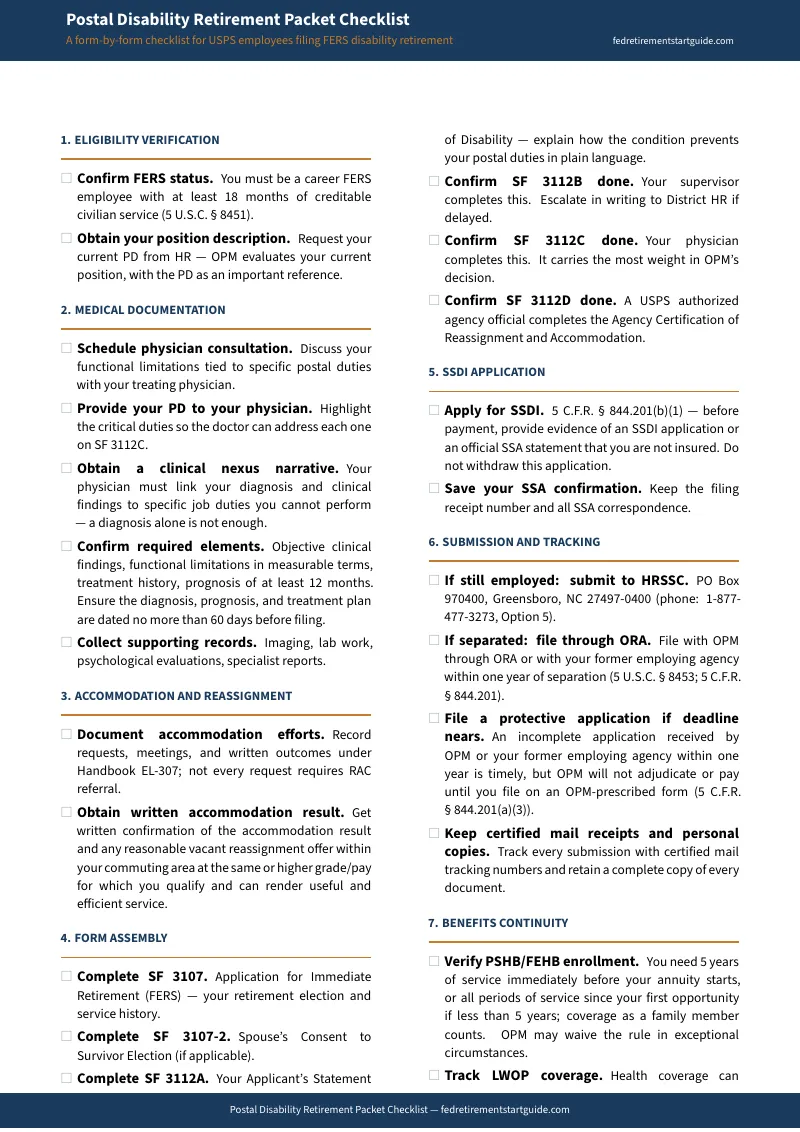
Not ready for the full guide? Download the free Postal Disability Retirement Packet Checklist — a form-by-form summary of what your packet needs before you file. It takes five minutes to review and shows you exactly where your application stands right now.
When you are ready for the full filing process — the HRSSC route for current employees, the ORA route for former employees, the form-by-form strategy, the annuity math, and the post-award rules — the full guide picks up where the checklist leaves off.
Get the Postal Disability Retirement Guide →
Frequently Asked Questions
What if the rules change after I buy?
We update the guide when the rules change. Email us any time, even years later, and we'll send you the current edition free.