You got the OPM notice. Now what?
The letter says you need to enroll in Medicare Part B to keep your health coverage under the new Postal Service Health Benefits Program. But you retired in 2023 — does the mandate even apply to you? Your spouse is covered on your plan and turns 65 next year — do they need Part B too? And what about the Part D prescription benefit you're apparently already enrolled in — can you opt out of that without losing drug coverage entirely?
The official OPM portal has answers to each of those questions. They're scattered across a dozen different pages, mixed in with rules that apply to non-postal federal employees, and written in the same regulatory language that made you search for help in the first place.
The Postal Coverage Navigator — Every PSHB Rule in One Place
This guide takes every piece of the PSHB-Medicare coordination — the Part B mandate, the statutory exceptions, the integrated Part D prescription benefit, open season mechanics, survivor coverage, and the five-year enrollment rule — and walks through each one in the order a postal retiree or family member actually needs it.
No plan recommendations. No insurance commissions. No agency affiliation. Just a plain-language reference that tells you which rules apply to your specific situation and what paperwork to file, with the deadlines that matter.
What's Inside
- Part B cohort rules, decoded — the mandate splits postal retirees into distinct groups based on retirement date, age on January 1, 2025, and Part B enrollment status. The guide maps each cohort so you can confirm in five minutes whether the requirement applies to you or not.
- Three statutory exceptions with documentation requirements — if you live outside the United States, are enrolled in VA health care, or are eligible for Indian Health Service, you may maintain PSHB without Part B. The guide specifies what OPM requires to prove each exception, so you don't submit the wrong paperwork and get denied.
- Medicare enrollment mechanics — which forms go where (CMS-40B to SSA, not to OPM), who completes Section B of CMS-L564, and the Special Enrollment Period windows so you don't trigger a permanent late-enrollment penalty.
- Part D EGWP — the opt-out that removes your PSHB drug coverage — PSHB plans automatically enroll Part D-eligible members in an integrated Part D drug benefit. If you disenroll, you lose all prescription drug coverage under your plan — not just the Part D portion. The guide explains the structure, the risk, and the limited grace period if you've already made this mistake.
- Open season under PSHB — the dates, the plan comparison process, and what changes you can and cannot make mid-year. Includes the 2027 plan year window (November 9 through December 14, 2026).
- Five-year continuous enrollment rule — what counts, what doesn't, how TRICARE credit and shorter-service exceptions work, and how to verify your record before you separate.
- Spousal and dependent coverage — how the primary enrollee's Part B status flows through to covered family members, what happens when a spouse reaches Medicare eligibility after the retiree, and the administrative sequence to prevent a gap.
- Survivor coverage after a postal retiree's death — the forms (SF 3104 for FERS, SF 2800 for CSRS), the conditions for continuing PSHB, and the step-by-step reporting timeline.
- Exception denials and reconsiderations — where to file (employees to USPS, retirees to OPM), the 30-day window, and what documentation strengthens your case.
- TRICARE, CHAMPVA, and VA coordination — how PSHB interacts with other federal health benefits, the difference between suspending and cancelling PSHB, and why cancellation is usually irreversible.
- Printable deadline checklists and tracking logs — every form, enrollment window, and confirmation step mapped to your personal dates, with fields for tracking numbers and OPM confirmation receipts.
Who This Guide Is For
- Postal annuitants who received an OPM Part B notice and need to know whether the mandate applies to their cohort or whether they qualify for an exception
- Active postal employees planning retirement who need to verify the five-year rule, understand which Part B cohort they fall into, and time their Medicare enrollment around separation
- Spouses and family members on a postal retiree's plan who need to understand their own Part B obligations when they reach Medicare eligibility
- Adult children helping a parent navigate OPM and SSA paperwork — especially when the retiree needs help filing exception documentation or tracking confirmation receipts
- Surviving spouses who need to continue PSHB coverage after a postal annuitant's death
Why Not Just Read OPM's Website?
You can. Everything in this guide comes from public regulations and official agency pages. The problem isn't access — it's navigation. OPM's PSHB portal mixes postal-specific rules with general federal employee guidance. The SSA POMS manual explains the Special Enrollment Period in regulatory language written for claims examiners. Union bulletins cover their own sponsored plans but not cross-agency troubleshooting.
The result: a postal retiree who needs to file a Part B exception has to piece together requirements from OPM, SSA, the VA, and their PSHB plan carrier — four agencies, four sets of forms, four different portals. This guide puts the complete sequence in one document, in the order you need to follow it.
No Financial Advice, No Affiliation
This is an independent educational publication. It is not affiliated with OPM, USPS, SSA, the TSP, or any postal union. It does not provide financial, tax, legal, or medical advice. It does not recommend which PSHB plan to choose, whether to drop Part B, or how to invest your TSP. It explains the official process in plain language so you can navigate it yourself — and directs you to free official help (OPM Retirement Services, SSA, SHIP counselors) where your situation needs it.
Full refund, no time limit. If the guide doesn't help, email [email protected] and we'll refund your purchase.
Start With the Free Self-Check
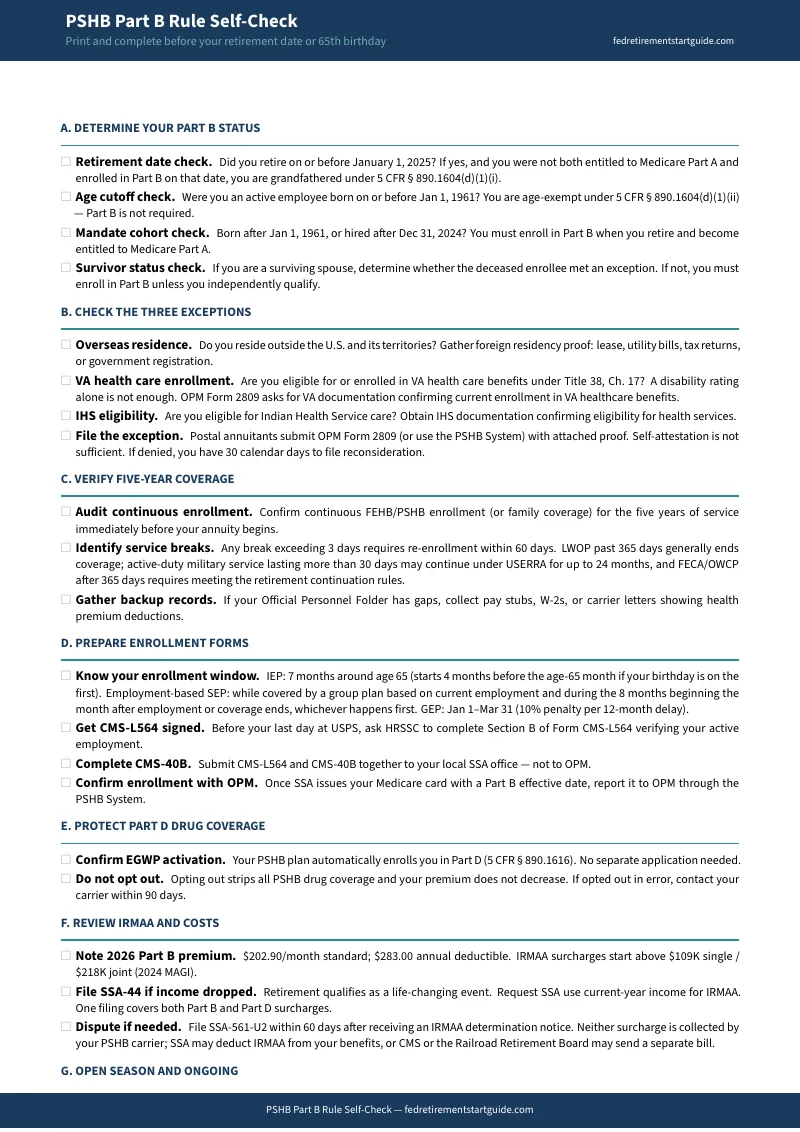
Not sure whether the Part B requirement applies to you? The free PSHB Part B Rule Self-Check is a two-page flowchart that identifies your cohort, flags the exceptions to investigate, and lists the dates you need to act on. Download it now — if you need the full procedural framework, the complete guide is waiting.
Frequently Asked Questions
What if the rules change after I buy?
We update the guide when the rules change. Email us any time, even years later, and we'll send you the current edition free.