Your Agency Forgot You're Not FERS. This Guide Didn't.
You're one of the last federal employees covered under the Civil Service Retirement System — and the support infrastructure has moved on without you. The retirement seminars default to FERS. The online calculators skip CSRS rules. Your HR office hasn't processed a CSRS separation in years, and the advisor your union recommended spent the first thirty minutes explaining what FERS is.
Meanwhile, the rules that govern your retirement are genuinely complex. The annuity formula uses a three-tier progressive multiplier that caps at 80%. Deposits and redeposits for pre-1984 service carry permanent penalties if you get them wrong. If you're CSRS Offset, OPM will reduce your pension at age 62 using a formula most financial planners confuse with the recently repealed WEP — and getting that confusion into your plan means a surprise income drop of hundreds of dollars a month.
The CSRS Retirement Guide is a cross-agency transition manual built specifically for the legacy cohort. It connects the dots between OPM, SSA, TSP, FEGLI, and FEHB/PSHB in one document — with plain-language explanations, worked calculation examples, and fillable worksheets. No asset-management pitch. No membership. No seminar follow-up call. Just the process, in order, with the math shown.
What's Inside
- Coverage verification and eligibility — Confirm whether you're Standard CSRS or CSRS Offset, check the three immediate-retirement combinations (55/30, 60/20, 62/5), and verify you satisfy the "one-of-the-last-two-years" rule before you commit to a separation date.
- High-3 calculation with worked examples — Walk through the progressive formula (1.5% for the first 5 years, 1.75% for the next 5, 2.0% for the rest), understand how locality pay, special-rate pay, and sick-leave credit affect the result, and see where the 80% statutory cap kicks in.
- Deposit and redeposit decision worksheets — Pre-1982 non-deduction service, post-1982 temporary service, military deposits, refunded service — each type has different interest rules and different consequences for getting it wrong. The worksheets map the breakeven math so you can see whether paying the deposit makes financial sense before you separate.
- The CSRS Offset age-62 reduction, fully explained — This is the section most guides skip entirely. OPM uses the lesser of two formulas — the SSA-attributed benefit and the fraction-of-service calculation — to reduce your pension when you become eligible for Social Security. The guide walks through both formulas with a numerical example and shows how to coordinate your OPM retirement date with your Social Security claiming decision so the reduction doesn't create a gap in your monthly income.
- Survivor annuity elections and spousal consent — Full survivor (55% of base annuity), partial elections, insurable-interest elections, the cost formula (2.5% of the first $3,600 plus 10% of the remainder), and the notarized spousal consent requirements that trip up clean filings.
- SF 2801 / ORA filing walkthrough — OPM's "Last Day of Paper" on July 1, 2026, moved all retirement applications to the Online Retirement Application platform. The guide covers the digital filing process step by step, flags the common rejection triggers (line-outs on SF 2801-2, expired beneficiary designations, mismatched Social Security numbers), and explains why ORA submissions process in under 40 days compared to 73+ days for paper.
- The WEP/GPO repeal and SSA retroactive benefits — The Social Security Fairness Act eliminated the Windfall Elimination Provision and the Government Pension Offset for benefits payable from January 2024 onward. But SSA is capping retroactive payments for new applicants at six months from the filing date — potentially shortchanging you by up to 14 months of back pay. The guide includes step-by-step instructions for filing SSA-561 to claim the full retroactive amount, plus IRMAA lookback worksheets to manage the tax and Medicare-surcharge consequences of a lump-sum payment.
- FEGLI reduction options at retirement — The three post-65 reduction choices (75%, 50%, No Reduction), age-banded premium tables for Options A/B/C, and the math for deciding whether to keep or cancel each layer.
- FEHB and PSHB into retirement — How to carry your health coverage, the new PSHB program for postal employees (including the mandatory Medicare Part B enrollment and the specific grandfathering exceptions), and the BENEFEDS direct-billing trap during interim pay.
- TSP under SECURE 2.0 — 2026 contribution limits ($24,500 base, $8,000 standard catch-up, $11,250 super catch-up for ages 60–63), the mandatory Roth rule for high earners, withdrawal options after separation, and RMD timing.
The paid download also includes ten fillable worksheets you print and write on:
- High-3 Annuity Estimator Worksheet — progressive formula, 80% cap, sick-leave credit, survivor reduction
- Deposit & Redeposit Decision Worksheet — pre-1982 vs. post-1982 rules, Catch-62, SF 2803 tracker
- CSRS Offset Age-62 Reduction Worksheet — Formula A vs. Formula B, Social Security filing timing
- Survivor Annuity Election Worksheet — full 55% cost, SF 2801-2 notary checklist
- WEP/GPO Repeal Verification Tracker — Group 1 vs. Group 2 path, SSA-561 text
- IRMAA & Tax Planning Worksheet — MAGI lookback, SSA-44, estimated tax
- SF 2801 / ORA Filing Checklist — field-by-field upload list and rejection traps
- FEGLI Reduction Decision Worksheet — 75% / 50% / No Reduction math for SF 2818
- Cash Bridge & Interim Pay Planner — the interim pay gap, partial interim payments, BENEFEDS
- Service History Audit Worksheet — SF-50 log, SF 2801-1 cross-check, one-of-the-last-two-years rule
Who This Is For
This guide is for federal civilian employees — both Standard CSRS and CSRS Offset — who are within one to five years of retirement and need a current, accurate process map. Not a FERS overview with a CSRS footnote. Not a general "federal retirement" seminar that glosses over deposits, the Offset reduction, and Catch-62. A dedicated reference for the rules that apply to you.
It's especially useful if you have any of these situations in your service history:
- Pre-1984 temporary or part-time service that may require a deposit
- A refunded period from an earlier separation that requires a redeposit decision
- CSRS Offset coverage and uncertainty about how the age-62 pension reduction works
- A spouse who was previously denied Social Security benefits under GPO or WEP
- Plans to retire before the OPM backlog clears and questions about how interim pay works
Why Not Just Use the Free Resources?
OPM.gov has the regulatory text — hundreds of pages of it, scattered across separate pamphlets for each benefit, with no cross-agency coordination and no worked examples. NARFE publishes excellent advocacy content, but it's behind a membership paywall and spread across magazines, webinars, and white papers released over multiple years. FEDweek sells individual topic guides, but their CSRS materials still contain pre-repeal WEP/GPO calculations and pre-ORA paper-filing instructions as of mid-2026.
You could assemble all of this yourself. Most CSRS employees have been doing exactly that — pulling pamphlets from OPM, cross-referencing SSA rules, and trying to figure out which online calculator actually handles the CSRS formula. The guide compresses that research into a single, current document where the sections talk to each other: the annuity calculation feeds into the survivor election, the survivor election feeds into the filing checklist, and the filing checklist accounts for the ORA transition.
Satisfaction Guarantee
If the guide doesn't give you a clearer picture of your retirement timeline, calculations, and filing requirements, email us and we'll refund your purchase. No forms, no justification required.
Start With the Free Checklist
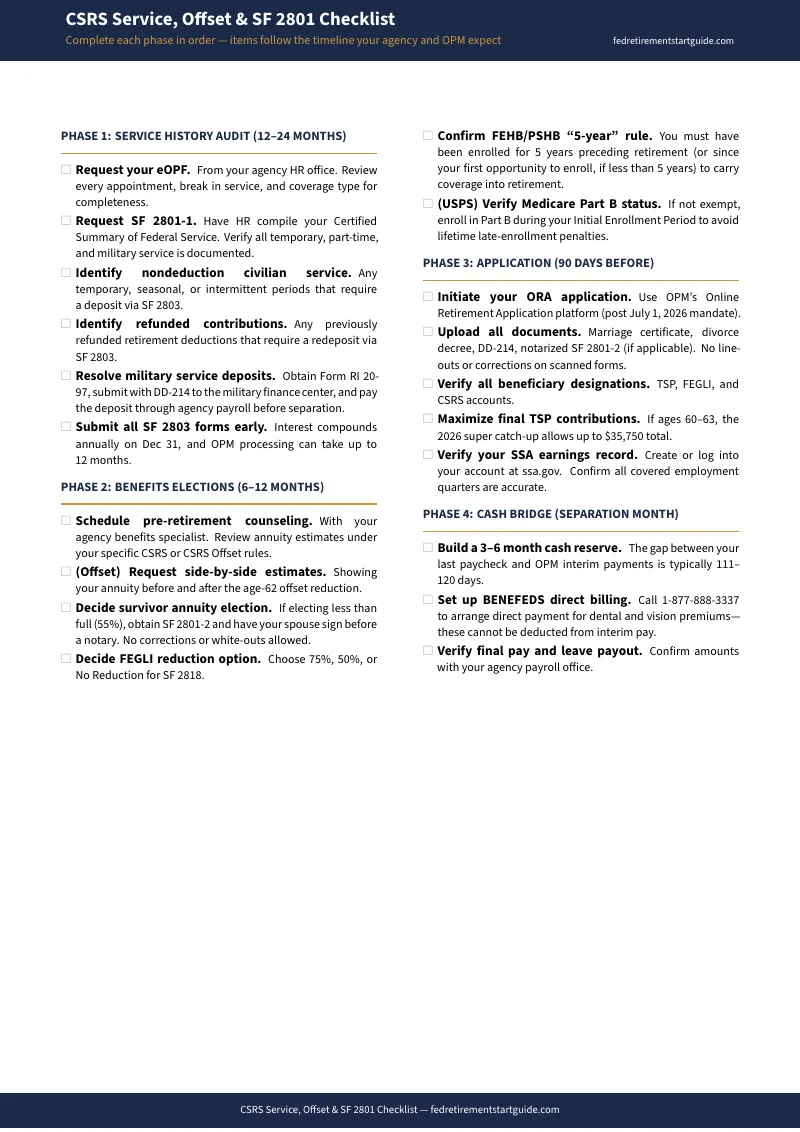
Not sure you need the full guide? Download the free CSRS Service, Offset & SF 2801 Checklist first. It walks you through the service-history audit, deposit verification, and application prep steps — enough to see where you stand and what gaps remain. If you decide you need the deeper explanations and worksheets, you can upgrade anytime.