Your agency gave you a number. Can you prove it's right?
You've spent decades building a federal career. Now your agency's retirement system has produced an estimate — a single number that's supposed to represent your lifetime pension. But that estimate is generated from a personnel database that may not reflect your complete history: every transfer, every schedule change, every military deposit, every SF-50 action across your career.
When you submit SF-3107 and OPM adjudicates your claim, they don't rubber-stamp your agency's projection. They verify every input against your Individual Retirement Record, line by line. And when they find an error — an uncertified form, a Service Computation Date that doesn't match, a missing deposit annotation — they send the file back to your agency for correction.
While that happens, you sit on interim pay: 60% to 80% of your estimated annuity, with no Special Retirement Supplement and no standard payroll deductions. As of mid-2026, OPM's processing backlog averaged 108 days. Employees whose files contain errors wait longer — indefinitely longer.
The Record-Level Audit Framework
This is not a calculator. It does not produce a personalized projection or tell you what your pension will be. What it does is disassemble the FERS annuity formula into its component inputs and walk you through verifying each one against your own official records — so you catch errors before OPM does.
Most online calculators ask you to enter a salary and years of service and hand back a number. That feels useful. But the number is only as good as the inputs — and the inputs are where agency estimates go wrong. A miscoded SCD, an unpaid military deposit, a GS pay cap that distorted your high-3 window: these are the errors that cause processing delays and permanent pension reductions. No calculator checks for them.
The FERS Annuity Guide gives you a structured audit process that starts with the records themselves.
What's inside
- High-3 salary audit framework — exactly which pay components count toward your high-3 (locality pay in, overtime out), how to identify your optimal 36-month window from your SF-50 history, and how to verify accuracy if you've ever hit the GS biweekly pay cap
- The 1.0% vs. 1.1% multiplier threshold — the precise eligibility rules, the common mistake of counting sick leave toward the 20-year requirement (it can't), and worked examples showing the permanent difference a 10% multiplier boost makes across decades of retirement
- OPM's 2,087-hour sick leave conversion — how the official conversion chart translates your accumulated hours into months and days of service credit, the drop-off rule that discards partial months, and how part-time service creates a compounding double reduction on sick leave value
- Creditable service verification — why your Leave SCD and Retirement SCD can differ by years, the exact process for military buyback deposits (3% plus compounding interest, completed before separation or permanently lost), pre-1989 non-deduction civilian service, and excess LWOP thresholds
- Part-time proration — the career-wide factor that reduces your annuity for any period of part-time service, including the counterintuitive rule that the high-3 uses your full-time equivalent rate while the final pension is multiplied by actual hours worked
- MRA+10 age reduction math — the exact penalty (5/12 of 1% per month under age 62) applied permanently, plus the administrative steps for postponed retirement and reactivating FEHB coverage
- Survivor annuity elections — the cost of maximum, partial, and zero coverage, the permanent nature of the election, and the notarized SF-3107-2 spousal consent requirement
- COLA mechanics — the "diet COLA" brackets that reduce adjustments for retirees under age 62, plus the special-category COLA exception
- Post-WEP/GPO repeal verification — how to confirm your Social Security estimate reflects the January 2025 repeal and what to file if the old reductions are still showing
Who this is for
Federal employees who are one to five years from retirement and want to understand what's behind their agency's estimate — not take it on faith.
- You've received a retirement estimate and something doesn't look right — or you want to confirm that it does
- Your career has complexity: transfers, military service, part-time periods, schedule changes, breaks in service, or temporary appointments
- You want to understand the mechanics of the 1.1% multiplier, the sick leave conversion, or the part-time proration before making timing decisions about when to retire
- You're the kind of person who reads the manual rather than trusting the default output
Why not free resources?
OPM's own handbook is the authoritative source. It's also 1,200+ pages of regulatory prose spread across dozens of chapters, cross-referenced by CFR citation, and written for benefits administrators — not for the individual employee trying to verify their own file.
Online calculators simplify the formula into a three-field entry box that skips the hard parts entirely. They can't check whether your Service Computation Date is correct. They can't flag that your military deposit is still showing "pending." They can't tell you whether the GS pay cap distorted your high-3 window. They produce a number, and the number looks authoritative, and then OPM finds the error anyway.
Private financial advisors offer "free" calculators as lead funnels for wealth management contracts that cost thousands per year. They're not wrong about the value of planning. But if you're a self-reliant federal employee who wants to verify your own records without hiring ongoing advisory services, there's a gap between the free calculator and the $3,000 retainer.
This guide sits in that gap: the clarity of the OPM handbook, organized as a step-by-step self-audit, at a fraction of a single advisory session.
What you get
- The complete FERS Annuity Guide — 12 chapters plus 2 appendices covering every variable in the FERS pension formula, with audit checkpoints, worked examples, and OPM citation references
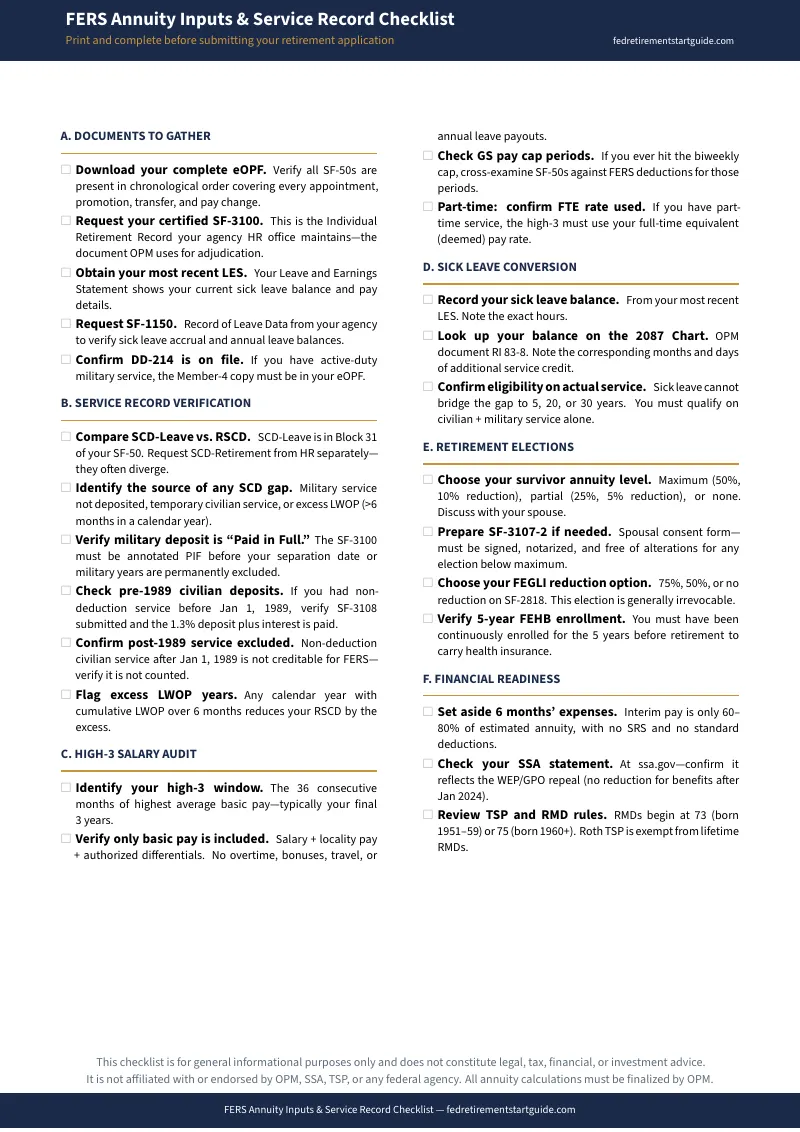
- The FERS Annuity Inputs & Service Record Checklist — a 20-item diagnostic checklist covering document gathering, service record verification, high-3 salary audit, sick leave conversion, retirement elections, and financial readiness
- High-3 Salary Audit Worksheet — record your 36-month window from SF-50s, mark which pay codes count, and flag GS pay-cap periods
- Multiplier Eligibility Worksheet — check the 1.0% vs. 1.1% threshold without counting sick leave toward the 20-year line
- Service Record Verification Worksheet — compare SCD-Leave to RSCD and track military deposits, non-deduction service, and excess LWOP
- Sick Leave Conversion Worksheet — convert your LES balance on OPM's 2,087-hour chart and run the drop-off math
- Part-Time Proration Worksheet — log hours by schedule period and check the career-wide factor against the agency estimate
- MRA+10 Reduction Worksheet — compute the permanent 5%/year cut and map postpone vs. deferred
- Survivor Annuity Election Worksheet — compare maximum, partial, and zero coverage before SF-3107-2
- Records Audit Workflow — the 16-step Chapter 11 sequence with a date line for each step
- WEP/GPO Repeal Verification Tracker — confirm your SSA estimate is post-repeal and file SSA-561 if retroactivity was capped
- HR Communication Log — landscape call log plus a routing table for who owns each correction
Satisfaction guarantee
If the guide doesn't give you what you need to audit your retirement estimate with confidence, email us for a full refund. No forms, no questions, no waiting period.
Start your audit
Download the free checklist to see what records to gather and what to check. When you're ready to understand the mechanics behind each check, the full guide is waiting.
The free checklist tells you what to look for. The full guide teaches you why it matters and exactly how to verify it — so you submit your retirement application knowing every input has been checked.