Your Agency Submits the Application. They Do Not Audit the File.
You are retiring under FERS. Your agency will schedule a counseling session, walk you through their portion of the SF 3107, and submit the package to OPM. What they will not do is review your 25 years of personnel actions for a missing SF-50 from a 2003 reassignment, verify that your Service Computation Date matches your actual entry-on-duty date, confirm your military deposit was credited correctly, or check that your spousal consent form meets OPM's zero-tolerance formatting requirements.
Those are your responsibility. And the window for catching errors closes the moment your application reaches OPM — where a missing record, an undocumented break in service, or a correction mark on the SF 3107-2 does not get a phone call. It gets a suspension notice, an interim pay period at a fraction of your estimated annuity, and weeks or months added to the average 109-day processing time.
The Filing Integrity System
The FERS Retirement Application Guide is a pre-filing audit and process manual for federal employees who want their retirement application assembled correctly before their agency submits it. It covers the complete filing sequence — from the first eOPF download through post-adjudication verification — in the order each step actually occurs, with current 2025–2026 regulatory figures and OPM processing statistics.
This is not a financial planning guide or an annuity calculator. It is a filing integrity tool: it teaches you how to audit your personnel records, verify every field on the SF 3107 and its schedules, navigate OPM's digital submission portal, budget for the interim pay period, and confirm that OPM's final computation matches your records. The kind of systematic check that costs several hundred dollars per hour from a federal retirement specialist — except you do it yourself, at your own pace, before you file.
What's Inside
- eOPF Audit Procedure — Your electronic Official Personnel Folder is the foundation of your retirement claim, and it has been accumulating records for decades. The guide walks through a systematic audit: how to identify missing SF-50 sequences, verify your Service Computation Date against your actual entry-on-duty date, reconcile temporary and term appointments, flag undocumented breaks in service, and confirm that your insurance enrollment history supports the FEHB five-year participation requirement. Errors discovered before filing are correctable through your agency. Errors discovered by OPM become suspension reasons that add weeks to your processing time.
- SF 3107 Field-by-Field Walkthrough — The FERS immediate retirement application is not one form — it is a package: the main application, Schedule A (military service), Schedule B (previous civilian service), Schedule C (survivor benefit election), the SF 3107-2 (spousal consent), and supporting documentation that varies by retirement type. The guide explains what OPM is calculating from each field, which schedules apply to your situation, what supporting documents each schedule requires, and the specific formatting rules that trigger rejections — including the absolute prohibition on any alteration to the SF 3107-2 spousal consent form.
- ORA Digital Submission Walkthrough — OPM designated July 1, 2026, as the "Last Day of Paper" for most voluntary FERS retirements, and over 95% of applications now go through the Online Retirement Application portal. But the portal pre-fills certain fields from agency databases, and the underlying data is only as accurate as the records on file. The guide walks through the ORA interface, explains which pre-filled fields to verify against your own records, covers the digital signature process, and identifies the scenarios that still require paper submission.
- Income Transition Planning Worksheet — After submission, OPM issues interim annuity payments, a partial payment below your estimated monthly benefit, while processing your claim. The FERS Special Retirement Supplement is withheld entirely during the interim period. In mid-2026, OPM averaged 109 days to finalize claims — 98 days for digital ORA submissions, 156 days for paper. The guide includes a cash-flow planning worksheet covering the payroll-to-interim transition, health insurance premium continuation, FEGLI cost changes at separation, and the retroactive lump-sum adjustment that arrives after final adjudication.
- Military Service Deposit Analysis — Post-1956 military service counts toward your FERS annuity only if you pay the full deposit to your agency before your separation date. The deposit accrues variable interest that grows every year you delay. The guide walks through how to request a deposit estimate, the payment timeline, what happens to partial payments, and the financial analysis for deciding whether the deposit is worth completing based on its impact on your annuity calculation.
- Survivor Benefit Election Guide — Your survivor benefit election on the SF 3107 determines whether your spouse receives a continuing annuity — and the default 50% maximum election reduces your own monthly annuity by approximately 10%. Electing less requires the SF 3107-2 spousal consent form, which must be signed in the presence of a notary with no corrections, white-out, or alterations of any kind. The guide covers every election option, the cost of each to your monthly annuity, the notarization requirements, and the narrow post-retirement window for changes.
- FEHB/PSHB and FEGLI Retirement Verification — Health insurance under FEHB (or PSHB for postal employees) continues into retirement only with five years of continuous enrollment. FEGLI premiums change based on your age-65 reduction election, with three options that carry dramatically different lifetime costs. The guide covers enrollment verification, the PSHB transition and Medicare Part B requirements for postal employees, the FEGLI reduction election with current 2026 premium rates, and how each decision affects your monthly take-home in retirement.
- Post-Adjudication Verification — When OPM finalizes your claim, you receive a CSA number and a final annuity computation letter. The guide walks through verifying the high-three average salary, creditable service years, COLA base date, and first full-annuity payment timeline against your own records — and covers the reconsideration process if you believe OPM made an error in the computation.
Who This Is For
Federal employees 6–18 months from their target retirement date — Your agency is talking about retirement counseling sessions and you want to know exactly what needs to be in order before you file. Your eOPF has decades of personnel actions and you have never systematically reviewed it. The guide gives you the audit procedure, the SF 3107 walkthrough, and the filing timeline so you arrive at your HR counseling session prepared to ask targeted questions rather than discover problems.
Employees who downloaded their eOPF and found discrepancies — Missing SF-50s, a Service Computation Date that does not match your start date, or an undocumented break in service. You need to know which discrepancies matter for your retirement calculation, which ones OPM will flag during adjudication, and how to get them corrected through your agency before submission.
Military veterans with unpaid service deposits — You have post-1956 military service and you have not paid the deposit. Interest has been accruing for years and you are not sure whether it is worth paying, how to request the current balance, or what happens if you separate without completing payment. The guide covers the deposit calculation, the payment process, and the permanent consequences of each decision.
Spouses who need to understand the survivor benefit election — Your partner is filing for retirement and needs to make an election that directly affects your financial future. You want to understand what each survivor benefit option means, what it costs the retiree's monthly annuity, and what the SF 3107-2 form requires. The guide explains every option from the surviving spouse's perspective.
Why Not Just Use Free Resources?
The forms, regulations, and procedures for filing a FERS retirement application are publicly available. OPM publishes the CSRS/FERS Handbook. Your agency distributes retirement checklists. Pre-retirement seminars walk through the basics in two-hour sessions. The information exists.
What does not exist — in any single free source — is a sequential process that tells you how to audit your personnel folder for the specific errors that delay adjudication, verify every field on the SF 3107 against the supporting documents OPM requires, navigate the ORA digital portal with an understanding of which pre-filled data to verify, budget for the interim pay period, and check OPM's final computation against your own records.
OPM publishes rules. Your agency processes paperwork. Financial advisors build portfolios at several hundred dollars per hour. Forums carry helpful but inconsistent advice — threads that still reference pre-2025 WEP/GPO rules or outdated OPM processing statistics. The guide consolidates current, verified information into one structured document that follows the actual filing sequence from eOPF download through post-adjudication verification.
Satisfaction Guarantee
If the guide does not help you audit your personnel records, prepare your SF 3107, or navigate the OPM submission process, email [email protected] and we will issue a full refund.
Your Retirement Application, Audited Before It Ships
Agency HR processes retirement applications competently and in good faith. But they are processing yours alongside dozens of others, working from whatever records are in your eOPF. The guide gives you the independent audit, the field-by-field walkthrough, and the verification steps — so the application your agency submits is the one you intended to file.
The complete toolkit costs — a fraction of a single session with a federal retirement specialist. You get the full guide, the printable checklist, and standalone worksheets: eOPF Audit Checklist, SF 3107 Package Tracker, Income Transition Planning Worksheet, Deposit Payment Checklist, Survivor Annuity Election Worksheet, FEGLI Reduction Option Comparison, Post-Adjudication Verification, Three-Month Pre-Filing Sprint, FEHB/PSHB Enrollment Verification, and SRS Planning Checklist.
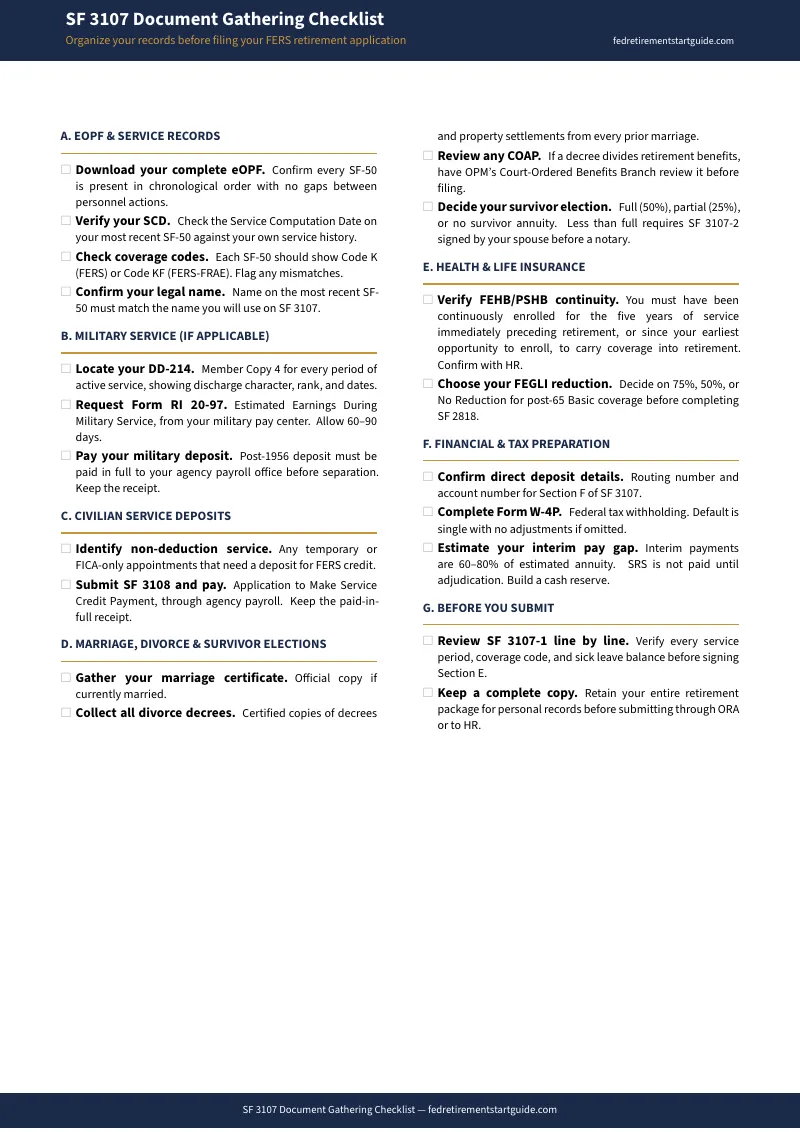
Not ready for the full guide? Download the free SF 3107 Document Gathering Checklist — a structured framework for identifying the records, elections, and supporting documents needed for a FERS retirement package. The full guide is there when you need the complete process.