Life changed after retirement — the survivor election has to change with it
You made a survivor annuity election when you retired — or you didn't, because there was nobody to cover. Then a new marriage happened, or a divorce came through, or the spouse your annuity was protecting died. The election that fit your household at retirement no longer matches your family, and OPM gives you exactly one narrow window to fix it. Miss the deadline, and the option locks shut permanently.
The stakes are not just the pension reduction. Under 5 C.F.R. § 890.303(c), continued FEHB coverage generally depends on Self Plus One or Self and Family enrollment that includes the spouse, and survivor eligibility; a qualifying FERS spouse entitled to a Basic Employee Death Benefit may also qualify. OPM also allows a surviving spouse to continue FEHB when a court-ordered former-spouse survivor annuity prevents the spouse's benefit, if the retiree had Self Plus One or Self and Family coverage. A child who does not qualify for a survivor annuity may qualify for Temporary Continuation of Coverage; eligible children may also have conversion rights. PSHB has related survivor-continuation rules and separate Postal-specific eligibility requirements. That link between the survivor election and health coverage turns every post-retirement family change into an urgent filing decision.
OPM's handbooks explain the rules across hundreds of pages of regulatory text written for benefits administrators. Financial advisors offer guidance, but their revenue comes from selling products. This guide sits in the gap: an independent, plain-language navigator that walks you through every post-retirement scenario, the forms each one requires, and the deposits each one costs — so your family can act before the window closes.
The Post-Retirement Survivor Election Navigator
This is not a financial advisor or a calculator. The Post-Retirement Survivor Election Navigator is a neutral filing framework that takes each life event — marriage, divorce, a spouse's death, an insurable interest relationship — and maps it to the exact deadline, the exact form, the exact deposit calculation, and the exact FEHB or PSHB consequence. It covers both FERS and CSRS rules side by side, because the deadlines are the same but the cost formulas are different.
Most free resources mention the two-year window for a new spouse. They rarely explain that the post-retirement marriage deposit is not a lump sum — it is a permanent actuarial reduction to your monthly annuity that accounts for every unpaid month from the annuity commencing date, or from when a prior reduction ended if applicable, plus 6% annual compound interest. And almost none connect survivor-election decisions to the current-spouse health coverage question: after a retiree dies, continued FEHB or PSHB coverage depends on the spouse's enrollment and survivor eligibility.
What's inside
- Post-retirement marriage election — the two-year window to elect a survivor annuity for a spouse you married after retirement, with worked examples showing how the permanent actuarial deposit is calculated for both FERS (full at 50% and partial at 25%) and CSRS (55% of any elected base, or 50% for separations before October 11, 1962)
- 18-month increase window — the separate window to add or increase coverage for a spouse who was already married to you at retirement, with the deposit and interest requirements that apply under FERS and CSRS
- Divorce and court order adjustments — how to notify OPM after a divorce, what happens when a Qualifying Court Order or COAP awards a former-spouse survivor annuity, the separate two-year current-spouse election window if an entitled former spouse dies or remarries after the marriage, and the steps to redirect the benefit to a current spouse
- Annuity restoration after a spouse's death — how to have your annuity restored to its full unreduced amount after the death of a covered spouse, with the notification letter, required documents, and the new election window that opens if you remarry
- Insurable interest elections — the option for someone who is not your spouse: presumed relationships, non-presumed relationship evidence requirements, the age-difference reduction table (10% to 40%), and the physician health certification OPM requires
- FEHB and PSHB health coverage rules — survivor-annuity and Basic Employee Death Benefit eligibility, the FEHB court-order exception for a surviving spouse, TCC for eligible children, and conversion rights, including related rules for postal retirees under PSHB
- SF 3107-2 spousal consent protocol — how to complete the consent form without triggering an OPM rejection: the same-day notary rule, the no-corrections policy, OPM's submission requirements, and the common errors that cause returned packages
- Actuarial deposit worked examples — step-by-step calculations showing how the retroactive deposit accumulates over 3, 5, and 10 years of unreduced annuity, so you understand the permanent cost before you file
- OPM filing, processing, and appeals — the submission address, required documents, how to check claim status, the reconsideration request when OPM denies an election, and the MSPB appeal path after a final denial
- Deadline and forms reference card — every post-retirement life event mapped to its filing window, the OPM form required, and the supporting documents to include
Who this is for
FERS and CSRS retirees — including postal retirees under PSHB — whose family situation changed after retirement and who need to understand the rules, the costs, and the filing steps for changing a survivor annuity election.
- You married or remarried after retirement and need to elect a survivor annuity within the applicable two-year period
- You're divorced and want to stop paying the survivor reduction — or an entitled former spouse died or remarried after the marriage and you want to check the separate current-spouse election window
- Your covered spouse died and you need to restore your full annuity, or you've since remarried and want to open a new election window
- You want to provide for someone who is not your spouse through an insurable interest election and need to understand the medical evidence and cost
- You need to know whether your surviving spouse will keep FEHB or PSHB after your death — and what to file if the answer is currently no
- You're the adult child or family helper organizing OPM paperwork for a retired parent facing one of these deadlines
Why not free resources?
OPM publishes the rules, and they're accurate. They're also scattered across CSRS/FERS Handbook Chapters 50, 52, and 54, written for agency payroll officers — not for the retiree sitting at the kitchen table trying to figure out how much the deposit will cost and whether the new spouse will keep health insurance.
Free articles and forum posts mention the two-year window and the deposit requirement. Almost none explain that the post-retirement marriage deposit is not a check you write but a permanent reduction to every future annuity payment, calculated from the annuity commencing date (or the day a prior reduction ended) with 6% annual compound interest. And almost none explain how the survivor election and enrollment requirements affect whether the current spouse can continue health coverage.
This guide connects every piece — the deadlines, the deposit math, the forms, the court order rules, and the health coverage link — into a single filing framework that covers each scenario from trigger event to OPM confirmation.
What you get
- The complete guide — 13 chapters covering every post-retirement survivor election scenario: new-spouse marriage windows, the actuarial deposit, spousal consent, divorce and court orders, spouse's death and restoration, the 18-month increase window, insurable interest, FEHB/PSHB continuation, OPM filing and appeals, and worked examples with forms checklists
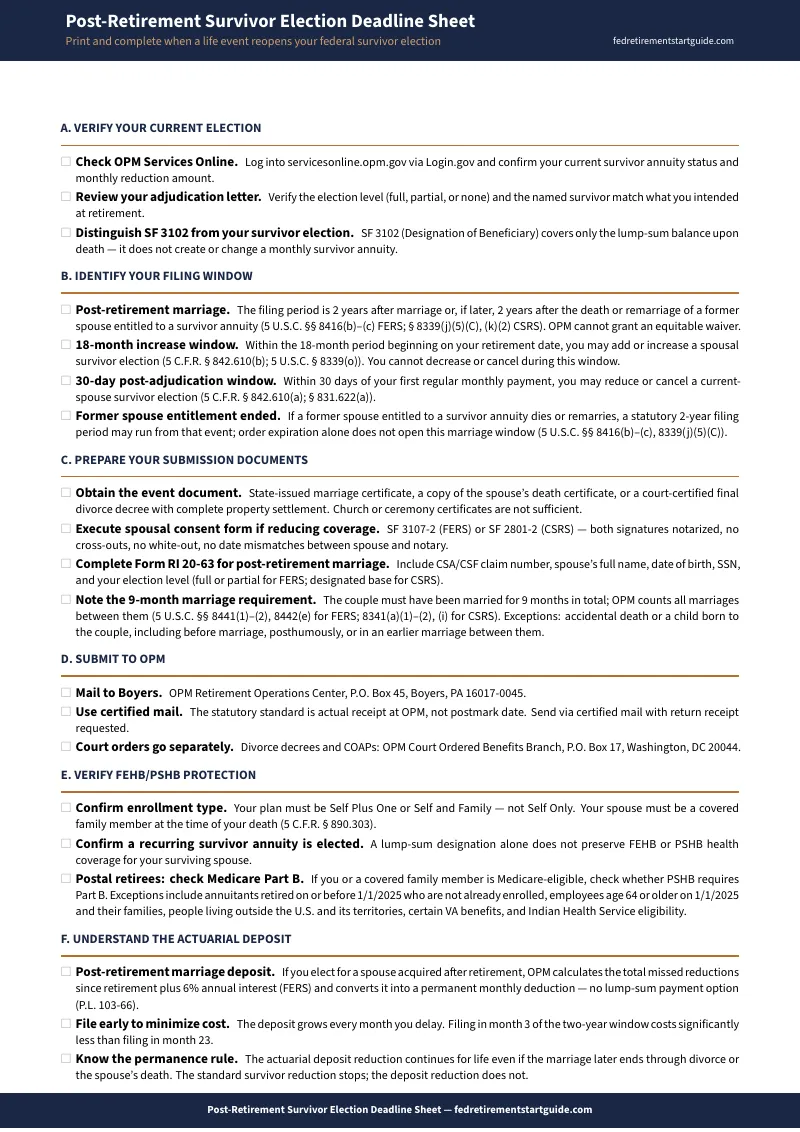
- Post-Retirement Survivor Election Deadline Sheet — a printable reference mapping every life event to its filing window, the form required, and the supporting documents to submit
- 5 fillable planning worksheets — a deposit estimator to project the actuarial reduction before you file, an OPM submission packet checklist for each scenario, a deadline tracker to log every statutory window and confirmation, a former-spouse court order audit, and an FEHB/PSHB continuation verification sheet
Satisfaction guarantee
If the guide doesn't give you what you need to understand and file your post-retirement survivor election change, email [email protected] for a full refund. No forms, no time limit.
Protect the coverage before the window closes
Download the free deadline sheet to see which life events open or close a survivor-election window, with the deadline and the form for each. When you're ready to understand the deposit calculations, the court order rules, and the health coverage link that makes all of it urgent — the full guide walks you through every step.
The free checklist tells you which window applies and what form you need. The full guide explains the costs, the filing steps, and the health insurance consequences — so you act before the deadline closes and your family's coverage is decided by default.
Frequently Asked Questions
What if the rules change after I buy?
We update the guide when the rules change. Email us any time, even years later, and we'll send you the current edition free.