Two agencies. Two payment systems. One form that decides everything.
OWCP sends you Form CA-1105 and asks you to pick: keep your FECA wage-loss compensation, which is exempt from federal income tax, or switch to an OPM retirement annuity. The form itself is short. The consequences are not. Your health insurance, life insurance, service credit, TSP, and long-term financial trajectory all change depending on which box you check — and the two agencies that run these programmes will not explain each other's rules to you.
OPM cannot tell you how OWCP calculates wage-loss compensation. OWCP cannot tell you what your OPM annuity would be. Neither one will walk you through what happens to your FEHB premiums during the transition, how qualifying OWCP periods can affect your eventual annuity computation, or how to time the effective date on the election form to avoid an overpayment notice. The gap between these two agencies is where federal employees lose money — not from choosing the wrong programme, but from not understanding the mechanics of the switch.
The Cross-Agency Election Workbook
The Federal Employee's Election Guide is a structured administrative workbook that covers both OWCP and OPM in one document — the dual-benefit bar, the election procedure, the financial comparison, the insurance transfer, and the overpayment defence — in the order the process actually unfolds. It is the cross-agency reference that neither OPM nor OWCP publishes.
It is not legal advice, it is not financial advice, and it is not affiliated with OPM, DOL, USPS, or any federal agency. It is the process navigation tool that organises both agencies' rules into comparison guidance, timelines, and record-tracking steps you can apply to your own case.
What's Inside
- The dual-benefit bar explained — what 5 U.S.C. § 8116(a) actually prohibits and what it permits, including the schedule award exception under § 8107 for injuries on or after 13 September 1957, which many HR offices and claims examiners get wrong
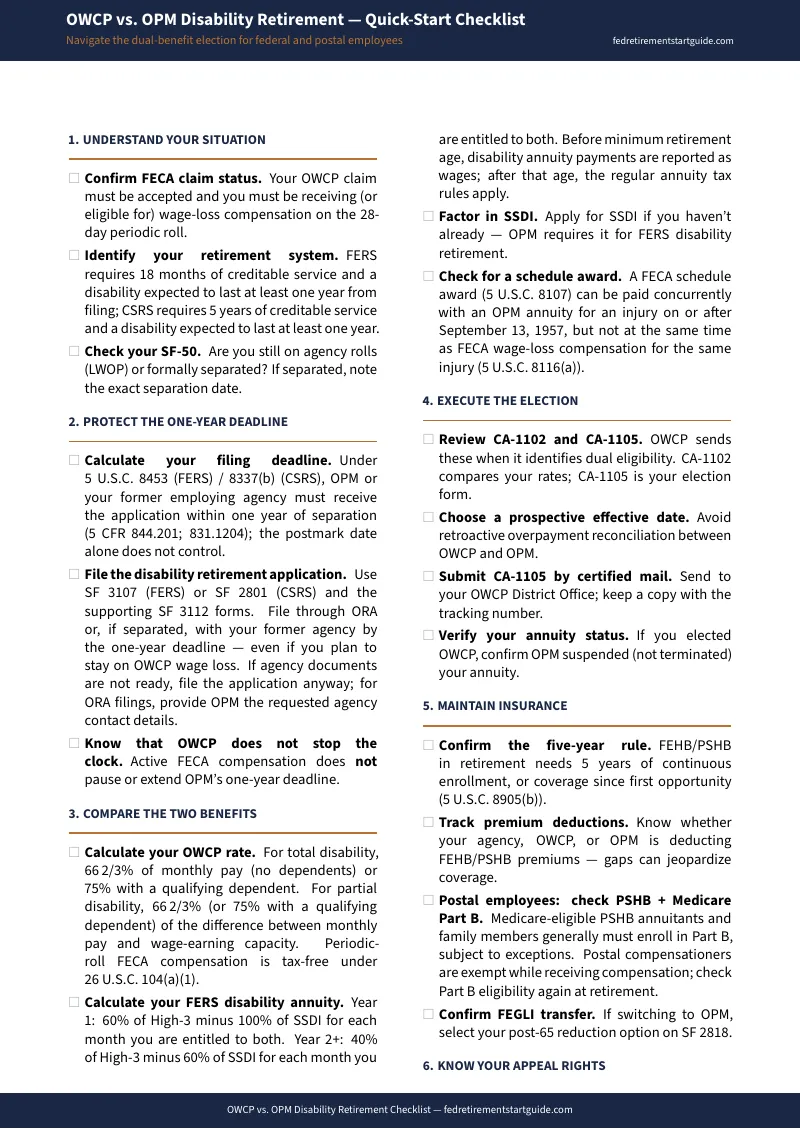
- Form CA-1105 walkthrough — how to complete the election form, what effective date to enter, how the statutory election period under 5 U.S.C. § 8116(b) works, and why getting the date wrong triggers retroactive overpayment assessments from OWCP
- Side-by-side financial comparison — for total disability, OWCP pays 66⅔% of the monthly pay rate (75% with a qualifying dependent); for partial disability, those percentages apply to the difference between monthly pay and wage-earning capacity. FECA compensation is exempt from federal income tax, and COLAs apply when disability occurred more than one year before March 1. For FERS disability annuitants under 62 who are not eligible for immediate voluntary retirement, OPM pays 60% of High-3 for the first 12 months, then 40% through age 62, less 100% then 60% of Social Security disability benefits for months of concurrent entitlement; the earned annuity is the floor. The guide includes worked examples so you can compare using your own figures
- Insurance Continuity Checklist — health coverage may continue under OWCP or OPM subject to each program's participation rules; FEGLI has separate continuation and retirement eligibility rules. The printable checklist tracks your enrolment dates, five-year rule compliance, premium switchover, and FEGLI option changes so nothing falls between the agencies during the transition
- Service credit, TSP, and the 1% enhancement — how qualifying OWCP periods before the separation that makes you eligible for an annuity can count toward service credit and High-3, why no retirement deductions are withheld from OWCP compensation, and how Public Law 108-92 provides a separate 1% annuity enhancement for qualifying periods in a regular annuity computation
- One-year filing deadline protection — the deadline for disability retirement under 5 U.S.C. § 8453 runs regardless of whether you are on OWCP. The guide covers the protective filing strategy for securing that deadline without being forced to elect immediately
- Switching later — the circumstances under which you can change from OWCP to OPM or from OPM back to OWCP, with the procedural steps and timing rules for each direction
- Overpayment defence and Agency Communication Log — ECAB case history shows that OWCP has assessed overpayments when OPM had not actually disbursed an annuity for the same period. The printable log is where you record every letter, call, and certified-mail tracking number — the documentation that matters if an overpayment is later assessed
The paid download includes eight PDFs: the 13-chapter guide, the 25-item checklist, and six printable planning tools:
- owcp-opm-financial-comparison-worksheet.pdf — OWCP vs. OPM Financial Comparison Worksheet: pay rate, FECA percentage, High-3, SSDI, taxes, and insurance premiums
- election-timeline-tracker.pdf — Election Timeline Tracker: dates from injury through CA-1105 and payment changes
- agency-communication-log.pdf — Agency Communication Log: calls, letters, and certified mail tracking numbers
- insurance-continuity-checklist.pdf — Insurance Continuity Checklist: FEHB/PSHB enrolment, five-year rule, FEGLI, and premium source
- earnings-monitoring-worksheet.pdf — Earnings Monitoring Worksheet: OWCP, OPM, and SSA earnings thresholds
- one-year-filing-deadline-calculator.pdf — One-Year Filing Deadline Calculator: compute the deadline from your SF-50 separation date
Who This Is For
You received Form CA-1105 and need to respond. OWCP has identified that you are eligible for or receiving an OPM annuity, and you have a response date. The guide walks through the financial comparison, the insurance implications, and how to complete the form with an effective date that does not trigger an overpayment — in time for your deadline.
You are weighing OWCP wage loss against OPM disability retirement. You have an accepted OWCP claim and someone has mentioned that you could also file for disability retirement. The guide gives you both agencies' rules in one place — what each pays, the tax treatment, the insurance, the service credit — so you can compare without guessing.
You are separated and the one-year filing deadline is running. Your agency separated you while you were on OWCP, and you may not want to elect OPM right now, but you need to protect the right to elect later. The guide covers the protective filing strategy that secures the deadline without forcing the election.
You are a postal employee navigating PSHB. Postal workers on OWCP face the same election as other federal employees, plus the Postal Service Health Benefits programme that replaced FEHB for postal workers from January 2025. The guide covers Part B requirements for certain Medicare-eligible annuitants and family members, subject to exceptions. Postal compensationers do not have to enroll in Part B while receiving compensation but may need it at retirement.
You are helping a family member. Your spouse or parent is injured and overwhelmed. You can research, organise documents, and prepare comparison notes — but the election form requires the employee's signature. The guide gives you the structured framework to help without crossing legal boundaries.
Why Free Resources Fall Short
OPM's CSRS/FERS Handbook Chapter 102 covers the relationship between annuities and workers' compensation from OPM's side. It does not explain OWCP's election procedure, Form CA-1105, the FECA compensation rates, or how to time the transition. Reading Chapter 102 alone is like getting directions to a city but not a specific address.
DOL's FECA Procedure Manual tells claims examiners how to process elections. It does not explain what an OPM annuity pays, how the SSDI offset works, or what happens to your insurance when you switch. The manual is comprehensive for OWCP, silent on OPM.
Federal disability law firms publish comparison articles designed to convert readers into retainer clients. Attorneys are essential if you are contesting an overpayment at ECAB or appealing a denial at MSPB. For the administrative task of understanding the election and completing the form, the guide covers the same procedural ground at a fraction of the cost.
Federal employee forums routinely confuse schedule awards with wage-loss compensation, misstate the dual-benefit bar, or reference policies that have changed. The guide consolidates current rules from both agencies into one structured document with 2026 figures.
100% Satisfaction Guarantee
If the guide does not give you a clear, structured path through the OWCP/OPM election, email [email protected] for a full refund, no time limit.
Stop Guessing. Start Comparing.
The election form is simple. The decision behind it is not — it affects your income, your insurance, your service credit, and your options for decades. The guide puts both agencies' rules on the same page, with formulas and worked examples to compare the numbers and guidance to manage the transition.
Get the full Election Guide — — and understand both sides of the decision before you sign CA-1105.
Not ready for the full guide? Download the free OWCP and OPM Annuity Comparison Worksheet — a side-by-side framework for setting out what each programme would pay and the questions to ask OWCP and OPM.
This guide is an independent administrative workbook. It is not legal, financial, tax, or medical advice and is not affiliated with, sponsored by, or endorsed by OPM, DOL, OWCP, USPS, SSA, or any government agency.
Frequently Asked Questions
What if the rules change after I buy?
We update the guide when the rules change. Email us any time, even years later, and we'll send you the current edition free.