
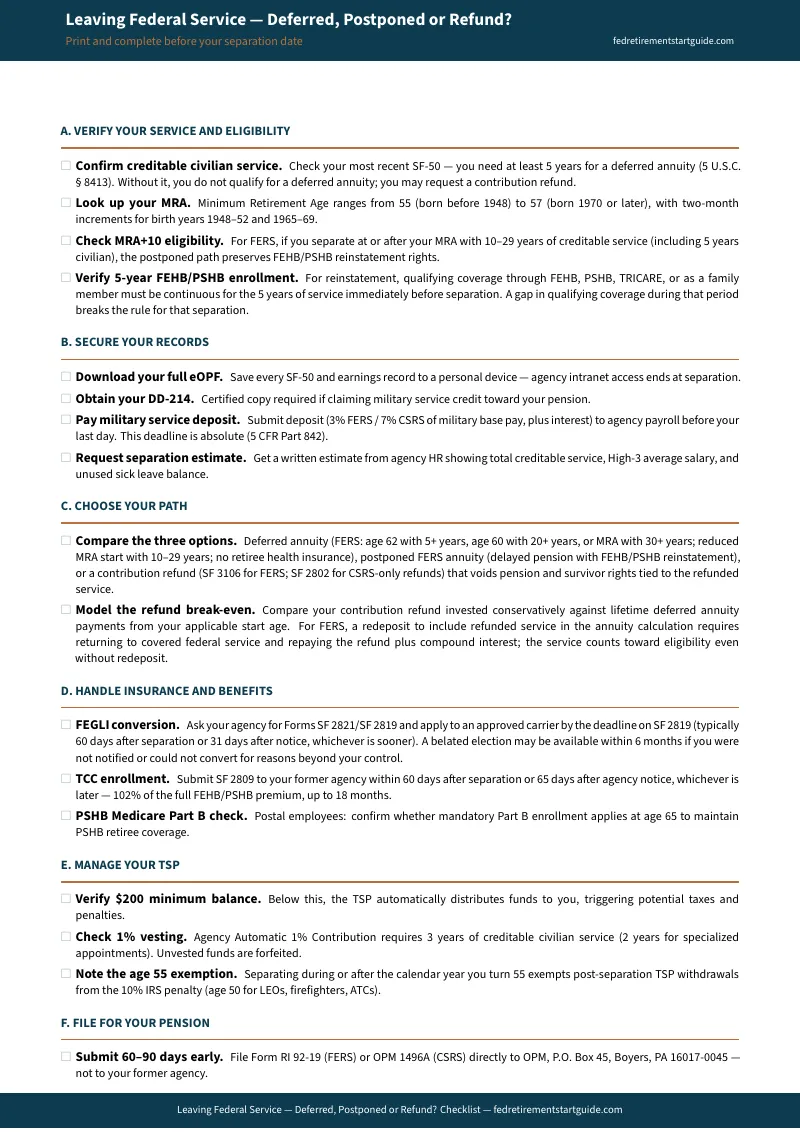
You're resigning from federal service. The paperwork on your desk could cost you a pension — or preserve it.
Your agency HR office hands you the exit packet: the SF-50 separation action, the FEHB election form, the TSP notice — and Standard Form 3106, the application to cash out every dollar you contributed to your federal retirement. Sign it, mail it, and a check arrives in a few weeks. Clean break.
Except it isn't clean. That refund permanently voids your right to a FERS annuity. It voids your spousal survivor benefit. It voids any possibility of re-enrolling in FEHB when you're 62 and the premiums on the open market are three times what the government was subsidizing. And if you ever come back to federal service, undoing the refund means repaying the full amount plus compound interest — a bill that grows every year you're gone.
The alternative — leaving your contributions in the fund and claiming a deferred annuity later — is barely explained in the exit packet. Nobody tells you that deferred retirement permanently forfeits your health insurance. Nobody distinguishes it from postponed retirement, which preserves FEHB re-enrollment. Nobody gives you the Form RI 92-19 walkthrough you'll need in 15 or 20 years when you're finally eligible to claim.
The Separation Decision Engine
The Leaving Federal Service Early guide puts all three separation paths — deferred retirement, postponed retirement, and the SF 3106 contribution refund — side by side in a single comparative framework with the eligibility rules, benefit trade-offs, form instructions, and long-term financial consequences of each one. It replaces the scattered OPM chapters, the contradictory forum advice, and the exit-briefing handout that covers immediate retirements but skips early separations.
What's Inside
The Three-Path Decision Framework — because each path permanently changes what you keep and lose. Deferred retirement: unreduced annuity at 62 (or 60 with 20+ years), but FEHB is gone forever after TCC expires. Postponed retirement: eliminates the 5% per-year MRA+10 age penalty and preserves FEHB re-enrollment, but requires reaching your Minimum Retirement Age with 10+ years of service. SF 3106 refund: your contributions back as a lump sum, but all annuity rights, survivor protection, and future health coverage are voided permanently.
Refund vs. Deferred Annuity Comparison Calculator — because the refund looks like found money until you run the numbers. The printable worksheet walks through the actual calculation: your employee contributions, the interest component (if you served more than one year), the 20% mandatory federal tax withholding on interest, the rollover option to an IRA or 401(k), and the break-even timeline comparing a lump sum invested privately against a guaranteed inflation-adjusted pension starting at 62. It also covers the Form SF 3106A spousal notification — your spouse must sign before OPM processes the refund, because it voids their survivor annuity.
MRA+10 Penalty Calculator — because the permanent age reduction is the most expensive mistake in early separation. The penalty is 5% for each full year under 62 (calculated as 5/12ths of 1% per month). The guide includes the month-by-month calculation, the break-even comparison between taking the reduced annuity immediately and postponing for the full unreduced amount, and the critical health insurance difference — postponed retirees can re-enroll in FEHB or PSHB at annuity commencement; immediate MRA+10 retirees keep continuous coverage.
FEHB Coverage Bridge Worksheet — because health coverage is the benefit most people underestimate until it's gone. The printable tracker and the guide cover the 31-day free extension, the 18-month TCC election at 102% of the full premium, the 5-year continuous enrollment rule, and the permanent loss of re-enrollment under deferred retirement. For postal employees, it addresses the PSHB program launched January 2025 and the mandatory Medicare Part B enrollment that applies to Medicare-eligible postal annuitants.
TSP Preservation Checklist — because your Thrift Savings Plan is the one benefit that survives every separation path. The printable checklist and the guide cover the $200 minimum balance requirement, interfund transfer rights across the G, F, C, S, and I Funds, partial and full withdrawal options, the Rule of 55 for penalty-free access, and the direct rollover process to an IRA or new employer plan.
FEGLI Conversion Timeline — because the 31-day window is absolute. Group life insurance continues without cost for 31 calendar days after your last day in pay status. Within that window, you can convert to an individual whole-life policy through an approved private carrier — no medical underwriting required. Miss it, and the option is gone. The guide covers Forms SF 2821 and SF 2819 and the conversion election process.
RI 92-19 Application Prep — because you will need this form 10, 15, or 20 years from now and your former agency will not help you fill it out. The printable packet plus the guide cover every field of the Application for Deferred or Postponed Retirement, including Schedule A (spousal consent), the 60-to-90-day filing window, submission to OPM Boyers, and the documentation you'll need to gather years after leaving (SF-50 service history, eOPF records, DD-214 for military credit).
Updated for Current Law — The Social Security Fairness Act, signed January 5, 2025, repealed both the Windfall Elimination Provision and the Government Pension Offset. If your separation financial plan assumed those provisions would reduce your Social Security, the math has changed. The guide integrates the repeal and covers the PSHB program that replaced FEHB for postal employees starting January 1, 2025.
Who It's For
- Federal employees with 5–9 years of service resigning for a private-sector job, a move, or caregiving — you're vested in a pension, and the choice between cashing out and keeping it is the most consequential financial decision in your exit packet
- Mid-career employees with 10–24 years of service leaving before their Minimum Retirement Age — you have substantial service but the deferred vs. postponed distinction, the FEHB rules, and the age-penalty math are more complex at this stage
- MRA+10 employees choosing between a reduced immediate annuity and postponement — the penalty calculation and the health insurance re-enrollment difference between the two paths are worth getting right
- Former federal employees approaching 60 or 62 who need to claim their deferred annuity — the RI 92-19 walkthrough, the OPM Boyers filing process, and the record-retrieval steps for legacy claimants who left years or decades ago
- Spouses of separating federal employees — because the SF 3106 refund voids the survivor annuity, and the Form SF 3106A spousal notification is a legal requirement, not a courtesy
Why Not Free Resources?
OPM's website scatters the rules across 14 separate handbook chapters, pamphlet PDFs, and FAQ pages. The deferred retirement rules are in one chapter. The postponed retirement rules are in another. The SF 3106 instructions are a third. The FEHB rules for separated employees are a fourth. None of them cross-reference each other, and none of them present the three options side by side.
Agency HR exit briefings focus on immediate retirements — the kind where someone is old enough to walk out the door and start collecting. If you're leaving early, HR hands you the SF 3106 and explains how to cash out. They may not explain that deferred retirement exists, that postponed retirement preserves health insurance, or that Form RI 92-19 is a different document from the SF 3107 immediate retirement application.
Reddit and federal employee forums are full of people who took the refund five years ago and want to know if they can get it back, or who claim FEHB continues into deferred retirement (it doesn't), or who confuse the MRA+10 immediate annuity penalty with a deferred annuity reduction (it's a separate calculation). Sorting the accurate posts from the wrong ones requires the same expertise that writing them does.
Financial advisor blogs explain individual rules clearly. Their business model is managing your TSP rollover — 1% annually on a $300,000 balance is $3,000 every year for the rest of your post-federal career. The blog is a lead funnel, not a standalone filing guide.
Full Refund, No Time Limit
If the guide doesn't help, email [email protected] for a full refund. No time limit, no questions, no forms to fill out.
One Download. Every Step From Resignation Through Annuity Claim.
The guide costs — once, no subscription, no annual management fee. It includes the 47-page guide, the side-by-side checklist, and ten printable worksheets: the Separation Decision Worksheet, Benefits Retention Checklist, Pre-Separation Timeline Planner, Refund vs. Deferred Annuity Comparison Calculator, Agency Communication Log, MRA+10 Penalty Calculator, TSP Preservation Checklist, FEGLI Conversion Timeline, FEHB Coverage Bridge Worksheet, and RI 92-19 Application Prep. One download. Every step from your resignation date through the day you file for your annuity.
Not ready for the full guide? Download the free Leaving Federal Service — Deferred, Postponed or Refund? Checklist — a side-by-side comparison of what you keep and lose under each path, with the key deadlines and forms. It's enough to see which option fits your situation.