OPM Doesn't Coordinate Your Withholding. Neither Does Anyone Else.
You're about to go from one employer withholding your taxes to three separate agencies — OPM, the TSP recordkeeper, and SSA — each applying its own default withholding rules without talking to each other.
OPM defaults your annuity withholding to single with no adjustments. The TSP withholds 20% on lump-sum distributions but only 10% on periodic payments. SSA withholds nothing unless you file a separate form. And none of them accounts for what the others are taking out.
Meanwhile, the health insurance premiums that were pre-tax during your career are now post-tax — silently raising your adjusted gross income, which pushes more of your Social Security into the taxable range and can trigger Medicare IRMAA surcharges you didn't see coming.
The result? Federal retirees who planned carefully for decades get blindsided by a tax bill in their first April after separation — not because they did something wrong, but because nobody mapped out how these systems interact.
The Federal Retirement Tax Coordination System
This toolkit is built around a single organizing principle: every income stream you'll collect in retirement has its own agency, its own forms, its own withholding defaults, and its own set of decisions that need to be made in a specific order. The guide walks through all of them — not as tax advice, but as an administrative map that shows you exactly what each agency expects, when it expects it, and where the coordination gaps are.
It's the reference you take to your CPA so you're paying them to solve your actual tax questions — not to research which form controls OPM's state withholding election or why your 1099-R shows a distribution code you don't recognize.
What's Inside the Toolkit
- FERS and CSRS Annuity Tax Mechanics — The IRS Simplified Method broken down step by step, including how to find your cost basis on your OPM finalized annuity statement and what happens to the tax-free portion when your expected payments run out.
- TSP Distribution and Rollover Tax Map — How each withdrawal type (single payment, installments, annuity purchase, in-service, hardship) is taxed differently, what mandatory withholding applies to each, the Roth ordering rules, and the state-level traps that can cost you your pension exemption if you roll TSP funds into a commercial IRA.
- Social Security Taxation and the WEP/GPO Repeal — The provisional income formula that determines whether 0%, 50%, or 85% of your benefits are taxable, how to coordinate voluntary withholding via Form W-4V, and what the January 2025 Social Security Fairness Act repeal of WEP and GPO means for CSRS and CSRS-Offset retirees — including how retroactive payments are reported and taxed.
- OPM Interim Pay Explained — What happens during the processing gap when OPM withholds only federal income tax, why your health and life insurance premiums accumulate as a debt, and how to avoid the cash flow shock when OPM deducts four months of premiums from your first regular payment.
- 50-State Federal Pension Tax Directory — State-by-state coverage of how FERS and CSRS annuities, TSP distributions, and Social Security benefits are treated, with key examples like Maryland's pension exclusion (and how rolling TSP into an IRA disqualifies it), North Carolina's Bailey exclusion, New York's full exemption, and Wisconsin's recent CSRS parity fix.
- PSHB Transition for Postal Employees — Medicare Part B enrollment mandates, exceptions, how PSHB premiums are withheld from your annuity, and what happens if you miss the enrollment deadline.
- Withholding Coordination Walkthrough — A system for aligning W-4P (annuity), W-4R (TSP), and W-4V (Social Security) withholding so the total deducted across all three payers matches your actual tax liability — not just what each agency defaults to.
- First-Year Filing Walkthrough — How to handle the split-year return when you have both a final W-2 and your first 1099-R, where CSRS contribution recovery goes on Schedule 1, and a checklist for verifying every figure against source documents before filing.
The Complete Toolkit
- guide.pdf — The full navigation guide: 11 chapters covering every income stream, form, and withholding decision, plus a 50-state tax directory and agency contact reference.
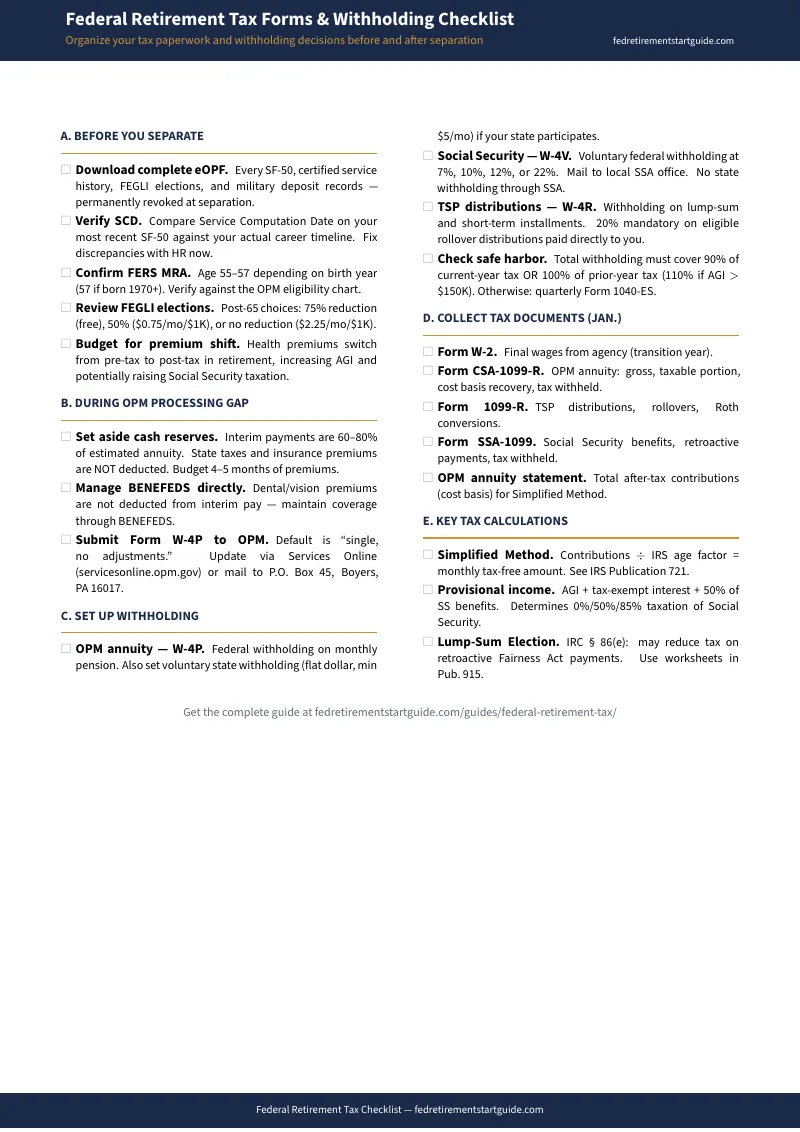
- checklist.pdf — A 24-item pre-retirement tax checklist organized across seven sections: records before separation, the OPM processing gap, withholding setup, January tax documents, key calculations, TSP rollover checks, and PSHB tasks for postal employees.
- simplified-method-worksheet.pdf — Fill-in Simplified Method calculation for the tax-free portion of each OPM annuity payment.
- provisional-income-worksheet.pdf — Fill-in worksheet for the Social Security taxable-percentage estimate.
- first-year-withholding-coordination-worksheet.pdf — Multi-payer withholding vs.\ IRS safe-harbor check.
- tax-forms-tracker.pdf — Incoming 1099/W-2 log and W-4P / W-4R / W-4V / TSP-44 filing tracker.
- interim-pay-cash-flow-worksheet.pdf — Premium reserve and cash-bridge math for the OPM processing gap.
- state-tax-treatment-worksheet.pdf — Your state's treatment of each income stream, plus a move-to comparison.
- withholding-election-worksheet.pdf — W-4P, W-4R, and W-4V elections to record before you submit them.
- pshb-medicare-decision-worksheet.pdf — Part B mandate / exception check and IRMAA exposure (postal households).
- tsp-rollover-state-tax-worksheet.pdf — Whether leaving money in the TSP keeps a state exemption.
- first-year-filing-prep-worksheet.pdf — Documents to gather, numbers to verify, and CPA questions.
Who This Toolkit Is For
Federal employees and postal workers who are one to five years from retirement and want to understand the tax mechanics before sitting down with a tax professional. Also for recent retirees navigating their first post-separation tax season — especially those on interim pay who've discovered that OPM's defaults don't match their actual withholding needs.
This applies whether you're under FERS, CSRS, or CSRS-Offset. Each system has different contribution recovery rules, different COLA formulas, and different interactions with Social Security. The guide covers all three.
Why Not Just Use Free Government Sources?
OPM publishes accurate annuity rules. TSP.gov publishes accurate distribution rules. SSA publishes accurate benefit formulas. And none of them tells you what happens when you stack all three income streams on the same tax return.
IRS Publication 721 explains the Simplified Method — but doesn't mention that rolling your TSP into a commercial IRA can strip your pension income of its state tax exemption in Maryland, North Carolina, and New York. The TSP withdrawal page explains withholding rates — but doesn't warn you that periodic TSP payments use W-4P withholding while nonperiodic payments use W-4R, and confusing them means OPM doesn't get the election you intended.
This toolkit connects the systems that the government explains separately. It's not smarter than OPM or the IRS — it just reads all of their publications so your CPA doesn't have to bill you for the hours it takes to piece them together.
Satisfaction Guarantee
If the toolkit doesn't help you organize your retirement tax records and prepare for a more productive meeting with your tax professional, email us for a full refund. No forms, no waiting period, no questions about how far you got.
Start with the free checklist to see if the approach fits how you think about retirement planning. When you're ready for the full map, the complete toolkit is waiting — for less than the cost of fifteen minutes with a CPA.