Your Approval Was the Beginning — Not the End
You fought for your FERS disability retirement and won. But OPM did not hand you a clean break. It handed you a new set of rules — an annual earnings survey, an income ceiling based on your former position's current pay rate, medical re-evaluations that arrive without warning, and a formula change at 62 that most annuitants do not see coming until OPM recalculates their check.
If OPM does not receive a required earnings report by the deadline on the form, it may stop payments until it receives the report. If you are under 60 on December 31 and your post-retirement wages or self-employment income earned that calendar year reach at least 80% of your former position's December 31 basic pay, your annuity ends the following June 30. OPM can recover amounts paid for periods after termination unless it finds you were without fault and repayment would be against equity and good conscience. Fail to respond to a medical review? OPM suspends your annuity until you establish continuing eligibility.
The rules are public. They are scattered across Title 5 of the U.S. Code, 5 C.F.R. Part 844, a Handbook chapter last substantially revised in 1998, and a trail of Benefits Administration Letters that update it. Nobody hands you a summary when you are approved.
The Post-Approval Compliance System
This guide pulls every post-approval rule into one place and turns it into something you can actually follow. It is built for FERS disability annuitants — not applicants, not regular retirees, not people trying to decide whether to apply. It starts where the approval letter stops and covers the administrative life of the annuity from month one through the age-62 recalculation.
What makes it different from reading OPM's website: the guide connects the rules to your calendar. It tells you what OPM will ask, when it arrives, what counts (and what does not), and what happens if you get it wrong — with worked examples plus eight fillable PDFs (earnings log, pay-rate tracker, Form RI 30-2 worksheet, medical-review checklist, correspondence log, yearly calendar, earning-capacity timeline, and age-62 verification sheet).
What's Inside
- The 80% Earnings Limit Explained — For disability annuitants under 60 on December 31, OPM compares post-retirement income earned during that calendar year against the current basic pay rate of the former position on December 31. Post-retirement W-2 wages and self-employment income calculated under OPM's rules count. OPM counts income in the year earned, even if payment is deferred. Investment income, TSP withdrawals, VA disability compensation, Social Security, and workers' compensation do not. The guide walks through the calculation with dollar examples. Print the Annual Earnings Tracking Log and the Former Position Pay Rate Tracker to record income and each year's 80% ceiling.
- Form RI 30-2 — Step by Step — The annual earnings survey goes to disability annuitants who are under 60 on December 31. The guide explains every field, covers the self-employment income rules, tells you what to do if you earned nothing (yes, you still file), and lays out what happens if you miss the deadline. The Form RI 30-2 Field Worksheet is where you assemble the numbers before you file.
- Medical Re-Evaluations — OPM can request updated clinical documentation at any time before you turn 60. The guide covers how to organize evidence requested in OPM's letter, who pays for medical exams, what happens if you fail to cooperate, and how recovery findings work. Use the Medical Review Documentation Checklist when the letter arrives.
- Restored Earning Capacity & the June 30 Timeline — If your calendar-year income reaches the 80% limit while you are under 60 on December 31, your annuity runs through June 30 of the following year. The guide maps the timeline, explains reinstatement if your income later falls below 80% while you remain medically disabled and are not reemployed in a FERS-covered position, and covers what happens to your FEHB and FEGLI during the transition. The Restored Earning Capacity Timeline is the fill-in date sheet.
- COLAs for Disability Annuitants — FERS disability annuities under the standard 60/40 formula receive cost-of-living adjustments after the first 12 months, effective in December and paid in January. If you meet the age and service requirements for an immediate FERS annuity, eligible COLAs begin from your annuity's commencing date. The guide covers how partial-year proration works for the first COLA and how the "diet COLA" cap applies.
- The Age-62 Recalculation — If you were not eligible for immediate voluntary retirement when your disability annuity began, OPM recomputes it at 62 as if you had worked continuously to 62. Your disability years count as creditable civilian service, your high-3 is increased by the COLAs paid during those years, and the SSDI offset ends. For you, this is the moment the formula changes permanently. The guide shows how the recalculation works; the Age-62 Recomputation Verification Sheet is where you compare OPM's notice to your estimate.
- Federal Reemployment — Returning to federal service triggers dual compensation rules and a potential salary offset. The guide explains how reemployment affects the annuity, what happens to your disability status, and the distinction between temporary and permanent appointments.
- FEHB, FEGLI & TSP — Keeping your health insurance, life insurance, and retirement savings while on the disability rolls — enrollment rules, premium payments, and what changes at 62.
- Overpayments & Appeals — If OPM determines you were overpaid, the guide covers reconsideration, MSPB appeal timelines, and waiver requests — without ever telling you what to decide.
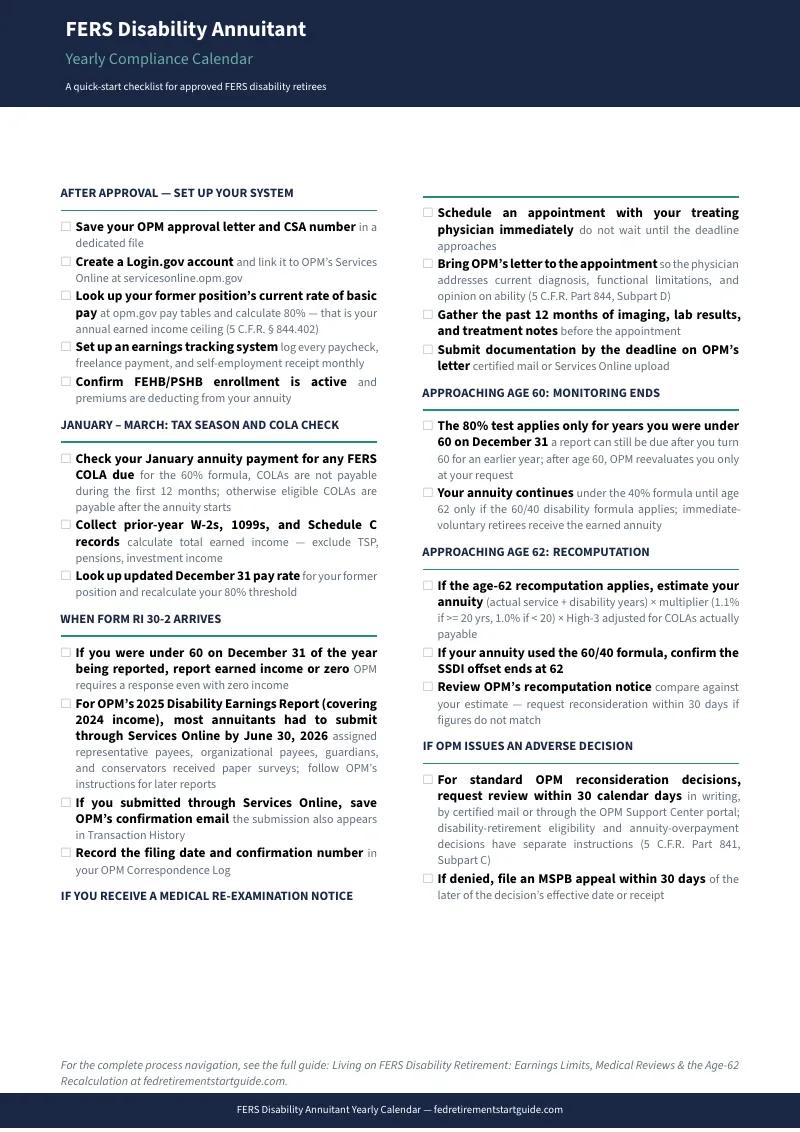
- Yearly Compliance Calendar — Every survey, review window, COLA announcement, and pay-table update mapped to the calendar year, with write-in dates and tracking numbers. Keep submissions in the OPM Correspondence Log.
Who It's For
- Approved FERS disability retirees under 62 who want to understand and follow the rules attached to their annuity — whether they are newly approved or years into it.
- Spouses and family members who help manage OPM correspondence, track deadlines, and handle household finances around the annuity.
- Annuitants working or thinking about working — in private employment, self-employment, or a return to federal service — who need to understand the 80% threshold and dual compensation rules before they accept a paycheck.
- Annuitants approaching 62 who want to understand the recalculation before OPM sends the new number.
Why Not Just Read OPM's Website?
You can. Everything in this guide is based on public law, public regulation, and OPM's own publications. The question is whether you want to piece it together yourself.
OPM's Disability Earnings Report FAQ answers a few questions. The CSRS/FERS Handbook Chapter 60 covers eligibility — OPM lists its current copy as dated December 2023, and the current rules still require cross-referencing Benefits Administration Letters that update it. The regulations in 5 C.F.R. Part 844 are dense legal text written for agency adjudicators, not for the people whose checks depend on them. Forum threads on Reddit and federal employee boards are full of helpful people sharing conflicting interpretations of the same rules.
This guide compiles the current rules from their primary sources, strips the legal language, and organizes them around the events that actually trigger action — the survey in the mailbox, the medical review letter, the job offer, the 62nd birthday. It saves you the cross-referencing and gives you working tools to track your compliance year by year.
What This Guide Is Not
This is process navigation — not financial advice, not tax advice, not legal advice, and not medical advice. It explains how the rules work and what evidence OPM requests. It does not tell you whether to take a job, how to invest your TSP, whether to file an appeal, or what to say to a physician. Those decisions belong with you, a licensed professional, or your union representative.
This guide is not affiliated with OPM, the TSP, USPS, the Department of Defense, the VA, the Social Security Administration, MSPB, or any labor union. Free official resources are referenced throughout.
Satisfaction Guarantee
Full refund, no time limit. If the guide does not help you, email [email protected] and we will refund the full amount — no questions, no deadline.
Download the free checklist to see the yearly calendar of surveys, reviews, and deadlines. If you want the full guide — every chapter, every worked example, every compliance tool — it is yours for .
Frequently Asked Questions
What if the rules change after I buy?
We update the guide when the rules change. Email us any time, even years later, and we'll send you the current edition free.