One form controls your spouse's pension and health insurance — forever
You've spent decades in federal service. Your retirement paperwork is thick, your HR briefing was dense, and somewhere inside SF 3107, Section D asks you to make a single election that permanently determines three things: how much your monthly pension is reduced, whether your spouse receives a continuing annuity after you die, and whether your spouse keeps access to FEHB or PSHB health coverage.
That third point is the one most federal families underestimate. If you elect no survivor annuity, your surviving spouse is permanently barred from the federal health benefits program. Not suspended. Not appealable. Permanently terminated at midnight on the date of your death, with only a 31-day extension as a fallback.
The election is irrevocable once OPM finalizes your retirement. And as of mid-2026, OPM's processing backlog averaged 109 days. If your forms contain errors — a scratch-out, a date mismatch, a missing notary seal — they go back to the bottom of the queue while you sit on interim pay.
The Survivor Election Decision Framework
This is not a financial advisor selling you insurance. It is not a calculator that asks for two numbers and hands back one. The FERS Survivor Benefit Election Guide is a neutral decision framework that walks your entire household through the structural consequences of each election — so you and your spouse can evaluate the costs, the healthcare implications, and the family dynamics together, without the pressure of a sales pitch or the complexity of OPM regulatory language.
Most online resources explain the 10% and 5% pension reductions. They rarely explain that the survivor election also controls your spouse's lifetime health insurance eligibility — or that a former-spouse court order you filed twenty years ago may have already allocated part of the benefit. This guide connects every dimension of the decision into a single, structured process.
What's inside
- The three elections, deconstructed — maximum (10% reduction, 50% spousal payout), partial (5% reduction, 25% payout), and none (no reduction, no payout, no health coverage for your surviving spouse). Each one analyzed for its pension cost, its healthcare consequence, and its consent requirements
- The healthcare link, explained in full — the two statutory requirements your surviving spouse must meet to keep FEHB or PSHB coverage, the 5-year enrollment rule, the Self Plus One requirement, and the PSHB Medicare Part B mandate for postal retirees ($202.90/month in 2026)
- SF 3107-2 walkthrough — how to complete the spousal consent form without triggering an OPM rejection. The same-day notary timing rule, the no-corrections policy, and the Remote Online Notarization digital seal warning that causes rejections when the PDF is printed and rescanned
- Former-spouse court order audit — how to determine whether OPM has a qualifying court order on file, how a court-ordered former-spouse survivor annuity reduces what's available for your current spouse, the QDRO trap (OPM doesn't accept QDROs — they require specific federal language), and same-sex marriage recognition rules
- Pension maximization analysis — the insurance industry pitch to waive the survivor annuity and buy private life insurance instead, and the three structural risks that cause this strategy to fail federal families: the permanent loss of FEHB healthcare, the inflation vulnerability of fixed death benefits versus COLA-adjusted annuities, and the underestimation of true life insurance costs for applicants in their late 50s and 60s
- Beneficiary form separation grid — why naming your spouse as a TSP beneficiary (TSP-3) or FEGLI beneficiary (SF 2823) does nothing for the FERS pension survivor annuity or health insurance eligibility, and how to audit all four forms together
- Social Security coordination after WEP/GPO repeal — confirming your spouse's Social Security estimate reflects the January 2025 repeal and filing SSA-561 if retroactive benefits were capped at six months
- TSP survivor planning under SECURE 2.0 — in-plan Roth conversions (effective January 2026), the mandatory Roth catch-up rule for high earners, RMD starting ages (73 or 75 depending on birth year), and Roth lifetime RMD exemption
- FEGLI premium escalation analysis — the 75% reduction option, the post-65 cost curve for Options A, B, and C, and the decision framework for dropping or keeping coverage into retirement
- The FERS Special Retirement Supplement — who qualifies, how it's calculated, the 2026 earnings test ($24,480 threshold), and why it matters for survivor planning
- Family Decision Workflow — a structured 6-phase timeline from five years before retirement through post-retirement life events, with a printable discussion worksheet for the family alignment meeting
- Complete forms directory — every OPM, TSP, FEGLI, SSA, and court-order form you may need, with filing instructions and the agency routing for each
- Post-retirement change rules — remarriage, divorce, and the 18-month window for election changes, including the actuarial deposit requirements
Who this is for
Married or previously married federal employees who are one to five years from retirement and need to make the survivor election with full understanding of its permanent consequences.
- You and your spouse haven't had a direct conversation about the survivor election yet — and you need a structured way to evaluate the options together
- You're weighing the 10% pension reduction against the risk of leaving your spouse without a federal pension and health insurance
- You have a former spouse and need to understand how a court-ordered survivor annuity affects your current spouse's share
- You've been pitched pension maximization by an insurance agent and want an independent analysis of the risks
- You want to file SF 3107 and SF 3107-2 correctly on the first attempt — OPM rejects forms with any corrections, whiteouts, or date mismatches
Why not free resources?
OPM's survivor benefit information is accurate and free. It's also scattered across regulatory handbooks written for benefits administrators, not for the employee sitting at the kitchen table with their spouse trying to decide how much pension to sacrifice for long-term protection.
Financial advisors offer "free" webinars and calculators — but their business model is selling insurance policies and wealth management contracts. The pension maximization pitch, where an agent advises you to waive the FERS survivor benefit and buy private coverage instead, is one of the most common advisory strategies targeting federal retirees. It works for the advisor's commission structure. It often fails the federal family, because no private policy replicates lifetime COLA-adjusted income plus government-subsidized health insurance.
This guide sits in the gap between OPM's regulatory complexity and the financial industry's sales funnel: independent, family-focused, and structured around helping you make the decision — not making it for you.
What you get
- The complete FERS Survivor Benefit Election Guide — 16 chapters covering every dimension of the survivor election: the three options, the healthcare link, consent and notarization, former-spouse court orders, pension maximization risks, beneficiary form coordination, Social Security post-repeal, TSP under SECURE 2.0, FEGLI premiums, the Special Retirement Supplement, post-retirement changes, and a family decision workflow
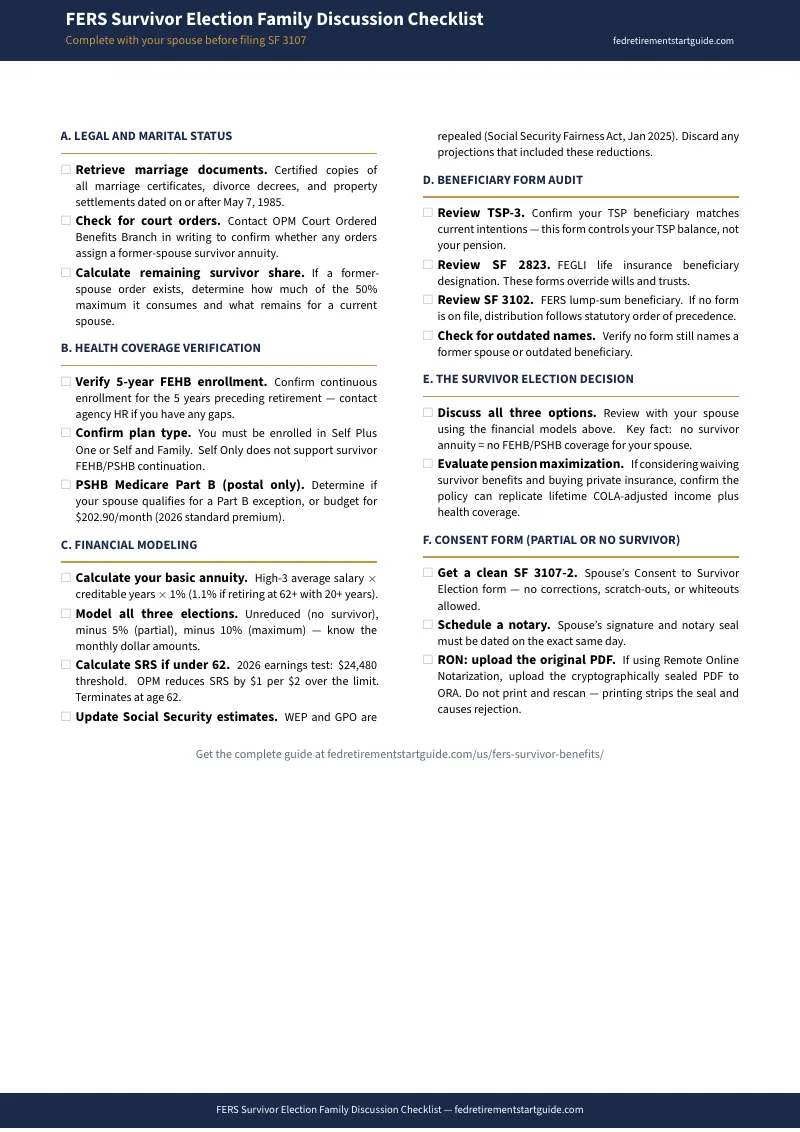
- FERS Survivor Election Family Discussion Checklist — a 20-item checklist covering legal and marital status, health coverage verification, financial modeling, beneficiary form audit, the survivor election decision, and consent form execution
- Six standalone printable tools — a family discussion worksheet, a survivor election comparison sheet, the SF 3107-2 consent and notarization protocol, a beneficiary forms audit worksheet, a forms directory with checkbox tracker, and a post-retirement changes reference card
Satisfaction guarantee
If the guide doesn't give you what you need to evaluate your survivor benefit options with confidence, email us for a full refund. No forms, no questions, no waiting period.
Start with the family conversation
Download the free checklist to see what documents, forms, and verification steps your household needs to complete before making the survivor election. When you're ready to understand the mechanics behind each step — the costs, the healthcare consequences, the former-spouse complications, and the pension maximization trade-offs — the full guide is waiting.
The free checklist tells you what to gather and what to verify. The full guide explains why each step matters and walks you through the decision framework — so you complete Section D of SF 3107 knowing exactly what your choice means for your family.