Your medical condition qualifies. Your paperwork decides.
FERS disability retirement is available to any federal employee with 18 months of creditable service whose health prevents "useful and efficient service" in their current position. You don't need to prove total disability — just that your condition impairs your ability to do your specific job.
But OPM doesn't evaluate your condition in the abstract. It evaluates a package of forms — five interlocking documents where your personal statement, your physician's clinical findings, your supervisor's performance observations, and your agency's accommodation record must tell one consistent story. A strong diagnosis paired with a weak personal statement, a physician who describes symptoms but not functional limitations, an agency certification that skips the reassignment search — any disconnect is grounds for denial.
If you've already separated from federal service, the pressure is worse. The statutory deadline gives you exactly one year from separation to get your application to OPM. Not to your former agency. To OPM. Miss it and no medical evidence reopens the case.
Law firms that specialize in FERS disability charge retainers starting at several thousand dollars. OPM publishes the forms but not the strategy for completing them. The gap between "here's the SF 3112" and "here's how to build a claim that survives review" is where applications fail — and where this guide sits.
The Disability Filing System
The FERS Disability Retirement Guide is a step-by-step administrative workbook that organizes the entire filing process — from eligibility verification through OPM adjudication and MSPB appeal — into the sequence it actually follows, with the documentation standards OPM's medical reviewers apply.
It is not legal advice and it is not affiliated with OPM or any federal agency. It is the filing structure that disability attorneys use, translated into a self-filing format with current 2026 regulatory figures, physician collaboration templates, and annuity offset worksheets.
What's Inside
- Eligibility verification framework — confirm your 18-month service requirement, evaluate your medical condition against OPM's "useful and efficient service" standard, and identify complications (LWOP periods, temporary appointments, part-time service) before you invest weeks in the application
- SF 3112 package walkthrough — form-by-form instructions for all five components (SF 3112A through SF 3112E), with guidance on how OPM's reviewers cross-reference your statements against your physician's findings and your agency's certification
- Clinical nexus templates — collaboration tools for your treating physician that translate medical language into the functional limitation framework OPM requires: what you cannot do, for how long, and how it maps to your position description duties
- Reasonable accommodation documentation strategy — how to request accommodations in writing, track your agency's interactive process under the Rehabilitation Act, evaluate reassignment offers against grade and commuting area requirements, and build the evidence trail SF 3112D demands
- SSDI coordination guide — the mandatory Social Security filing requirement explained clearly: OPM and SSA use different standards, an SSDI denial does not affect your OPM claim, and here is exactly what proof of filing OPM needs and when
- One-year deadline protection — protective filing procedures for separated employees, including the incomplete-application strategy (SF 3107 + SF 3112A to OPM), mailing postmark rules, and the five-day receipt presumption
- Annuity offset worksheets — calculate your net monthly income under the 60% first-year formula and 40% subsequent-year formula, including the SSDI offset, FEHB premium continuation, FEGLI changes, and the age-62 recalculation to a standard FERS retirement benefit
- Denial and appeal roadmap — the 30-day reconsideration window, extension procedures, supplemental evidence strategy, and the MSPB appeal timeline if reconsideration fails
The paid download includes the guide, the checklist, and these printable worksheets:
- eligibility-self-assessment.pdf — Eligibility Self-Assessment (Worksheet A)
- document-assembly-tracker.pdf — Document Assembly Tracker (Worksheet B)
- deadline-tracker.pdf — Deadline Tracker (Worksheet C)
- annuity-estimator.pdf — Annuity Estimator (Worksheet D; the offset worksheets)
- owcp-vs-fers-comparison.pdf — OWCP vs. FERS Comparison (Worksheet E)
- physician-collaboration-template.pdf — Physician Collaboration Template for SF 3112C
- position-duty-mapping-worksheet.pdf — Position-Duty Mapping Worksheet
- sf-3112a-personal-statement-worksheet.pdf — SF 3112A Personal Statement Worksheet
- accommodation-reassignment-tracker.pdf — Accommodation and Reassignment Tracker
- protective-filing-checklist.pdf — Protective Filing Checklist
Who This Is For
You're still employed but your condition is deteriorating. Your physician has documented the diagnosis, your performance reviews show the decline, and you want to start building the SF 3112 package while you still have agency access to HR, your supervisor, and your personnel records. The guide gives you the documentation checklist so nothing falls through the gaps.
You've separated and the clock is running. You left federal service — voluntarily, through medical separation, or at the end of extended LWOP — and now you're outside the agency without access to HR or your former supervisor. You need to know what to submit, where to send it, and how to file a protective application before the one-year deadline closes. The guide covers the exact procedure.
Your condition is psychiatric, not physical. Major depression, PTSD, severe anxiety, bipolar disorder — conditions that don't prevent you from physically showing up but significantly impair concentration, decision-making, emotional regulation, and sustained attention. OPM evaluates functional limitations against your position description, not the nature of the diagnosis. The guide explains how to document psychiatric impacts in the administrative language OPM requires.
You're weighing FERS disability against OWCP or VA disability. You may qualify for multiple programs, and you need to understand which can be received concurrently (VA — no offset), which require an election (OWCP — choose one), and how each combination affects your long-term financial position. The guide maps the interactions.
Why Free Resources Fall Short
OPM's SF 3112 instructions tell you to describe your medical condition. They don't explain what "functional limitation language" means, how to structure a personal statement that maps symptoms to position duties, or how to ensure your narrative is consistent with what your physician and supervisor will say on their forms. The gap between "describe your condition" and "build a clinical nexus" is where initial applications fail.
Federal employee forums provide peer experiences, but accuracy varies. Many threads reference pre-2025 WEP/GPO rules that have since been repealed, outdated processing time estimates, or agency-specific procedures. The guide consolidates current, verified information with 2026 regulatory figures.
Disability retirement attorneys bring MSPB litigation experience and know OPM's review patterns. Their retainers typically start at several thousand dollars — difficult when you're on medical leave or already separated. The guide covers the same administrative territory at a fraction of the cost, and if your case reaches MSPB, it helps you build the strongest possible initial record before you engage an attorney.
100% Satisfaction Guarantee
If the guide doesn't give you a clear, step-by-step path through the FERS disability retirement process, email us and we'll refund your purchase. No time limit, no conditions.
Start Building Your Application
The longer you wait, the harder the documentation gets — supervisors transfer, physicians' notes grow stale, agency HR staff change, and the one-year deadline doesn't pause. The guide is available as an instant PDF download. Print it, work through it section by section, and file with confidence that your package is complete.
Get the full FERS Disability Retirement Guide — — and start organizing the evidence, the forms, and the timeline that OPM will evaluate.
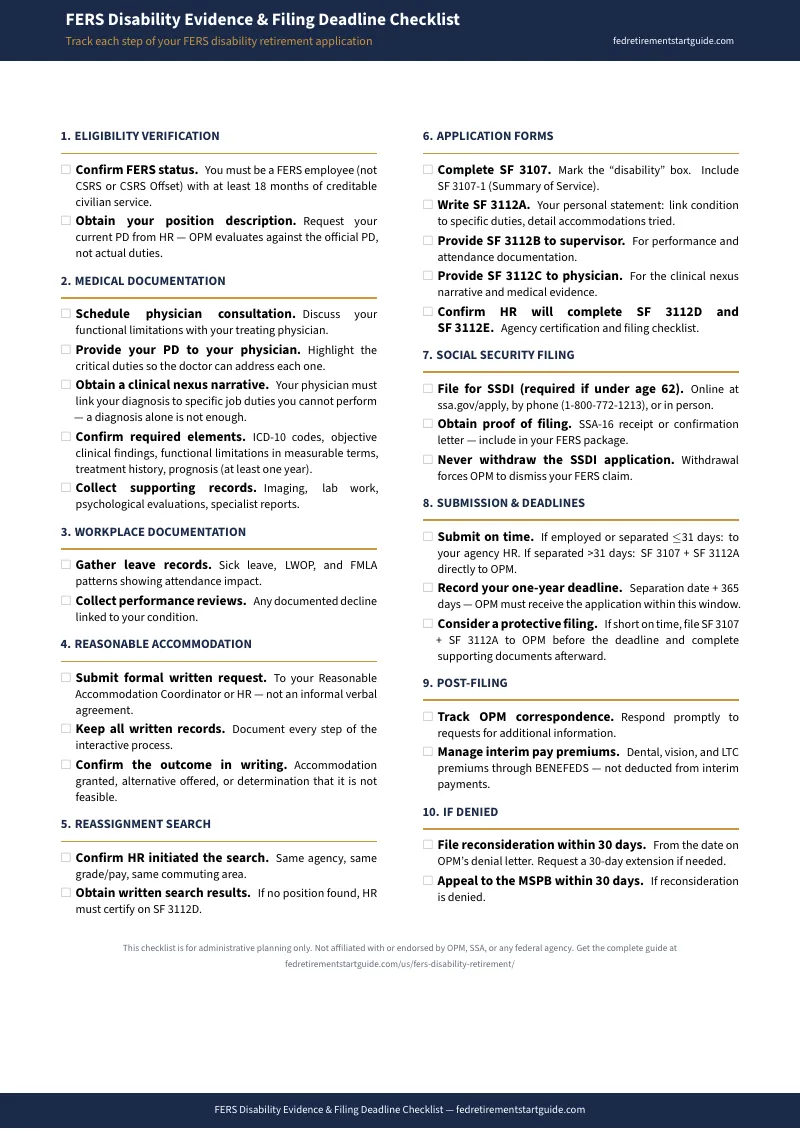
Not ready for the full guide? Download the free FERS Disability Evidence & Filing Deadline Checklist — a structured framework for tracking deadlines, organizing medical evidence, and verifying the SF 3112 package components.
This guide is an independent administrative workbook. It is not legal advice and is not affiliated with, sponsored by, or endorsed by OPM, SSA, or any federal agency.