OPM Sent Your Court Order Back. Now What?
You spent thousands on a divorce attorney. The decree divided the pension, the TSP, the survivor annuity. It looked finished. Then OPM's Court Ordered Benefits Branch returned the order stamped "not acceptable for processing" — and your attorney isn't sure what went wrong, because the same language worked for every private-sector pension they've ever divided.
The problem is structural. Federal retirement benefits are exempt from ERISA. The QDRO templates that divide every 401(k) and corporate pension in the country fail at OPM and the TSP because federal benefits run on a completely separate legal framework — 5 C.F.R. Part 838 for the annuity, Part 1653 for the TSP, and Part 581 for support garnishment. Each one has its own office, its own intake requirements, and its own rejection criteria. An order that satisfies one may be meaningless to another.
And OPM won't help you fix it. By statute, OPM operates in a strictly ministerial capacity — it accepts or rejects court orders as written. It will not advise your attorney on how to draft acceptable language, review a proposed amendment before you file it, or explain what an order should have said. The rejection letter identifies the defect. The rest is on you.
The Court Order Resolution Map
This guide is a Court Order Resolution Map — a step-by-step system for identifying exactly what went wrong with your court order, understanding what can and cannot be fixed at this stage, and preparing for the attorney meeting with the right questions, the right documents, and a realistic understanding of the administrative process ahead.
It doesn't replace your attorney. It makes your time with them dramatically more productive. Instead of paying billable hours for your lawyer to research OPM's acceptance rules from scratch, you walk in knowing which regulatory requirement your order missed, whether an amendment is still possible given the retirement and death-related restrictions under 5 C.F.R. § 838.806, and what explicit language the order needs to reach the FERS supplement after the OPM v. Moulton ruling.
What's Inside the Full Guide
- OPM's six-point COAP screening breakdown — every requirement OPM checks before it will act on a court order, with the specific regulatory citations and the common drafting defects that trigger each type of rejection
- Amended order rules and hard limits — what an amended or nunc pro tunc order can fix, the "first order" rule under 5 C.F.R. § 838.806, and the scenarios where an amendment is no longer possible because the employee has retired or died
- The FERS supplement after Moulton — the Federal Circuit ruled that OPM may not apportion the supplement unless the court order expressly provides for it, so general "FERS annuity" language may no longer be enough — the guide explains what explicit language is needed and what options exist if the original decree is silent
- TSP RBCO qualification and the loan-balance trap — Part 1653's separate requirements for Retirement Benefits Court Orders, the automatic inclusion of outstanding loan balances in the account division (which inflates the award if the attorney didn't know), and the account restriction when the TSP Court Order Center receives a draft domestic relations order, court order, or joinder: distributions, loans, and withdrawals are blocked, while participants can still change contribution amounts and investment choices
- FEGLI court order deadlines — the requirement that a certified order must reach the employing agency or OPM before the insured's death, the irrevocable assignment rules, and what happens when the deadline is missed
- Child support and alimony garnishment — the entirely separate process under 42 U.S.C. § 659 and 5 C.F.R. Part 581 for collecting support from a federal annuity or paycheck, the CCPA garnishment caps (50–65% depending on support status and arrears), and Income Withholding Order procedures
- FEHB and PSHB health coverage for former spouses — enrollment under the Spouse Equity provisions, the 60-day application deadline measured from the later of the divorce date or the retirement system's notice of eligibility to enroll, Temporary Continuation of Coverage as a bridge, and why postal former spouses enroll in FEHB rather than PSHB
- Four printable worksheets — Attorney Meeting Preparation Worksheet, Document and Deadline Chronology, Garnishment Calculation Worksheet, and Agency Communication Log, plus the Federal Court Order Acceptance Checklist
Who This Is For
- A federal employee or retiree whose divorce decree was rejected by OPM or the TSP — and whose attorney needs to understand why before filing an amendment
- A former spouse whose court-ordered annuity share or TSP distribution isn't being paid because the order doesn't meet federal acceptance requirements
- A family-law attorney handling a federal retirement case for the first time and needing to understand what 5 C.F.R. Part 838 and Part 1653 require
- A custodial parent trying to garnish a federal annuity for child support or alimony and hitting procedural walls
- An adult child or family helper sorting out a parent's rejected court order paperwork and trying to figure out which office does what
Why OPM's Handbooks Aren't Enough
OPM publishes two pamphlets that cover court-ordered benefits: RI 38-116 (the attorney handbook, last substantively revised in 1997) and RI 84-1 (the former spouse pamphlet). They contain the raw regulatory text and some model language. What they don't contain:
- A plain-language decoder for the most common rejection reasons, mapped to the specific regulatory requirement that failed
- The OPM v. Moulton ruling on the FERS supplement — decided October 2025, long after the handbook's last revision
- A practical timeline for how long the amendment process takes, including the state court filing, OPM resubmission, and processing backlog
- The TSP's separate RBCO requirements under Part 1653 (RI 38-116 does not cover the TSP)
- Printable worksheets: Attorney Meeting Preparation Worksheet, Document and Deadline Chronology, Garnishment Calculation Worksheet, and Agency Communication Log
The guide synthesizes the current regulations, case law, and administrative procedures into a step-by-step process you can actually follow — without reading 300 pages of the Code of Federal Regulations yourself.
Satisfaction Guarantee
Full refund, no time limit. If the guide doesn't help you understand what went wrong with your court order and prepare for the next step, email [email protected] and we'll refund the purchase — no forms or waiting period before you request it.
Get Started
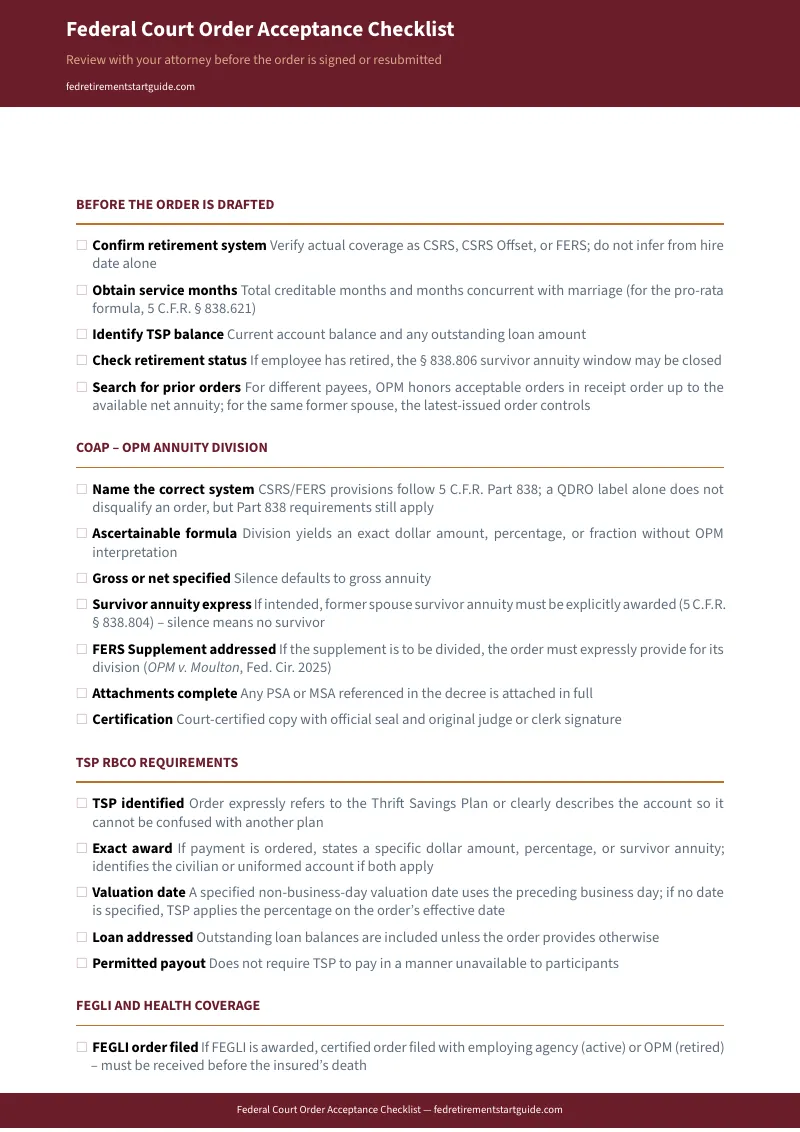
Download the free Federal Court Order Acceptance Checklist to audit your existing order against OPM and TSP requirements right now. If it confirms the gaps you suspected — or reveals new ones — the full Court Order Resolution Map walks you through every step of fixing them.
Get the full Court Order Resolution Map →
Frequently Asked Questions
What if the rules change after I buy?
We update the guide when the rules change. Email us any time, even years later, and we'll send you the current edition free.