You Know the Fire — But Do You Know Your Retirement Math?
You've spent years running toward the thing everyone else runs from. You know flame lengths, crew rotations, and incident command like the back of your hand. But ask most federal firefighters to explain how their High-3 is computed under the new GW pay scales, or whether their six seasons as a temporary GS-3 actually count — and you'll hear silence. Then uncertainty. Then worry.
That's not your fault. The retirement rules governing federal firefighters are scattered across OPM handbooks, CFR subparts, and agency-specific memos that contradict each other depending on which year they were written. Your HR office is processing fire-season backlogs while you're trying to get a straight answer about your Service Computation Date. The union rep has opinions. Reddit has more. None of them show you the actual math.
The Firefighter Retirement Audit System
This guide turns your retirement from a question mark into a number you can verify yourself. It walks you through every rule that applies specifically to federal firefighters under FERS special provisions — the 6(c) coverage determination, the seasonal credit calculations, the annuity formula, the mandatory separation timeline — with the exact statutory citations and worked examples that let you audit your own eOPF and hold HR accountable.
It is not financial advice. It is not a replacement for OPM's final determination. It is the self-audit tool that sits between free government forms (which tell you nothing about your specific situation) and a $1,000+ financial planner (who may not know the difference between primary and secondary 6(c) coverage).
What's Inside
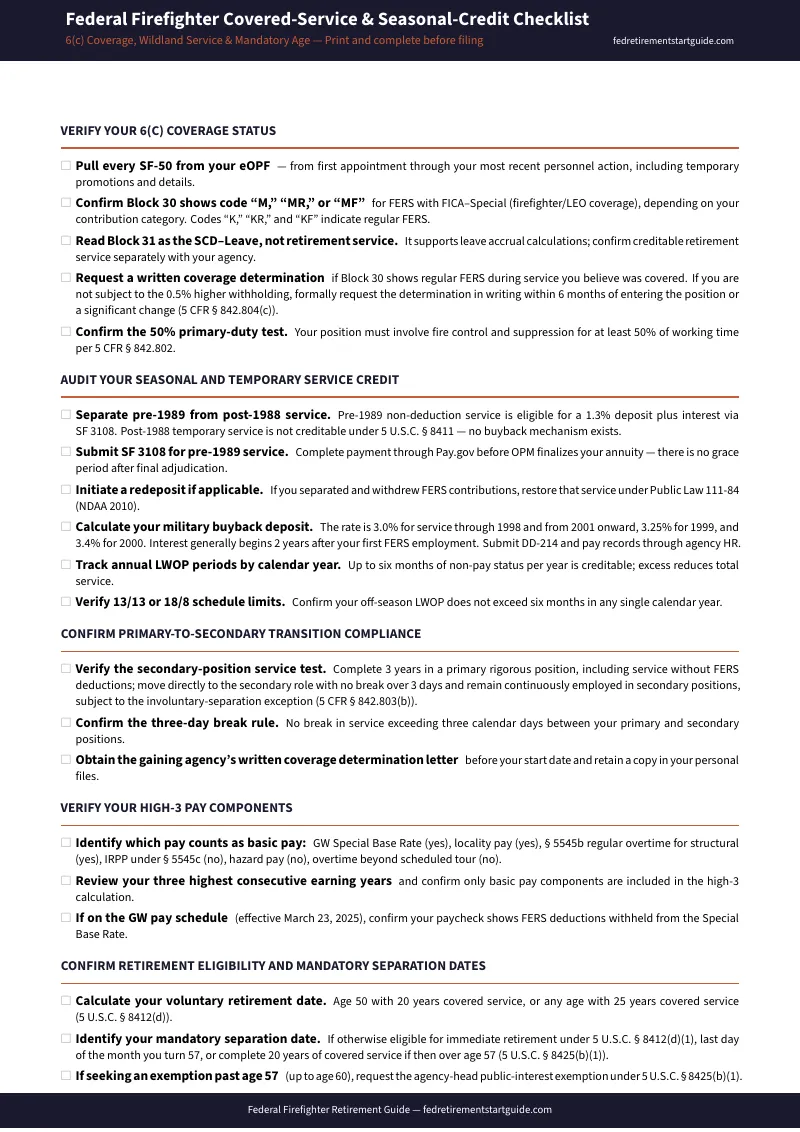
- Covered-Service Audit Worksheet — because knowing whether Block 30 on your SF-50 says "M," "MR," or "MF" is step one, and knowing what to do when it says "K," "KR," or "KF" is step two. The worksheet walks you through pulling every SF-50, reading the retirement plan code, and building a coverage timeline that shows exactly which periods count.
- Seasonal Credit and LWOP Tracker — because five fire seasons as a temporary GS-3 feel like five years of service, but FERS counts them differently. The tracker logs your non-pay status per calendar year against the six-month creditable limit and flags the pre-1989 deposit window that could add years to your creditable service.
- High-3 Average Pay Worksheet — because the GW pay schedule changed which dollars count toward your retirement, and most personnel are still confused about it. GW special base rates count. Incident response premium pay does not. The worksheet shows you how to compute your 36-month High-3 window under the current pay tables and run the 1.7%/1.0% formula.
- Two Worked Annuity Examples — because the 1.7%/1.0% formula sounds simple until you try to apply it to a career that includes temporary seasons, a GW pay bump, and a primary-to-secondary transition. The guide computes two complete annuities: a wildland career with seasonal gaps, and a DoD structural career with § 5545b tour overtime.
- Pre-Retirement Timeline Planner — because the clock at age 57 is real, the exemption process to 60 is discretionary, and the decisions you make in the two years before separation determine whether you bridge the income gap or fall into it. Covers the exemption request process, FEHB continuation, and the SF 3107 filing sprint.
- Primary-to-Secondary Transition Checklist — because taking that dispatch or fuels management promotion without verifying your 3-year primary service gate can permanently strip your special provision coverage, and there is no way to undo it. The checklist walks through the exact requirements under 5 CFR § 842.803(b).
- OWCP Injury Protection Map — because a light-duty detail before your 36th month of primary service triggers a different consequence than one after, and your OWCP case manager won't explain the retirement implications. The guide maps every injury scenario to its coverage impact.
- TSP Penalty-Free Withdrawal Guide — because IRC § 72(t)(10) lets public safety personnel retiring at 50 or older withdraw from the TSP without the 10% early withdrawal penalty, and the rules for structuring those withdrawals determine whether you pay taxes on a lump sum or spread them across years.
- SF-3107 Application Walkthrough — because filing your retirement application 60–90 days before separation is the standard advice, but nobody tells you what happens when HR is buried under fire-season paperwork and your Certified Summary of Federal Service has errors. The guide walks you through a pre-submission self-audit that catches mistakes before OPM does.
- Post-Repeal Social Security Roadmap — because the WEP and GPO are repealed, retroactive adjustments are complete, and firefighters who never applied for benefits need to file a new claim — it is not automatic. The guide explains the two action paths: already receiving adjusted benefits, and eligible but never applied. Dual-career firefighters still need to check any state-plan offset separately.
Who It's For
- Wildland firefighters in the GS/GW-0456 or GS-0462 series at the Forest Service, BLM, NPS, Fish and Wildlife, or BIA — especially those who started in temporary seasonal roles and need to figure out what actually counts
- DoD structural firefighters in the GS-0081 series at Army, Navy, Air Force, or Marine Corps installations, working 72-hour weeks with standby pay that does count toward the High-3
- Secondary fire management, dispatch, and fuels personnel who moved from the line and need to confirm their 3-year primary gate is intact
- Any federal firefighter within five years of retirement who wants to run the annuity math, audit their eOPF, and build a retirement application package that doesn't get bounced back
Why Not Free Resources?
Government sources give you the rules without the roadmap. The OPM retirement handbook does not walk you through reading your SF-50s for coverage errors. The Forest Service HR FAQ does not compute your annuity under mixed primary-secondary service with GW pay reform adjustments. And the Reddit thread that convinced your crewmate his temporary seasons count? It cites a regulation that applies only to pre-1989 service.
The gap between access to the rules and ability to apply them to your career is where mistakes compound. A single uncaught SF-50 error — wrong retirement plan code, missing coverage determination letter, uncredited seasonal period — can delay your annuity payments by months or cost you years of creditable service you earned on the line.
This guide closes that gap for less than the cost of one meal on a fire deployment.
Full Refund, No Time Limit
If the guide doesn't help you understand your retirement situation better, email [email protected] for a full refund. No time limit, no questions.
The free checklist gives you the audit framework. The full guide gives you the math, the worked examples, the worksheets, and the application walkthrough to turn that framework into a verified retirement plan.