
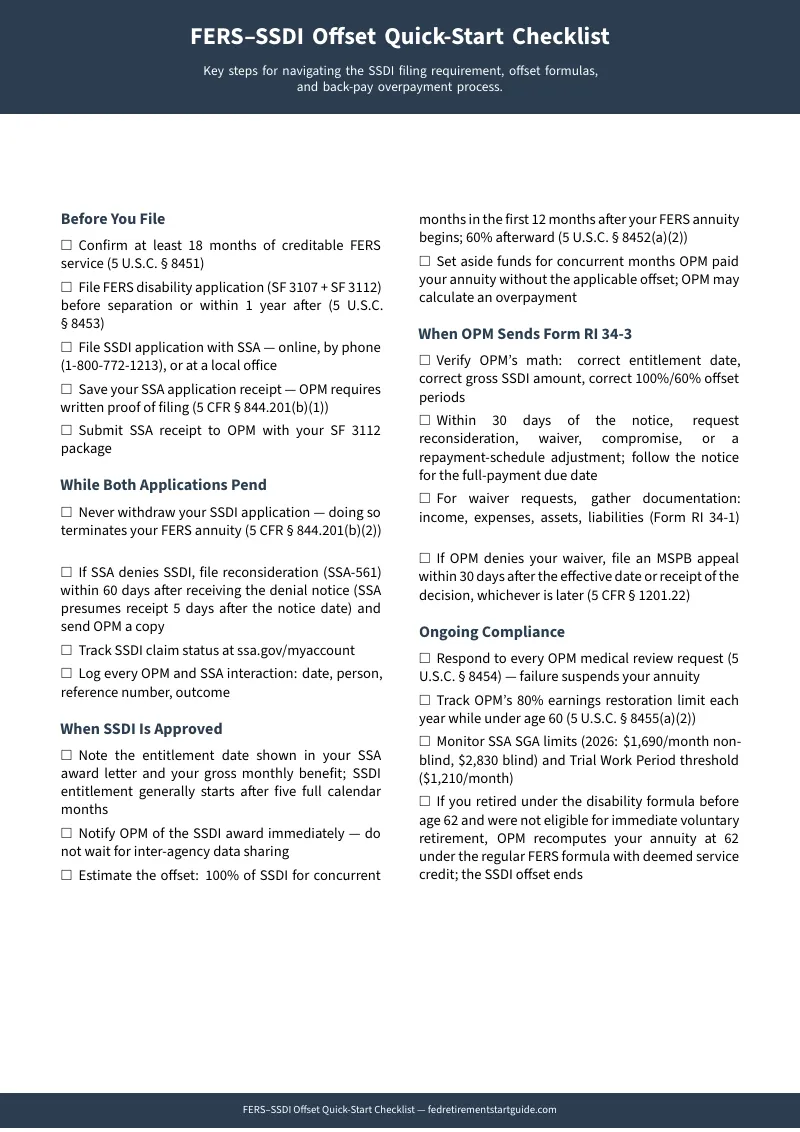
You got the FERS disability approval. Then OPM sent you a bill.
You filed your SF 3112, waited months for OPM to approve your FERS disability retirement, and finally started receiving annuity payments. But buried in the approval process was a requirement nobody emphasized: you also had to apply for Social Security Disability Insurance.
Now one of two things has happened — or is about to:
- SSA awarded you SSDI with a retroactive lump sum, and you're staring at a five-figure deposit you're not sure you can keep
- OPM sent Form RI 34-3, demanding repayment of months when it paid you the full annuity while SSA says you were already entitled to SSDI
The gap between these two agencies — OPM running disability retirement and SSA running SSDI — is where federal employees lose money they didn't know they owed.
The Dual-Agency Offset Navigator
This guide is built around the one financial event that connects FERS disability retirement to SSDI: the offset under 5 U.S.C. § 8452. For annuitants under age 62 who are not eligible for immediate voluntary retirement, it explains how OPM reduces the annuity in months when they are entitled to both benefits, why a retroactive award can create a debt, and what your options are when the debt notice arrives.
Unlike general federal retirement books that mention the offset in a paragraph, this guide follows the entire sequence from filing proof through the age-62 recalculation — with calculation examples, form references, and a fillable worksheet so you can run your own numbers.
What's Inside
- The mandatory filing requirement — exactly what OPM accepts as proof of your SSDI application (not a list of guesses — the specific documents SF 3112 identifies), how withdrawing your SSDI application can lead OPM to dismiss your FERS disability retirement application, and what an SSDI denial means for your disability retirement
- Year-one and year-two offset formulas — for annuitants under age 62 who are not eligible for immediate voluntary retirement: 60% of high-3 minus 100% of SSDI in the first twelve annuity months, then 40% of high-3 minus 60% of SSDI afterward in months with concurrent entitlement, with the earned annuity floor that prevents your check from dropping below what you earned by service alone
- Retroactive overpayment arithmetic — how SSA's onset and entitlement dates, and the five-month waiting period (not required for ALS or when a prior period of disability ended within five years before the current period began), identify overlap months OPM may bill as debt
- Worked examples — two full calculations (a year-one offset scenario and an overpayment scenario) with every step shown, so you can verify how OPM reaches the numbers on your debt notice
- Responding to Form RI 34-3 — the 30-day response window, Form RI 34-1 financial disclosure, lump-sum repayment, installment deductions from your annuity, waiver requests under OPM's no-fault and equity-and-good-conscience standard, and hardship-based installment adjustments
- Medicare timing — Medicare generally starts after 24 months of SSDI entitlement, with no 24-month wait for ALS; how Part A and Part B coordinate with FEHB or PSHB, and the Part B requirement for certain PSHB annuitants, with exceptions
- The age-62 recalculation — for annuitants under age 62 who were not eligible for immediate voluntary retirement, how OPM converts the disability annuity to a regular earned pension using credited disability years, COLA-adjusted high-3, and the 1% formula (or 1.1% when service plus credited disability time reaches 20 years)
- The FERS–SSDI Offset Worksheet — for annuitants under age 62 who were not eligible for immediate voluntary retirement, a fillable tool for estimating net annuity under both offset stages and projecting potential overpayment liability before the debt notice arrives, plus an OPM Communication Log, Debt Response Preparation Checklist, and Timeline Planner
Who This Guide Is For
- Federal employees filing for FERS disability retirement who need to understand what SSDI proof OPM requires before it will approve the application
- FERS disability annuitants who just received an SSDI award and want to calculate how much their annuity will drop and whether they'll owe OPM money
- Annuitants holding Form RI 34-3 who need to understand the repayment options, the financial disclosure process, and whether a waiver request makes sense
- Spouses, adult children, and family helpers who are managing the dual-agency paperwork for someone who can't navigate it alone
Why Not Just Read the OPM Handbook?
OPM publishes the rules, but it doesn't publish a workflow. The CSRS/FERS Handbook scatters the offset formula, the overpayment rules, and the waiver procedures across separate chapters written for HR specialists, not annuitants. SSA's materials don't mention the FERS offset at all — SSA staff have no training on how SSDI affects an OPM annuity.
Union retirement hotlines help during office hours if you're a member, but they lose jurisdiction after you separate. HR centers process your paperwork and hand it to OPM — they don't assist with post-separation offset calculations or debt response.
This guide takes the two-agency reality and puts it in one sequence: what happens first, what happens next, what numbers to check, and what deadlines to meet.
Satisfaction Guarantee
If this guide doesn't help you understand the SSDI offset and your options, email [email protected] for a full refund, no time limit. The free FERS–SSDI Offset Worksheet is yours to keep either way.
Download the free worksheet to run the offset calculation tonight. When you're ready for the full filing-to-age-62 walkthrough, the complete guide is waiting on this page.
Frequently Asked Questions
What if the rules change after I buy?
We update the guide when the rules change. Email us any time, even years later, and we'll send you the current edition free.