One Miscoded SF-50 Can Cost You 20 Years of Enhanced Pension Math
You spent decades running toward danger — clearing rooms, working the border, standing a post. Your retirement should reflect that. But the system that calculates your pension treats you like every other federal employee unless your personnel file proves otherwise.
A single wrong code in Block 30 of your SF-50. A four-day gap between your field assignment and your headquarters transfer. A payroll office that forgot to send Employment Code "P" to the TSP. Any one of these clerical oversights can strip away your 1.7% computation rate, trigger an 8-to-18-month OPM adjudication stall, or hit you with a 10% early withdrawal penalty on your Thrift Savings Plan.
Agency HR processes your paperwork — but you bear 100% of the financial consequences when something is wrong.
The 6(c) Service Verification System
The Federal Law Enforcement Retirement Guide is the independent process manual that puts you in control of your own retirement records. It delivers the exact regulatory framework, self-audit procedures, and formula calculations you need to verify your covered service, catch errors before OPM does, and retire on the timeline you earned.
This is not financial advice, not an investment pitch, and not a generic FERS overview. It is a focused operational manual built specifically for 6(c) law enforcement officers — the rules that apply to you and only you.
What's Inside
- SF-50 Block 30 Audit Worksheet — a printable log to pull every SF-50 from your eOPF and verify that your retirement coverage codes (6, M, or P) are correct across your entire career. You'll know exactly what to look for and what to do if you find a red-flag code like K, N, or R.
- Two-Tier Annuity Formula with Worked Examples — the 1.7% rate on your first 20 years plus the 1.0% rate on everything after, calculated against your High-3 average salary. The guide includes agency-specific examples showing how LEAP, BPAPRA overtime, and AUO factor into your High-3 — because generic calculators get this wrong.
- Primary-to-Secondary Transfer Rules — the exact requirements under 5 CFR 842.803 for moving from a rigorous field position to a supervisory or headquarters role without breaking your 6(c) coverage. The three-year primary service rule, the three-day transfer window, and what to do if you discover a gap.
- FERS Supplement Earnings Window Map — the earnings test does not apply between age 50 and your Minimum Retirement Age. The printable map walks that window and shows you how the 2026 $24,480 limit works once you hit MRA, so you can plan second-career income without losing your Supplement.
- TSP Penalty-Free Access Under SECURE 2.0 — the age-50 exception and the 25-year service alternative under IRC 72(t)(10), including what to do when payroll fails to transmit Employment Code "P" and you need to claim the exemption yourself on IRS Form 5329.
- Mandatory Separation Timeline — the age-57 rule under 5 U.S.C. 8425(b), the exceptions for officers who haven't reached 20 years, the agency-head waiver to age 60, and the exact calendar math for your separation date.
- Agency-Specific Chapters — dedicated sections for CBP officers (pre- vs. post-July 2008 rules and BPAPRA overtime), BOP correctional staff (detention credit and position transfers), Postal Inspectors (6(c) pension math plus PSHB health coverage), and the First Responder Fair RETIRE Act for line-of-duty injured officers.
- Administrative Correction Procedures — if your self-audit turns up an error, the guide walks you through compiling position descriptions, performance appraisals, and vacancy announcements to build a formal service credit correction request under 5 CFR Part 842.
Who This Guide Is For
- CBP Officers and Border Patrol Agents planning around BPAPRA pay rules and pre-2008 service
- BOP Correctional Officers and detention staff tracking primary-to-secondary transfers
- FBI, ICE, USMS, and Secret Service agents calculating LEAP in their High-3
- Postal Inspectors navigating the intersection of 6(c) pension and PSHB health coverage
- Criminal investigators and police officers at smaller agencies and OIGs where HR lacks 6(c) expertise
- Officers injured in the line of duty exploring the Fair RETIRE Act
- Mid-career officers (10–15 years) verifying that a headquarters promotion won't break their coverage
- Senior officers (18+ years) preparing their file for OPM submission
Why Not Free Tools?
Retirement calculators process the numbers you input — they cannot audit your service record. If your transfer from the field to headquarters involved a four-day break in service, your calculator's output is built on a false premise. If your SF-50 shows Code K instead of Code M, the calculator doesn't know and doesn't care.
FLEOA and NARFE publish policy overviews, not individual audit procedures. Your agency HR office won't review your eOPF until six months before your separation — and generalist HR specialists frequently miss 6(c) nuances they process once or twice a year.
Financial advisory firms like ProFeds and Haws Federal offer retirement seminars, but their primary objective is capturing assets under management. The seminar moves quickly past the granular audit steps — the SF-50 code checks, the transfer continuity verification, the premium pay inclusion rules — because those don't lead to AUM.
The guide fills that gap: the operational audit and formula verification, without the investment pitch.
Satisfaction Guarantee
Full refund, no time limit. If the guide doesn't deliver what you expected, email [email protected] and you'll get your money back. No forms, no hoops.
Start Auditing Your File
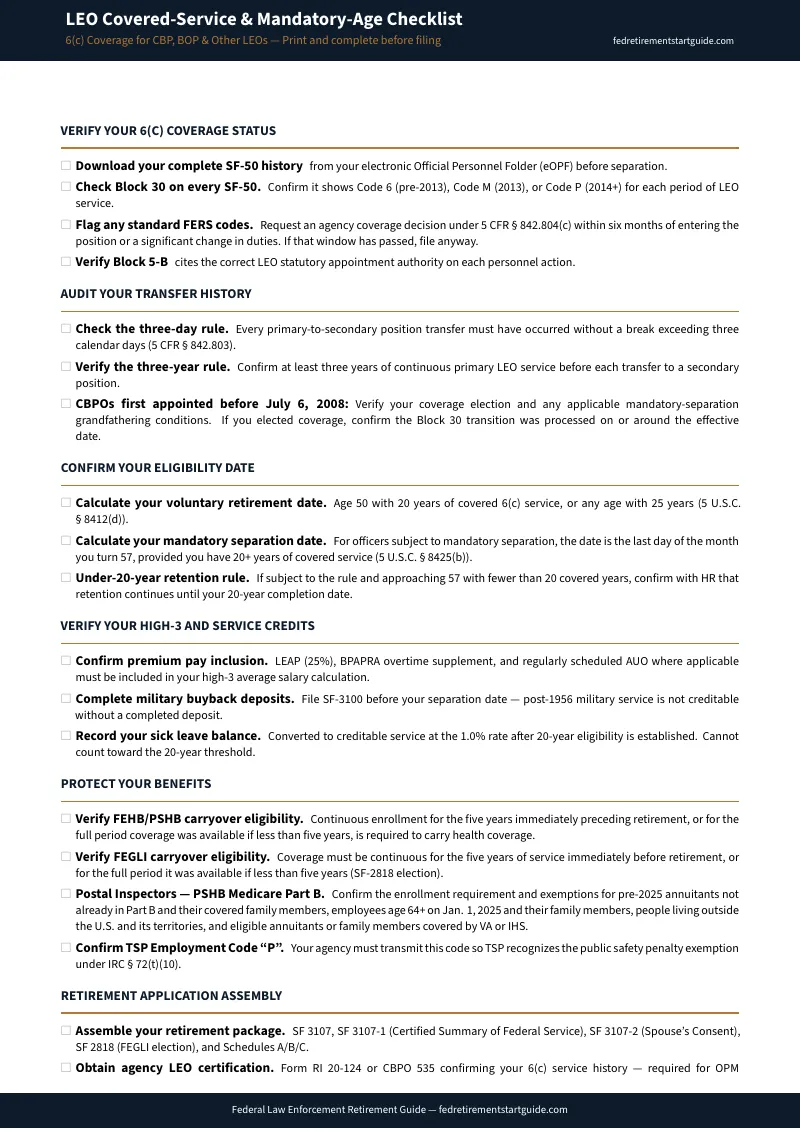
Download the free LEO Covered-Service & Mandatory-Age Checklist to verify your SF-50 codes and eligibility date tonight. When you're ready for the full self-audit system — the formula calculations, the transfer rules, the agency-specific chapters, and the administrative correction procedures — the complete guide is waiting.