You Retire Before 62. Social Security Does Not Follow You.
You have 30 years of federal service. You are reaching your Minimum Retirement Age. Your FERS annuity is locked in, your TSP balance is solid, and you are ready to separate. But the third leg of the retirement stool — Social Security — does not start paying until at least age 62. That gap can be five, six, seven years of retirement income with a pillar missing.
The FERS Special Retirement Supplement is supposed to fill that gap, paying a monthly benefit that approximates the Social Security income you earned through federal service. OPM calculates it automatically when they adjudicate your retirement claim. What they do not tell you is how they calculate it, which of your post-retirement income streams will trigger reductions, or that the entire enforcement mechanism operates on a one-year delay that catches retirees off guard.
A retiree who earns $30,480 in consulting income during 2026 will not see the supplement reduction until July 2027 — when OPM collects last year's earnings through a spring survey and applies the penalty retroactively. That is not a design flaw. It is the documented process. But almost no one discovers it until the survey arrives in the mailbox.
The Retirement Bridge System
The FERS Special Retirement Supplement Guide is a process manual for the benefit that bridges your retirement and age 62 — covering who qualifies, how OPM calculates the amount, which income types trigger the earnings test (and which are completely exempt), how the retrospective survey cycle works, and what happens when the supplement terminates and you face the Social Security claiming decision.
Standard federal retirement resources mention the supplement in passing — one paragraph in a chapter about FERS benefits, one slide in a two-hour pre-retirement workshop. This guide is an entire manual dedicated to the supplement alone, built for the specific questions that arise when you actually try to plan around the benefit: Can I consult part-time without losing it? How much will OPM calculate for me? What happens in the year between earning the income and the reduction taking effect? Do I have to claim Social Security the month the supplement stops?
What's Inside
- Eligibility Verification Framework — A systematic walkthrough of every qualifying retirement path (MRA+30, age 60+20, VERA, DSR, special category) and every exclusion (MRA+10, deferred, disability, age 62+). The supplement is available only on immediate, unreduced retirements — but the rules for VERA and DSR retirees include a delayed-start provision that HR offices rarely explain. The guide maps each path with the exact MRA schedule by birth year so you can confirm your eligibility and expected start date before you file.
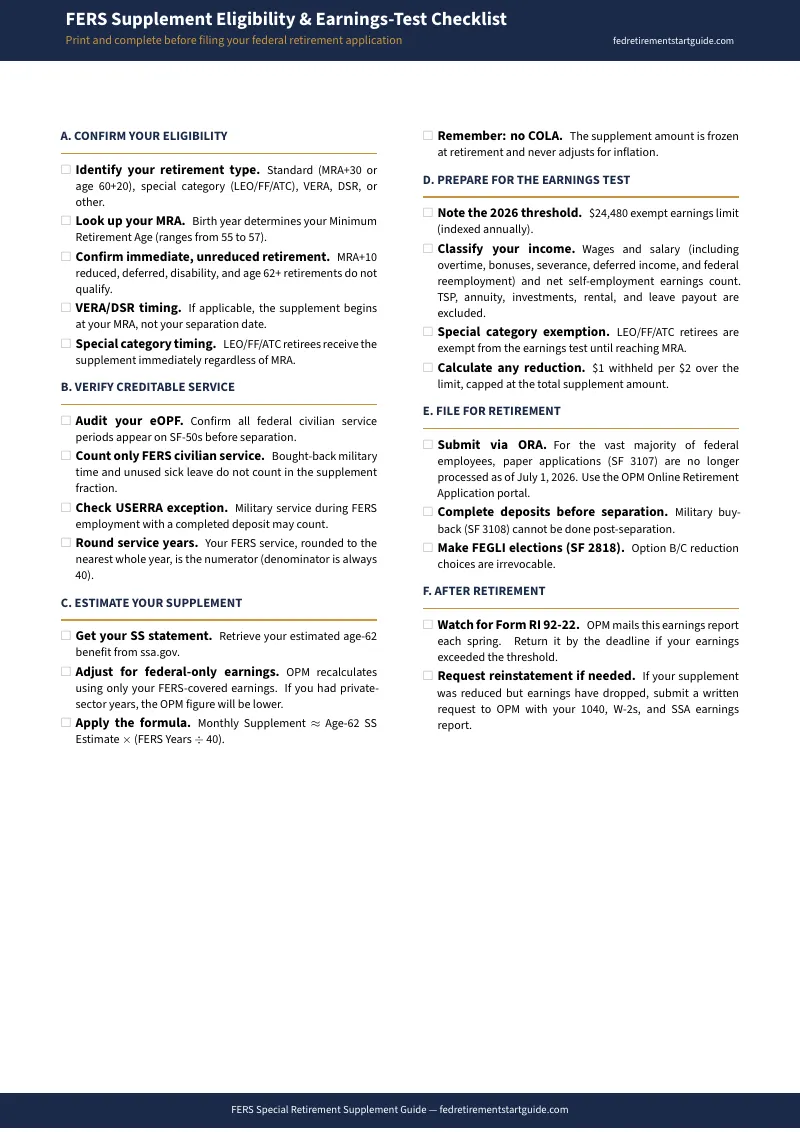
- Supplement Estimation Formula — OPM's calculation uses your estimated age-62 Social Security benefit multiplied by the ratio of your FERS-covered civilian service years to 40. The guide walks through the formula with worked numerical examples, explains why OPM's determination often differs from the estimate on your SSA statement (OPM uses only your FERS-covered federal earnings, not your full earnings record), and covers the military service exclusion — active-duty time does not count in the numerator unless a formal deposit has been completed.
- Post-Retirement Earnings Test — Complete Income Classification — The earnings test reduces your supplement by $1 for every $2 of earned income above the annual exempt amount ($23,400 in 2025; $24,480 in 2026). But only W-2 wages and net self-employment earnings count. Your FERS annuity, TSP withdrawals, required minimum distributions, rental income, capital gains, interest, dividends, and private pension income are completely exempt. The guide provides the full classification with regulatory citations so you can structure post-retirement income to preserve the supplement.
- The RI 92-22 Survey Cycle — How OPM Actually Enforces the Test — Unlike Social Security, which can withhold benefits prospectively, OPM's earnings test is entirely retrospective. Each spring, OPM mails the FERS Annuity Supplement Earnings Survey (Form RI 92-22) asking for prior-year earnings. Any calculated reduction does not take effect until July of the following year. The guide covers what to report, when reductions begin, how monthly withholding is calculated from annual figures, and the reinstatement process when earnings drop below the limit.
- Age-62 Transition Strategy — The supplement terminates automatically at the end of the month before you turn 62, regardless of whether you file for Social Security. You are not required to claim at 62 — and claiming at 62 permanently reduces your monthly benefit by approximately 25–30% compared to Full Retirement Age. The guide covers the income timeline from supplement termination through Social Security claiming, the break-even analysis between early and delayed claiming, and the TSP bridge strategy for covering the income gap.
- Special Category MRA Exemption — Law enforcement officers, firefighters, and air traffic controllers who retire before reaching their MRA are exempt from the earnings test until the first month they reach MRA. The guide covers who qualifies for the exemption, how the transition to the standard earnings test works, and planning strategies for the post-MRA period when the test begins to apply.
- Digital ORA Filing Walkthrough — OPM's Online Retirement Application became mandatory July 1, 2026. For cases processed in August 2026, OPM reported an average of 79 days to finalize immediate retirement claims and 6 days to authorize interim pay (OPM Retirement Processing Times). During adjudication, OPM issues interim payments (a partial payment below the final annuity), but the supplement is excluded from interim checks and paid retroactively only after final adjudication. The guide walks through the platform, required documents, and common errors that delay processing.
- WEP/GPO Repeal Implications — The Social Security Fairness Act (January 2025) repealed both the Windfall Elimination Provision and the Government Pension Offset for benefits payable after December 2023. Standard FERS employees were not directly affected, but the repeal matters if you or your spouse have non-covered pension income from state or local government, CSRS service, or foreign government employment. The guide clarifies who benefits and the SSA-561 reconsideration process for those who never filed.
- Health Insurance, Life Insurance, and TSP Coordination — The supplement interacts with your broader retirement planning: FEHB/PSHB continuation decisions, FEGLI cost escalation across age bands, TSP withdrawal timing relative to the supplement's earnings test (TSP withdrawals are exempt — they can replace earned income without reducing the supplement), and RMD planning under SECURE 2.0 rules.
Printable Tools Included
In addition to the guide and checklist, the download includes 8 standalone printable worksheets and reference cards — each designed to be used independently at your desk, in an advisor meeting, or on the fridge:
- Eligibility & MRA Reference Card — The eligibility quick-reference table plus the full MRA birth-year schedule on one page. Print it and bring it to your HR meeting.
- Supplement Estimation Worksheet — Fill in your own SSA estimate and FERS service years, apply the formula, and calculate your total supplement value through age 62.
- Earnings Test Income Classification — The complete list of counted and exempt income types in two clear columns, plus a fill-in section to classify your own planned income sources.
- RI 92-22 Survey Cycle Reference — OPM's retrospective enforcement timeline, the reduction formula with a fill-in calculator, reinstatement instructions, and an annual tracking table.
- Retirement Filing Timeline — A printable checklist covering every step from 12 months before separation through post-adjudication — with checkboxes and date columns to track your progress.
- Age-62 Transition Worksheet — Plan the income bridge from supplement termination to Social Security claiming — current income, the gap calculation, a side-by-side claiming comparison, and your post-62 monthly budget.
- FEGLI Cost Comparison Card — Option B cost escalation by age band, with space to calculate your projected premiums at each decade. Bring it to your SF 2818 election.
- Contacts, Forms & Resources — Every agency phone number, key form, critical deadline, and official URL on one page. Keep it with your retirement planning file.
Who This Is For
Federal employees within two years of MRA+30 or age 60+20 — You are planning the transition and the supplement is a meaningful part of your retirement income budget. You have seen the SSA statement estimate but you do not know how OPM's calculation will differ, whether your planned consulting income will trigger reductions, or how the retrospective enforcement timeline works. The guide gives you the formula, the income classification rules, and the survey cycle so you can model the numbers before filing.
VERA and DSR candidates evaluating early-out offers — Your agency announced a restructuring and you have received a voluntary early retirement or discontinued service offer. You qualify for the supplement, but payments will not start until you reach your MRA — which could be years after separation. The guide maps the exact timeline so you can evaluate the offer with accurate income projections for the gap years.
Retirees planning to work after separation — You have a consulting contract, a part-time position, or a private-sector job lined up. You have heard that working after retirement eliminates the supplement, but the reality is more nuanced. The guide shows exactly which income types count, how the retrospective enforcement works, and how to estimate your reduction so you can make an informed decision about post-retirement employment.
Retirees approaching 62 and facing the Social Security claiming decision — Your supplement is about to terminate and you need to decide whether to claim Social Security immediately or delay. The guide covers the transition mechanics, the permanent reduction for claiming at 62, the break-even analysis, and the TSP bridge option for covering the income gap between supplement termination and delayed Social Security claiming.
Why Not Just Use Free Resources?
The rules governing the FERS Supplement are published across OPM's CSRS/FERS Handbook, the Social Security Administration's policy manuals, and the CFR. The information exists. What does not exist — in any single free source — is a sequential process that tells you how to verify eligibility, estimate the benefit, classify your post-retirement income, navigate the annual survey, and plan the transition to Social Security.
OPM publishes the regulations. NARFE publishes legislative updates. Financial planners build investment portfolios at several hundred dollars per hour. Pre-retirement workshops dedicate one slide to the supplement in a two-hour session covering all of FERS. Federal employee forums carry helpful but inconsistent advice — threads that still reference pre-2025 WEP/GPO rules, outdated earnings limits, and incorrect VERA eligibility information.
The guide consolidates current, verified regulatory information into one structured document — eligibility paths, the estimation formula, the complete earnings test classification, the RI 92-22 survey timeline, the age-62 transition analysis, and the digital filing process — so you do not have to assemble the process from scattered sources that may or may not reflect current law.
Satisfaction Guarantee
If the guide does not help you verify your supplement eligibility, estimate your benefit, or navigate the earnings test, email [email protected] and we will issue a full refund.
Bridge the Gap Between Retirement and Social Security
The FERS Supplement can be worth $1,000 to $1,800 per month for up to seven years. It bridges the income gap between your retirement date and age 62 — if you qualify, if you understand the earnings test, and if you plan the transition correctly. The rules are not complicated. They are scattered across sources that were not written to be followed as a step-by-step process.
The complete toolkit costs — a fraction of a single hour with a federal retirement planner. You get the full guide, the printable checklist, and 8 standalone worksheets and reference cards covering eligibility verification, supplement estimation, earnings test classification, the RI 92-22 survey cycle, the retirement filing timeline, the age-62 transition, FEGLI cost comparison, and key contacts — 10 PDFs total.
Not ready for the full guide? Download the free FERS Supplement Eligibility & Earnings-Test Checklist — a structured framework for confirming your eligibility path, categorizing post-retirement income sources, and tracking the annual survey deadline. The full guide is there when you need the complete process.