
You Have the Years. You Have the Age. But Do You Have the Right Retirement Path?
You have been running the numbers for years — your Minimum Retirement Age, your creditable service, your high-3 average salary. You have a rough idea of when you can retire. But "rough" is the problem. The difference between an MRA+30 unreduced annuity and an MRA+10 reduced annuity is not just a few percentage points — it is a permanent 5%-per-year penalty on every check you receive for the rest of your life. And the difference between a postponed retirement and a deferred retirement is not just terminology — one preserves your health insurance and sick leave credit, and the other forfeits both permanently.
Standard retirement calculators give you a number. They do not tell you whether that number accounts for your part-time stint in 2004, your unpaid military deposit from 1998, or the three years you refunded your FERS contributions during a stint in the private sector. They assume continuous full-time service. When OPM processes your application and discovers the gaps, they adjust your annuity downward — and by then, you have already separated.
The Service Record Verification Architecture
The FERS Retirement Eligibility & Timing Guide is a neutral, step-by-step process manual designed for FERS employees one to five years from retirement who need to verify which eligibility path actually fits their service record before committing to a separation date. It does not advise you on when to retire. It gives you the complete verification-and-filing framework — eligibility path comparison, service credit audit, pension math, insurance continuation, and the digital filing sequence — so you can set a date with confidence instead of anxiety.
What's Inside
Every FERS Eligibility Path — Mapped and Compared — Five paths, five different combinations of age and service, five different consequences for your pension, your health insurance, and your Special Retirement Supplement. Immediate unreduced at MRA+30, age 60 with 20 years, or age 62 with 5 years. Immediate reduced at MRA+10 with the permanent 5%-per-year age penalty. Early departure via deferred or postponed annuity. The guide maps every path against your age and service, shows the reduction math, and identifies which paths preserve your benefits and which ones forfeit them.
The Postponed vs. Deferred Decision Framework — These two terms are governed by separate sections of Title 5. A deferred annuity (5 U.S.C. § 8413) means you left before your MRA — annuity begins at 62, health and life insurance permanently forfeited, sick leave forfeited. A postponed annuity (5 U.S.C. § 8412(g)) means you left after MRA with 10+ years — you delay commencement to eliminate the age reduction, and FEHB, FEGLI, and sick leave are restored when the annuity begins. The guide provides the complete decision framework and the documentation steps for each path.
The Service Credit Audit Worksheets — Post-1956 military service requires a 3% deposit plus interest paid before separation — unpaid, it vanishes from both eligibility and annuity calculations entirely. Part-time service applies a proration factor that reduces your effective service years. Non-deduction civilian service before 1989 requires a 1.3% deposit. Refunded FERS contributions can be restored via redeposit under 5 CFR § 842.308 — but if unpaid, that service counts toward eligibility while being excluded from your pension. The worksheets walk through each category with the specific forms, deadlines, and interest calculations.
High-3 and Annuity Computation — The formula looks simple: High-3 × Years of Service × 1% (or 1.1% at age 62 with 20+ years). In practice, step increases within the high-3 window, locality pay adjustments, part-time proration, and sick leave conversion in 30-day blocks all affect the result. The computation worksheets let you verify OPM's calculation line by line — because a single error in your Service Computation Date compounds across every month of retirement.
The SRS Eligibility & Earnings-Test Calculator — The Special Retirement Supplement bridges FERS retirement to Social Security at age 62. It is available under MRA+30 and age 60 with 20 years — but not to deferred retirees, age-62 retirees, or MRA+10 retirees who did not postpone. Once active, every two dollars earned above the 2026 limit of $24,480 reduces the supplement by one dollar. TSP withdrawals, investment income, and Social Security do not count. The calculator maps your eligibility, projects the approximate amount, and models the earnings test against your planned post-retirement income.
FEHB Five-Year Rule & Survivor Coverage — Five consecutive years of enrollment immediately before your annuity starts. OPM counts breaks differently depending on whether you re-enrolled within 60 days. And your surviving spouse can only continue FEHB after your death if you elected a survivor annuity — without that election, their coverage terminates. The guide covers the enrollment verification, the waiver provisions, and the survivor coordination requirements.
FEGLI Premium Projections & Reduction Elections — Option B and Option C premiums escalate sharply after age 55 and more than double at the 60–64 bracket. At retirement, you make a one-time, irrevocable election on Basic coverage: 75% reduction (free after 65), 50% reduction ($0.75/month per $1,000 after 65), or no reduction ($2.25/month per $1,000 after 65). The projections let you model the lifetime cost before you commit.
TSP Under SECURE 2.0 — 2026 Rules — The Rule of 55, the $8,000 catch-up for ages 50–59 and 64+, the $11,250 super catch-up for ages 60–63, mandatory Roth catch-ups for prior-year wages above $150,000, RMDs starting at 73 (75 in 2033), and the Roth TSP pre-death RMD exemption. The guide covers which withdrawal rules apply to your separation and how to time your access without unnecessary penalties.
WEP/GPO Repeal — Integrated Throughout — The Social Security Fairness Act, signed January 5, 2025, repealed both the Windfall Elimination Provision and the Government Pension Offset retroactive to January 2024. Any guide, calculator, or seminar still listing these provisions is dangerously stale. If you never applied because the offsets would have zeroed your benefit, you must file a new claim. The guide integrates the repeal into every relevant section.
Postal Workers — PSHB & Medicare Part B — PSHB replaced FEHB for career postal employees and annuitants on January 1, 2025. Postal annuitants who become Medicare-eligible must enroll in Part B ($202.90/month in 2026) or lose PSHB coverage permanently — unless they qualify for one of the four statutory exceptions. The guide covers the PSHB mandate, the exception categories, and the enrollment timing.
The ORA Digital Filing Roadmap — Paper applications ended July 1, 2026 for most agencies. Digital Online Retirement Application packages averaged 50 days as of April 2026, compared with 100 days for paper; the overall average was 78 days. Interim pay is typically 60% to 80% of estimated net, which is why the kit includes a 3-to-6-month cash-bridge checkpoint. The ORA Digital Filing Checklist and Retirement Timeline Worksheet cover every document, every verification step, and the processing window.
Who It's For
- FERS employees one to five years from retirement who need to verify which eligibility path fits their service record — MRA+30, age 60+20, age 62+5, or MRA+10 — before committing to a separation date
- Employees deciding between early and full retirement who need the math comparing an immediate reduced annuity today against an unreduced annuity in two or three more years, including the impact on health insurance, sick leave, and the SRS
- Employees with mixed service — military time, part-time, or prior federal stints whose service records contain gaps and deposits that standard calculators do not account for
- Spouses evaluating the retirement decision together — survivor annuity elections, FEHB family coverage, Social Security spousal benefits after the GPO repeal, and the financial impact of interim pay during OPM processing
- Postal workers navigating PSHB and Medicare Part B who face the additional health coverage integration rules that took effect in 2025
What Free Resources Get Wrong
OPM provides the law — hundreds of pages across CSRS/FERS Handbook chapters, Benefits Administration Letters, and pamphlets written for benefits officers. No chronological workflow. No single page that compares all five eligibility paths side by side. No cross-reference between service credit rules, insurance continuation requirements, and the filing timeline. Agency HR can confirm your Service Computation Date and process paperwork — they cannot model your SRS earnings test, project your FEGLI premiums through age 80, or tell you whether to postpone. Financial advisor blogs publish excellent explanations of individual rules as a lead funnel for managing your TSP at 1% annually. NARFE covers all federal employees for $48 a year, not individual eligibility verification workflows. Reddit and forums confidently cite WEP reductions that were repealed, FEHB rules that do not apply to postal workers, and SRS earnings limits from previous years.
This guide assembles the scattered statutory rules into one chronological verification-and-filing workflow — from auditing your service record today through receiving your finalized annuity — with current 2026 figures, the WEP/GPO repeal integrated, SECURE 2.0 TSP rules applied, and the ORA digital filing steps that replaced paper on July 1, 2026. It sells zero financial products, manages zero investments, and has no stake in when you retire.
Your Download Includes
- guide.pdf — The FERS Retirement Eligibility & Timing Guide: complete eligibility verification, annuity computation, and filing manual (12 chapters)
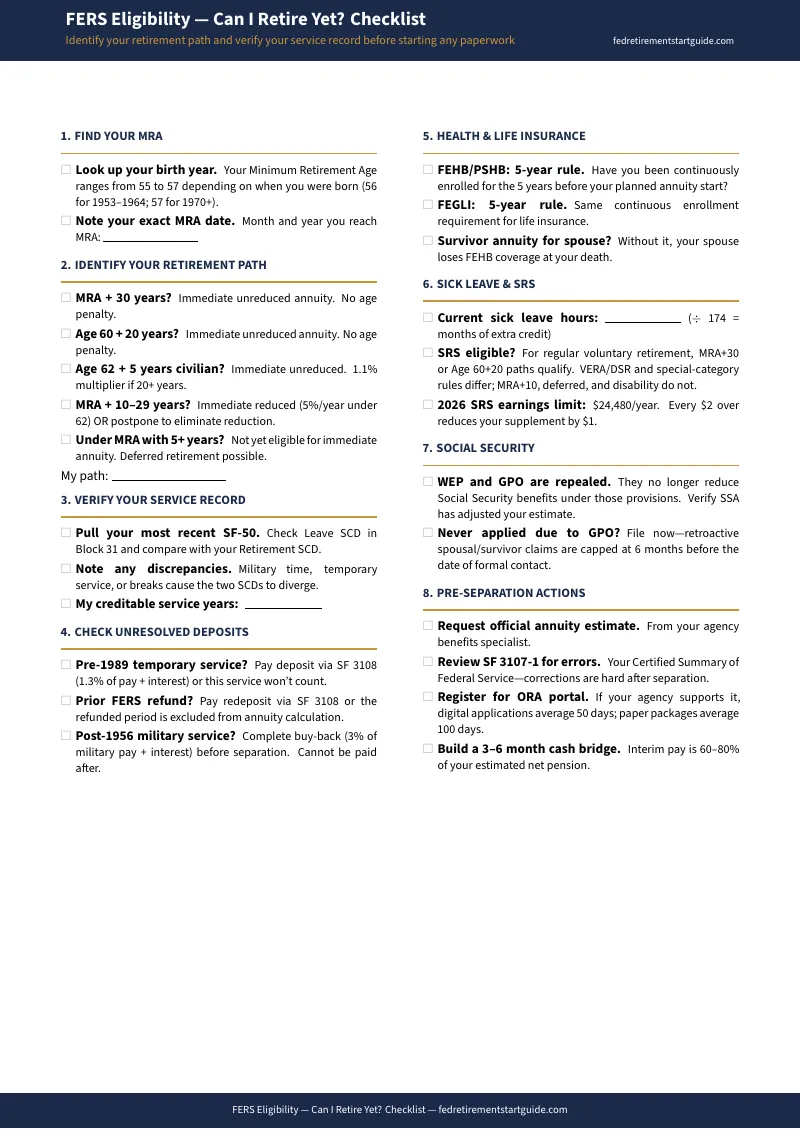
- checklist.pdf — FERS Eligibility — Can I Retire Yet? Checklist: the 10-step diagnostic covering MRA, service paths, deposits, insurance, and SRS eligibility
- eligibility-path-worksheet.pdf — Eligibility Path Worksheet: map your MRA, SCD, and creditable service against the five FERS paths
- postponed-vs-deferred-decision.pdf — Postponed vs. Deferred Decision: the Title 5 gate that keeps or forfeits FEHB, FEGLI, and sick leave
- service-credit-audit.pdf — Service Credit Audit Worksheets: eOPF pull, civilian deposits, part-time periods, and military buy-back
- annuity-computation-worksheet.pdf — Annuity Computation Worksheets: High-3, multiplier, proration, MRA+10 cut, and sick leave vs. HR
- srs-earnings-test-calculator.pdf — SRS Earnings-Test Calculator: eligibility, approximate amount, and the $24,480 (2026) earnings test
- fehb-five-year-verification.pdf — FEHB Five-Year Rule Verification: enrollment history, 60-day gaps, survivor election, PSHB/Part B
- fegli-premium-projection.pdf — FEGLI Premium Projection: Option B age-band costs and the irrevocable Basic reduction election
- wep-gpo-repeal-tracker.pdf — WEP/GPO Repeal Tracker: confirm SSA's adjustment or file the new claim that is not automatic
- ora-filing-checklist.pdf — ORA Digital Filing Checklist: documents, forms, and post-submit CSA / interim-pay log
- retirement-timeline-worksheet.pdf — Retirement Timeline Worksheet: 5-year, 3-year, 1-year, 90-day, and post-separation actions
One download. No subscription. No membership renewal. No annual management fee.
Not sure yet? Download the free FERS Eligibility — Can I Retire Yet? Checklist first — it covers the top-level diagnostic: your MRA, your retirement path, your service credit gaps, your FEHB enrollment status, and your SRS compatibility. When you are ready for the full computation worksheets, the postponed-vs-deferred framework, and the ORA filing roadmap, the complete guide is here.