Your attorney drafted the divorce decree. OPM and the TSP will decide whether it actually works.
Federal retirement benefits operate outside the private-sector playbook. A standard QDRO — the document that splits a corporate pension or 401(k) — is legally meaningless to OPM and the Thrift Savings Plan. Both agencies will reject it. And they won't tell you what to file instead.
That's the central problem: your divorce decree divides "retirement benefits," but OPM requires a Court Order Acceptable for Processing (COAP) drafted to 5 CFR Part 838 specifications, while the TSP requires a separate Retirement Benefits Court Order (RBCO) under 5 CFR Part 1653. Different agencies, different rulebooks, different rejection criteria. A court order that satisfies one will not satisfy the other.
Meanwhile, the deadlines are running. Health insurance coverage ends the day the divorce is finalized. The 60-day window to file SF 2809 under the Spouse Equity Act starts whether you know about it or not. And if the employee retires before the survivor annuity language is right, that omission becomes permanent — OPM is legally prohibited from reading intent into a court order that doesn't explicitly award survivor benefits.
The Dual-Track Administrative Map
This guide is a Dual-Track Administrative Map — a structured walkthrough of the separate filing sequences required by OPM and the TSP, plus the health insurance, life insurance, and Social Security coordination that connects them. It replaces the scattered, contradictory advice online with a single document that shows you what each agency requires, in what order, and what happens when something is missing or wrong.
Most free resources online explain what a COAP is. None of them walk you through the seven specific reasons OPM rejects submitted orders, how a nominal 50/50 TSP split becomes economically unequal when Roth and traditional balances are mixed, or why an old decree that never mentioned survivor benefits cannot be fixed after the employee retires.
This guide does. It covers the regulatory mechanics behind every step — not just what to file, but what each agency does with it, what triggers a rejection, and what you lose if the language is wrong.
What You Get
The complete toolkit includes 9 PDFs — the full guide plus 7 standalone printable worksheets you can bring to attorney meetings, HR appointments, and agency submissions:
- COAP drafting requirements — the exact language standards OPM applies when evaluating a court order, the three pension division formulas (fixed dollar, percentage, coverture fraction), and the specific errors that trigger automatic rejection
- TSP division mechanics — how the RBCO process works, the account freeze that triggers on submission, the $600 processing fee allocation, and the Roth vs. traditional tax allocation trap that makes a straight 50/50 split unequal
- Former-spouse survivor annuity — the explicit language required under 5 U.S.C. § 8341(h) and § 8445, the difference between insurable interest and court-ordered elections, and the retirement-date deadline after which the survivor clause is locked
- Health insurance continuation — FEHB and PSHB enrollment paths for former spouses under the Spouse Equity Act, the 60-day SF 2809 window, the pre-2025 FEHB safe harbor for postal divorces, and the Medicare Part B exemption that saves former spouses routed to FEHB
- FEGLI and life insurance — how divorce decree security clauses interact with federal group life insurance, the 60-day Qualifying Life Event election window, Option C former-spouse ineligibility, and the age-banded premium escalation that can make a lifetime mandate unsustainable
- Social Security after the WEP/GPO repeal — how the Social Security Fairness Act changes the picture for former spouses of CSRS employees, the six-month retroactivity application trap, and the 10-year marriage duration requirement
- Dual-track filing checklists — separate step-by-step checklists for the federal employee and the former spouse, organized by agency (OPM, TSP, FEHB/PSHB, FEGLI, SSA), with the submission order, required forms, and verification checkpoints
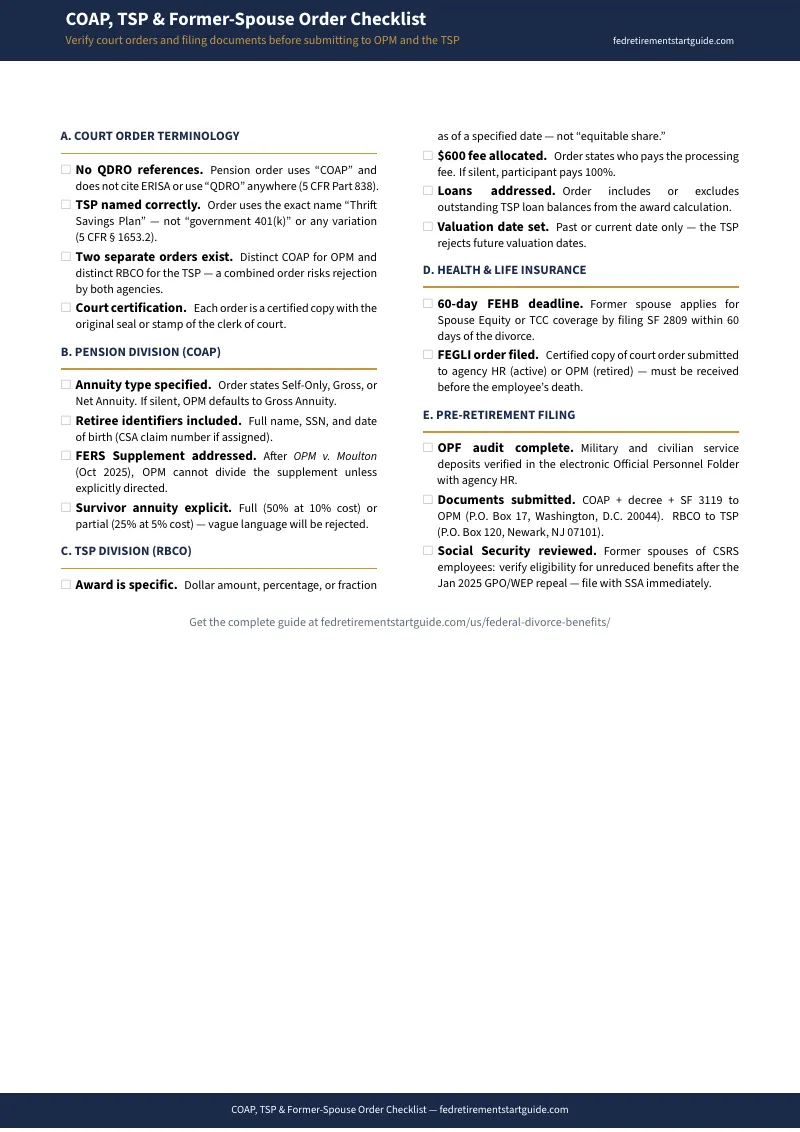
- Standalone printable worksheets — pre-retirement document audit, OPM and TSP submission checklists, COAP language requirements card, common drafting errors reference, contact directory, and health insurance deadline timeline
Who This Is For
This guide is built for two audiences that need the same information from opposite sides of the table:
- Federal employees approaching retirement after a divorce — you need to verify that the court orders on file will actually be accepted by OPM and the TSP before you submit your retirement application, because a rejected order at that stage delays your first annuity payment and freezes your former spouse's share
- Former spouses of federal employees — you need to confirm that the divorce decree includes the right language for each agency, that your survivor benefits are explicitly awarded (not implied), and that your health insurance continuation path is secured before the deadlines pass
You'll also find it valuable if your attorney is experienced in state family law but unfamiliar with the federal benefit system — the guide serves as a technical reference that helps you ask the right questions and verify that the drafted orders will survive OPM and TSP review.
Why Free Resources Don't Cover This
OPM publishes handbook RI 38-116. The TSP publishes its court order processing guide. Both are written for administrators, not for divorcing parties. They explain each agency's rules in isolation, but neither explains how the two tracks interact, how the health insurance timeline connects to the court order timeline, or what happens when a decree drafted for one agency gets submitted to the other.
Free online articles — including those from NARFE, federal employee forums, and general divorce sites — typically cover one piece of the puzzle: what a COAP is, how to divide a TSP, or whether former spouses can keep FEHB. None of them map the full sequence across all five agencies (OPM, TSP, FEHB/PSHB, FEGLI, SSA) with the overlapping deadlines and the specific language requirements that determine whether each order gets processed or returned.
Family law attorneys handle the legal strategy — the negotiation, the property division, the settlement terms. This guide handles the administrative coordination that determines whether those terms actually get executed by the agencies that administer the benefits.
Satisfaction Guarantee
If the guide doesn't help you map the filing requirements for your situation, email [email protected] for a full refund. No forms, no time limit.
Get Started
Download the free checklist to identify the court orders, benefit elections, and submission records involved in your situation. When you're ready for the full regulatory walkthrough — the agency-specific drafting requirements, the rejection criteria, the overlapping deadlines, and the filing sequence checklists — get the complete Dual-Track Administrative Map for a fraction of what a single billable hour costs.